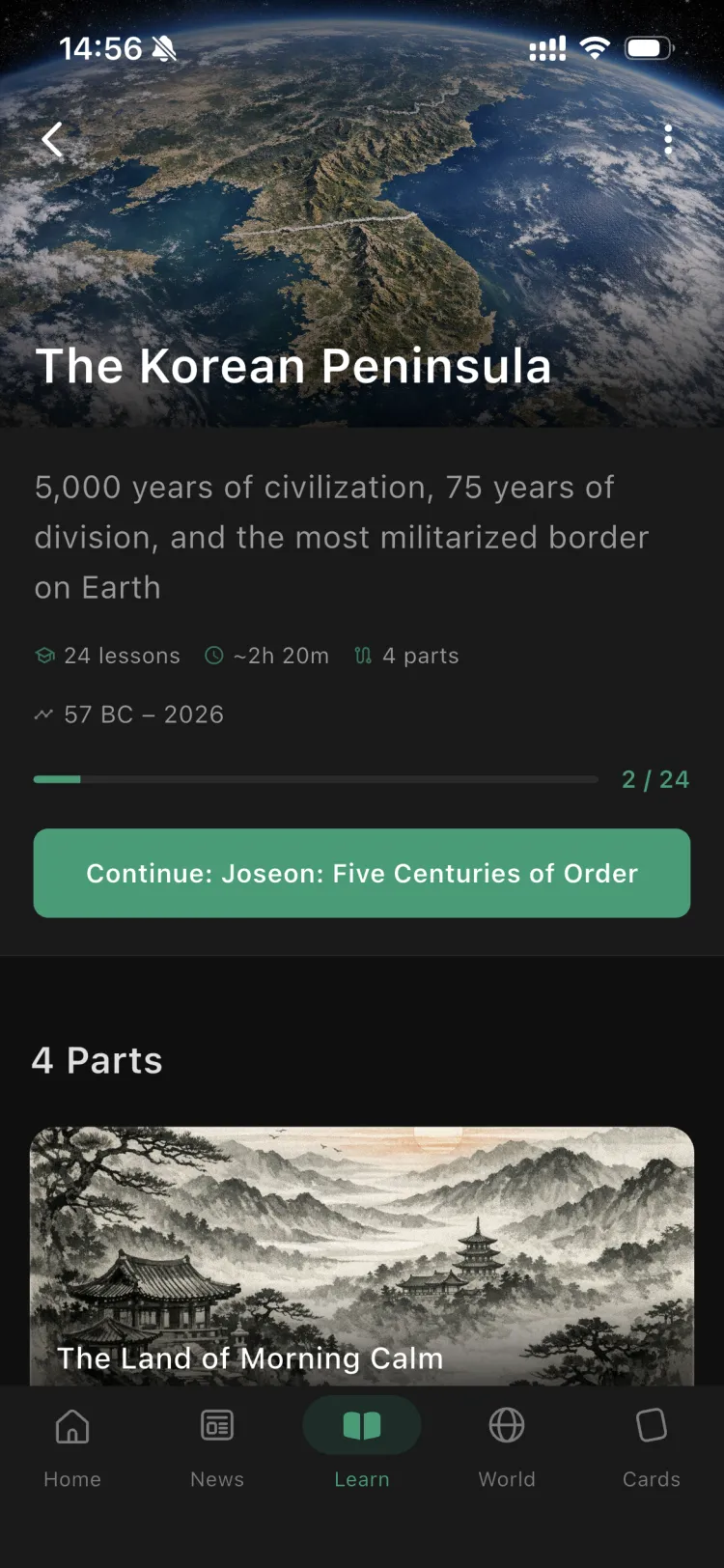
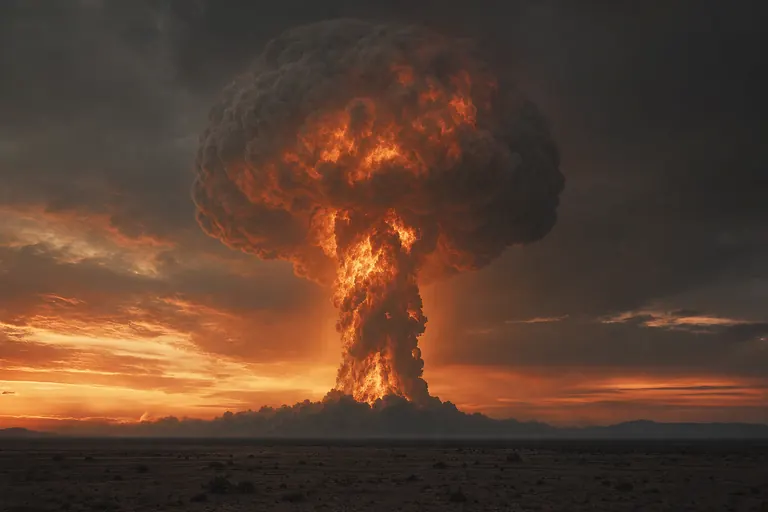
The Korean Peninsula
How Korean civilization survived two millennia in the shadow of China, why a line drawn in thirty minutes by two American colonels became the most militarized border on Earth, and how the same starting point in 1945 produced an economic miracle and a nuclear-armed dynasty.
57 BC to 2026 · 4 parts · 24 lessons · about 2.5 hours
Free for 7 days, cancel anytime. iPhone and Android.
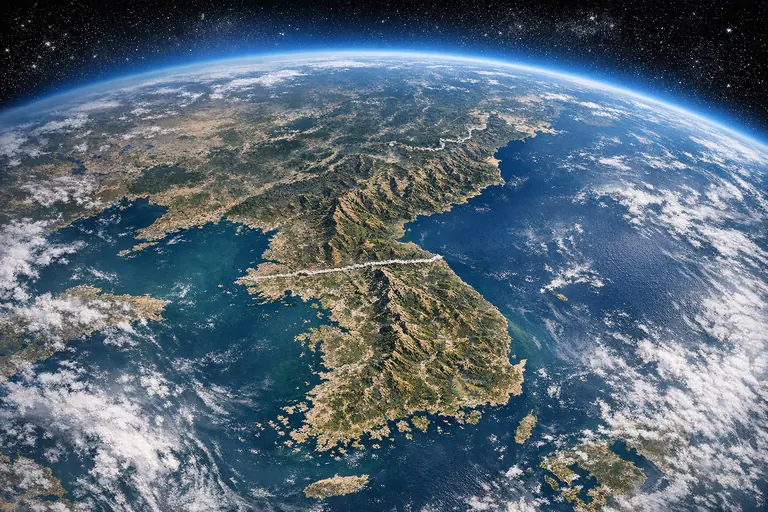
Questions this course answers
- How did Korean civilization survive for two millennia next to China without being absorbed?
- Why did Goryeo Korea invent metal movable type two centuries before Gutenberg?
- How did two American colonels with a National Geographic map divide Korea in thirty minutes?
- How did Park Chung-hee turn one of the world's poorest countries into an industrial powerhouse?
- Why does South Korea have the lowest fertility rate ever recorded in any country?
- Why has every prediction of North Korea's collapse been wrong?
Four parts, 24 lessons
 Part 1 · 57 BC to 1910
The Land of Morning Calm
Korea from 57 BC to 1910: three rival kingdoms, seven Mongol invasions, the first metal movable type, a 505-year Confucian dynasty, and annexation by Japan.
-
1
6 min
The Three Kingdoms
For seven centuries, three kingdoms fought over Korea. Goguryeo defeated Chinese invasions, Baekje passed culture to Japan, and Silla united all three.
-
2
6 min
Goryeo: The Kingdom That Named Korea
Goryeo survived seven Mongol invasions, invented metal movable type two centuries before Gutenberg, and carved the entire Buddhist canon onto 81,000 woodblocks.
-
3
6 min
Joseon: Five Centuries of Order
Joseon ruled Korea for 505 years under a strict Neo-Confucian order. King Sejong created Hangul, a writing system simple enough to learn in an afternoon.
-
4
5 min
The Imjin War: When Japan Invaded
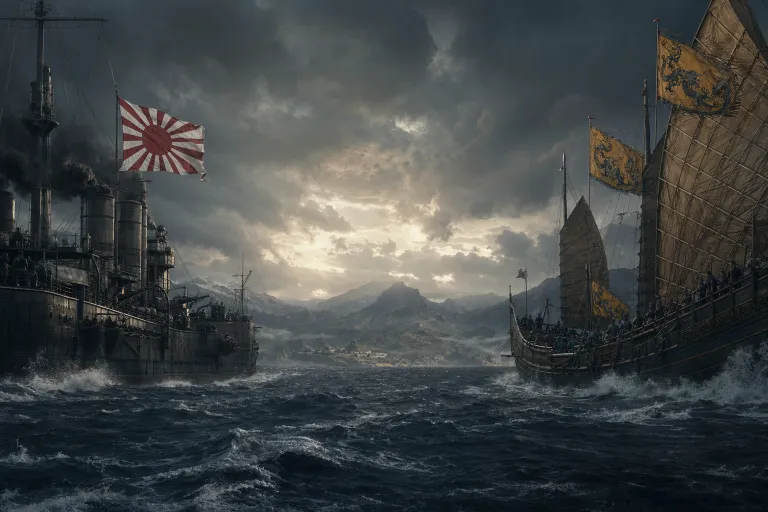
In 1592, Toyotomi Hideyoshi of Japan landed 158,000 soldiers in Korea. Admiral Yi Sun-sin cut their supply lines, and Ming China sent an army to help Korea.
-
5
5 min
The Hermit Kingdom and Its Forced Opening
Korea tried to shut its doors like Japan had. It failed because it lacked a modern military. In 34 years it went from hermit kingdom to Japanese colony.
 Part 2 · 1910 to 1953
Occupation, War, and Division
35 years of Japanese rule, the independence movement that survived it, a war that killed three million, and an armistice that never became peace.
-
6
6 min
Under the Rising Sun
Japan built railways and factories in Korea, forced Koreans to take Japanese names and speak Japanese, and mobilized 5.4 million for its war effort.
-
7
5 min
The March First Movement
From March 1, 1919, two million Koreans joined protests for independence. Japan killed 7,500, but both Koreas still trace their legitimacy to that day.
-
8
5 min
The 38th Parallel
Two American colonels with a National Geographic map chose the 38th parallel in thirty minutes. No Korean was consulted. The temporary line is still there.
-
9
6 min
The Korean War: Fire Across the Parallel
In June 1950, North Korea invaded South Korea and took Seoul in three days. Then General Douglas MacArthur's landing at Inchon reversed the war in two weeks.
-
10
6 min
The Korean War: China Enters
General MacArthur ignored Chinese warnings and pushed north toward China. In November 1950, 120,000 Chinese soldiers attacked, and the war became a stalemate.
-
11
6 min
The Armistice That Never Became Peace
The fighting stopped on July 27, 1953, after three million deaths. No peace treaty was ever signed, so North and South Korea are still technically at war.
 Part 3 · 1961 to 2026
South Korea's Transformation
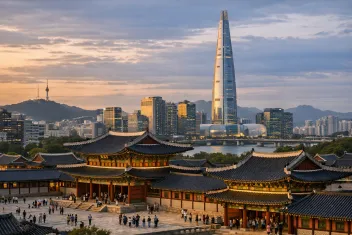
South Korea went from military dictatorship to democracy, from poverty to one of the world's largest economies, and became a cultural superpower.
-
12
6 min
The Dictator Who Built the Miracle
In 1961, Park Chung-hee seized power in South Korea. He drove growth of 10% a year and crushed opposition until his own intelligence chief shot him in 1979.
-
13
6 min
Gwangju and the Democracy Movement
In May 1980, South Korean soldiers killed 1,000 to 2,000 civilians in Gwangju. In June 1987, a million people protested and the regime accepted democracy.
-
14
6 min
The Miracle on the Han River
In 1960, South Korea was poorer than most of sub-Saharan Africa. Today its GDP per person exceeds $36,000. The government planned and directed that growth.
-
15
6 min
The Korean Wave
South Korea's cultural exports grew from almost nothing in 1998 to over $13 billion in 2023, helped by a deliberate government strategy.
-
16
6 min
The Chaebols: Korea's Corporate Dynasties
Four families control over 40% of South Korea's GDP. Samsung's leader Lee Jae-yong was convicted of bribery, jailed, and then pardoned.
-
17
6 min
The Country That Stopped Having Children
South Korea's fertility rate fell to 0.72 in 2023, the lowest ever recorded in any country. The government spent $270 billion trying to raise it and failed.
-
18
6 min
South Korea Today
South Korea relies on China for trade and the US for security, and both ties are fraying. Young men and women vote for different parties by 30-point margins.
 Part 4 · 1948 to 2026
North Korea
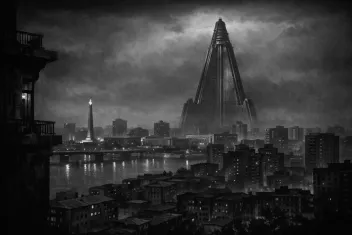
Under the Kim family, North Korea became a hereditary totalitarian state, built nuclear weapons, and outlasted every prediction of its collapse.
-
19
6 min
Kim Il-sung and the Invention of Juche
Installed by the Soviets in 1945, Kim Il-sung made North Korea a totalitarian state built on Juche, an ideology of self-reliance that outlived the Cold War.
-
20
6 min
The Kim Dynasty
Kim Il-sung, his son Kim Jong-il and grandson Kim Jong-un form the only hereditary succession in communist history. Each handoff was predicted to fail.
-
21
6 min
How North Korea Got the Bomb
North Korea carried out six nuclear tests between 2006 and 2017, ending with a claimed hydrogen bomb. The harshest sanctions in history did not stop them.
-
22
6 min
Inside North Korea
North Korea's 26 million people have no internet and no legal way to leave, yet black markets thrive and USB drives carry South Korean dramas.
-
23
6 min
What If North Korea Collapses?
Everyone plans for North Korea's collapse. Nobody wants it. It would bring loose nuclear weapons, millions of refugees, and a bill of up to $2 trillion.
-
24
6 min
Why the Korean Peninsula Matters
The Korean Peninsula is the last Cold War frontier and the world's most dangerous nuclear standoff, and what happens there affects everyone.
Lessons you can finish in one sitting.
Each lesson tells one part of the story and explains why it happened, with maps, images and quotes from the sources. A few questions at the end check that it stuck, and the key facts go into the course's flashcards.
- 5 to 6 minutes a lesson
- Two to three questions after each lesson
- 173 flashcards for this course