
ABM Treaty
The Anti-Ballistic Missile Treaty was a 1972 US-Soviet agreement banning nationwide missile defense, in force until the United States withdrew in 2002.
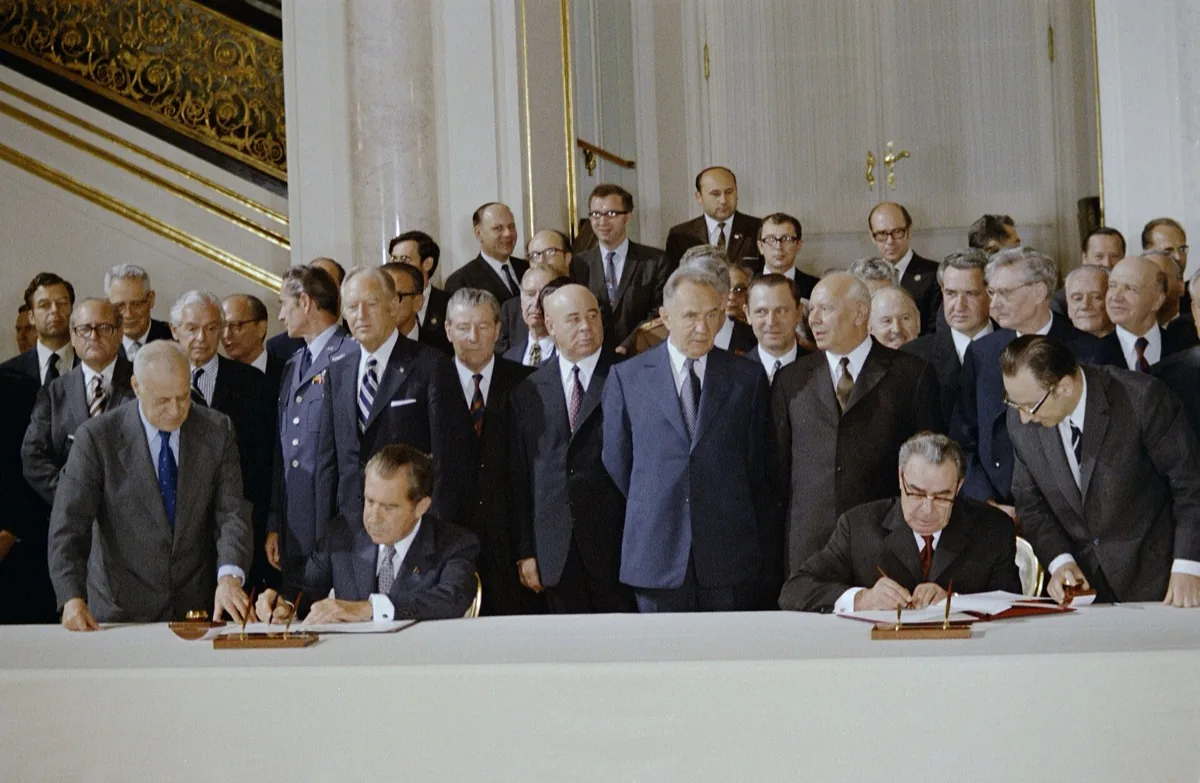
The Anti-Ballistic Missile Treaty was an agreement between the United States and the Soviet Union, signed on May 26, 1972, that banned nationwide missile defense. Both governments promised to leave their own populations unprotected from nuclear attack. The logic was that mutually assured destruction only works when neither side doubts its ability to strike back. Even a limited missile defense undermines that confidence. The country with the defense might be tempted to strike first, betting that its shield could handle the weakened response. The other side would respond by building more warheads to overwhelm the defense, which is always cheaper than building the defense itself. For thirty years, every agreement limiting offensive nuclear weapons rested on the assumption that neither side would try to defend against them.
How the ABM Treaty came about
Both superpowers learned this the hard way in the 1960s. The Soviet Union built a missile defense system around Moscow. The United States responded with the Sentinel program, then the Safeguard program. Each program drove its rival to add more warheads and delivery systems, and both countries ended up spending heavily for less security than they started with.
President Richard Nixon and Soviet leader Leonid Brezhnev signed the ABM Treaty in Moscow on the same day they signed SALT I, the first agreement to limit the number of offensive missile launchers each side could deploy. The pairing was deliberate. Capping defense was what made capping offense possible. If one side could block incoming missiles, the other would need more of them, and no limit on offense would hold.
Under the original treaty, each side could defend two sites with up to 100 interceptors each: the national capital and one intercontinental ballistic missile field. A 1974 protocol reduced this to one site per side. Nationwide defense was banned outright. So was any missile defense deployed on ships, aircraft, satellites, or mobile ground launchers.
The Soviet Union kept its site around Moscow. Russia still operates a descendant of that system, called the A-135, today. The United States completed the Safeguard system at a complex in North Dakota and brought it online on October 1, 1975, but the House of Representatives voted to close it the very next day. The complex shut down in February 1976.
Why did the United States withdraw from the ABM Treaty?
The treaty survived the Cold War, but not by much. In 1983, President Ronald Reagan proposed the Strategic Defense Initiative, a plan for a network of satellites and ground-based systems that could detect and destroy missiles in flight. The treaty banned exactly this kind of nationwide defense. Reagan's administration argued for a broad reinterpretation that would permit testing the system. Congress resisted, and the initiative never moved beyond research.
After the Soviet Union collapsed, the debate shifted. The question was no longer whether to defend against a massive Soviet attack, but whether it was worth giving up the treaty to build a limited defense against a small number of missiles from countries like North Korea or Iran. Supporters of the treaty argued that any defense, once built, could be expanded, and that Russia and China would build more warheads in response. Opponents called the treaty a Cold War relic that left the United States vulnerable to new threats.
President George W. Bush gave the required six months' notice of withdrawal on December 13, 2001. The United States formally left the treaty on June 13, 2002, the first time it had ever withdrawn from a major arms control treaty.
Missile defense and arms control after the ABM Treaty
Russia's response came the next day. President Vladimir Putin declared that Russia would not honor START II, a treaty signed in 1993 that would have banned land-based missiles carrying multiple warheads. START II had never entered into force, and now it never would.
The United States built the missile defense the treaty had prevented. It deployed 44 ground-based interceptors at Fort Greely, Alaska, and Vandenberg Air Force Base, California, designed to stop a small number of incoming ICBMs. It deployed Aegis Ashore missile defense systems in Romania in 2016 and Poland in 2024. Moscow says those European systems are aimed at Russia, not at Iran.
Russia developed a new generation of weapons designed to make missile defense irrelevant. Putin has said explicitly that the withdrawal from the ABM Treaty forced Russia to build them. They include the Avangard, a nuclear-armed hypersonic glide vehicle that maneuvers to evade interceptors, and the Poseidon, a nuclear-powered torpedo designed to bypass missile defense by traveling underwater. The United States later also withdrew from the Intermediate-Range Nuclear Forces Treaty in 2019, continuing the unraveling of the Cold War arms control framework.
The ABM Treaty's supporters had predicted much of this: that withdrawing would not make the United States safer but would push Russia to build weapons harder to defend against than the missiles the defense was meant to stop. Whether they were right depends on whether the interceptors in Alaska provide meaningful protection against North Korea, and whether Russia would have built these weapons anyway. The treaty's central idea, that limiting defense is the price of limiting offense, has not been replaced by anything since.