
Akbar
Akbar was the third Mughal emperor, who conquered most of northern India and governed it by including Hindus as partners in power.
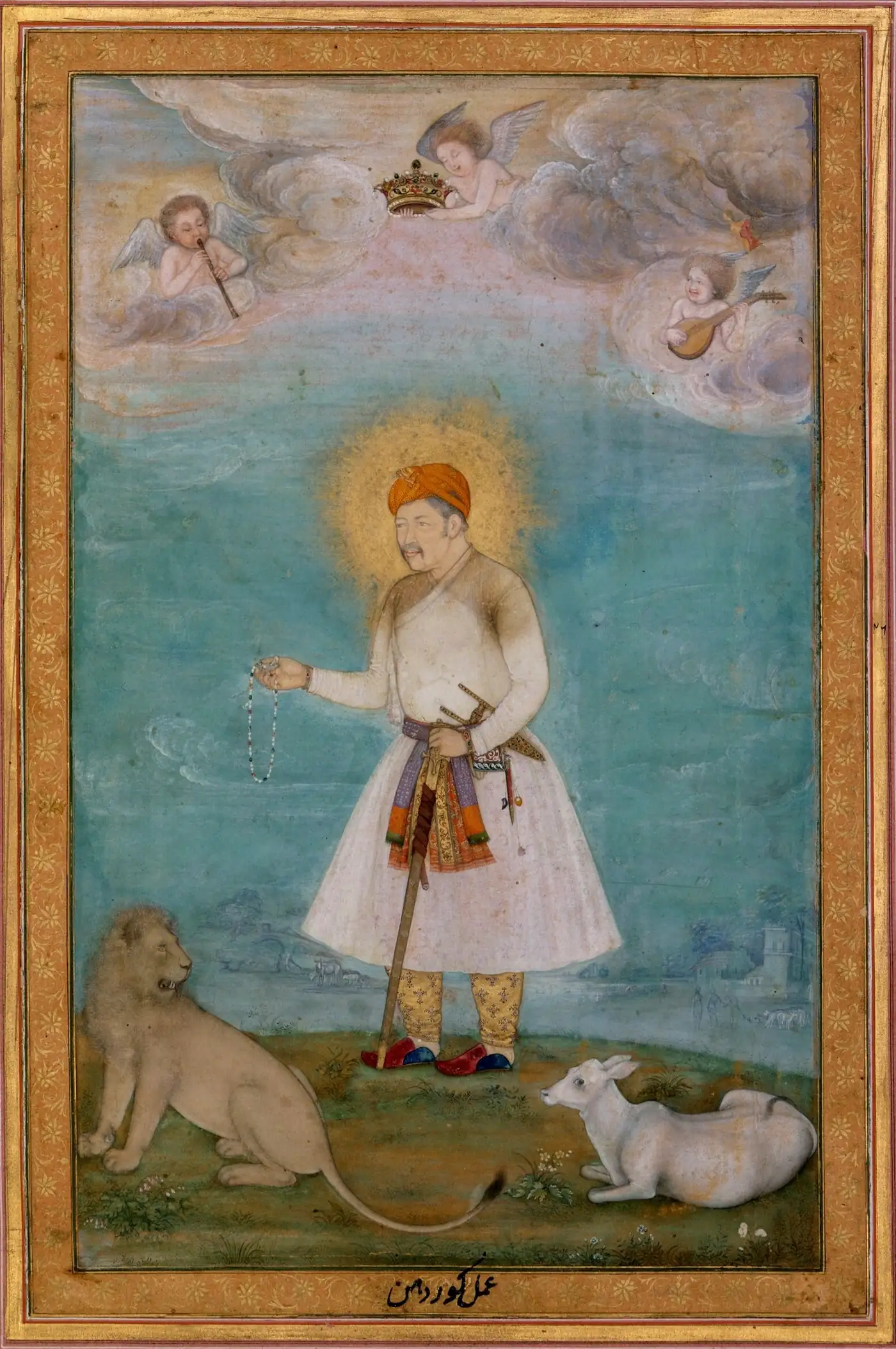
Akbar was the third emperor of the Mughal Empire, ruling from 1556 to 1605. His name means "great" in Arabic. He took the throne at thirteen, when the dynasty controlled one unstable province in northern India. By the time he died, Akbar governed most of the subcontinent, and the Mughal economy produced roughly a quarter of the world's goods. Akbar recognized that a ruling family from Central Asia, Muslim in a land where most people were Hindu, needed more than military power to keep control. He ended the tax on non-Muslims, married into Rajput warrior families, and gave Hindus the highest positions in his government and army. He called this approach sulh-i kul, meaning "peace with all."
How Akbar conquered northern India
Akbar's father, Humayun, died in January 1556, barely a year after returning from fifteen years in exile. A regent, Bairam Khan, governed on behalf of the thirteen-year-old emperor. In November 1556, Bairam Khan led the Mughal army to victory at the Second Battle of Panipat against Hemu, a Hindu commander who had taken Delhi and crowned himself king. Hemu had won twenty-two consecutive battles before Panipat. An arrow struck him in the eye during the fighting, and his forces broke apart. That victory restored Mughal authority over the north.
Akbar removed Bairam Khan from power in 1560, at about age eighteen, and began ruling alone. Over the next forty years he waged campaigns from Afghanistan to Bengal and from Kashmir to the Deccan plateau, placing most of the subcontinent under Mughal rule.
Akbar was illiterate. Multiple tutors tried to teach him to read and write as a child, and all failed. Some historians believe he was dyslexic. He had books and documents read aloud to him and assembled an imperial library of more than 24,000 volumes.
How Akbar governed a Hindu majority
Akbar reshaped the empire so that its Hindu majority would be partners in government, not a conquered population. In 1562 he married a Rajput princess from the kingdom of Amber, the daughter of Raja Bharmal. He gave Rajput chiefs military commands and provincial governorships, and allowed them to retain their territories, their religion, and their armed forces. In 1563 he ended a tax that Hindu pilgrims had to pay. In 1564 he ended the jizya, a tax on non-Muslims required by Islamic law. Hindus rose to senior posts in the army and in the revenue administration.
Akbar organized the empire through a ranking system called mansabdari. Every official received a numerical rank that set how much he was paid and how many cavalry he was required to maintain. The system converted a collection of allied chiefs into a structured bureaucracy. His chief revenue official was Todar Mal, a Hindu trained under the Afghan king Sher Shah Suri. Todar Mal surveyed farmland across much of the empire and classified soils. Todar Mal then set tax rates using a decade of local price and harvest data. That system gave Akbar a reliable income to fund the rest of his government.
Did Akbar create a new religion?
Starting in 1575, Akbar held religious debates at the Ibadat Khana, a hall for religious discussion at Fatehpur Sikri, the capital he had built near Agra. The sessions began with Muslim scholars, but Akbar grew frustrated with their infighting and invited Hindu scholars, Jain monks, Zoroastrian priests, and Jesuits who had traveled from Portuguese Goa. In 1579 a decree gave Akbar supreme authority on religious disputes across the empire.
In 1582 Akbar created the Din-i Ilahi, which is often described as a new religion. It was closer to a small personal cult centered on the emperor that never attracted more than a handful of followers. It disappeared when Akbar died in 1605. The lasting changes were the taxes he ended and the government posts he opened to non-Muslims.
What happened to the Mughal Empire after Akbar?
The wealth that Akbar's system generated was still flowing two generations later, when his grandson Shah Jahan commissioned the Taj Mahal. But Akbar's great-grandson Aurangzeb undid the religious settlement. In 1679 Aurangzeb brought back the jizya. He then spent twenty-seven years fighting the Hindu Maratha kingdom in the Deccan, a resistance that his own policies had fueled. Those campaigns exhausted the Mughal army without producing any lasting result.
By the mid-1700s, less than fifty years after Aurangzeb died in 1707, the empire controlled little beyond Delhi. Provincial governors ruled their territories as independent kings, and the emperor's word carried little weight outside his palace walls. The East India Company absorbed what remained.
Few historical figures in South Asia are as contested as Akbar. Secular nationalists in India point to him as evidence that religious coexistence has deep roots in the subcontinent, not something the British introduced. Hindu nationalists argue that Akbar was a foreign conqueror whose tolerance was a political calculation. In Pakistan, school textbooks generally favor Aurangzeb over Akbar. The argument continues because it is really about what kind of country India should be.