
Jizya
Jizya was a tax that non-Muslims paid to Islamic states in exchange for protection, religious freedom, and exemption from military service.
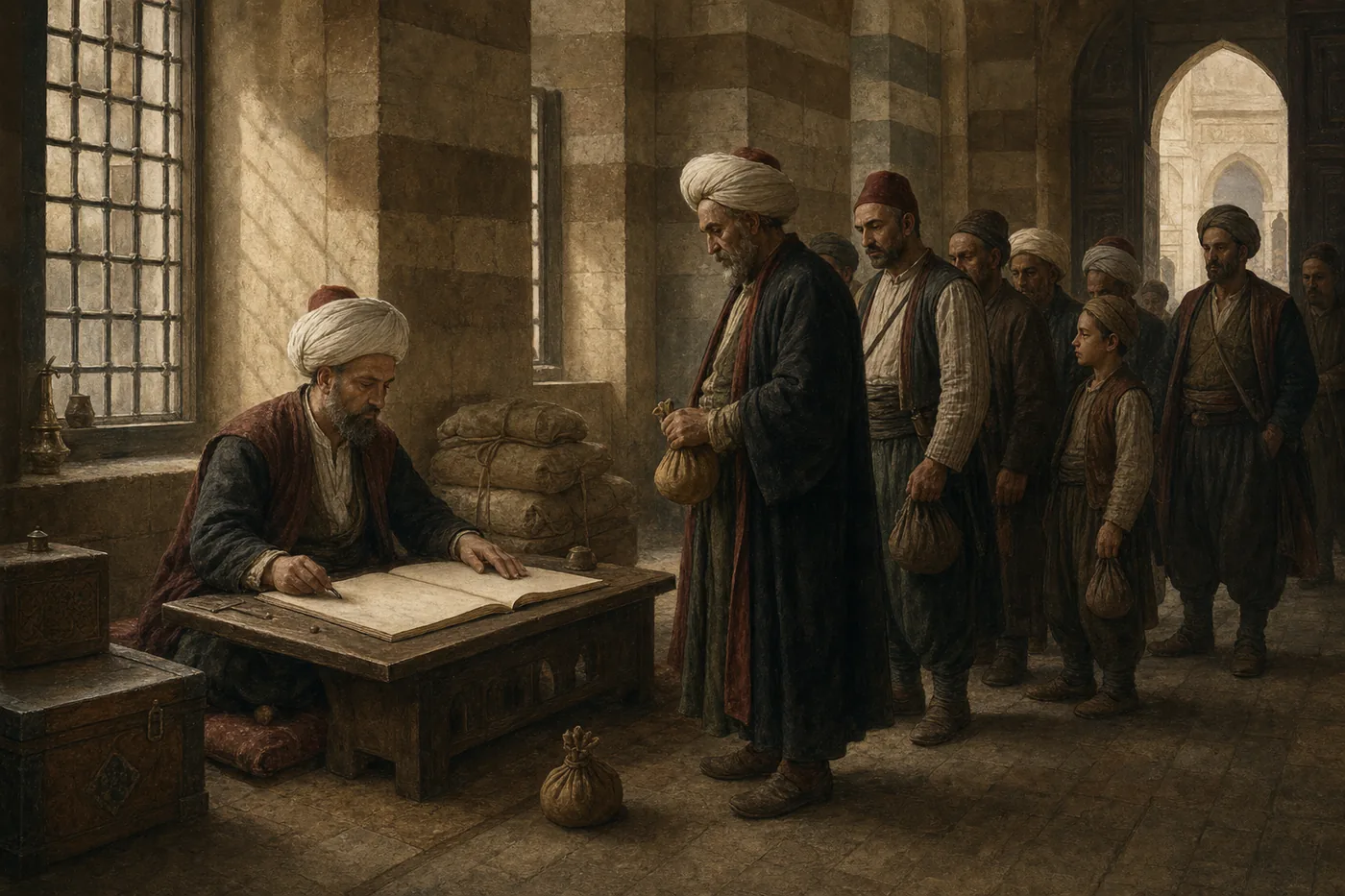
Jizya was a yearly tax that non-Muslim men paid to Islamic states, from the seventh century through the nineteenth. In exchange, payers received protection, the right to practice their religion, and exemption from military service. The Quran mentions the tax once, in verse 9:29, which tells Muslims to fight the People of the Book until they pay the jizya. In practice, the tax was the financial foundation of a larger arrangement called the dhimma, a contract between Muslim rulers and their non-Muslim subjects. Jizya was collected for more than 1,200 years, beginning with the first Arab conquests in the 630s.
How jizya worked in the early Islamic world
In the 630s and 640s, Arab armies swept across the Middle East and took control of Syria, Egypt, Iraq, and Persia. The new rulers were vastly outnumbered by the people they governed, most of whom were Christians, Jews, or Zoroastrians. Converting or killing these populations was neither possible nor desirable, so the conquerors offered a deal called the dhimma. Non-Muslims could keep their faith, their communal leaders, and their own courts for internal affairs. In return, they paid jizya, were forbidden to carry weapons, and accepted social restrictions that varied by time and place.
The Quran's command referred to the "People of the Book," meaning Christians and Jews. In practice, Muslim rulers extended the system to Zoroastrians in Persia and later to Hindus in India.
Only free adult men with the means to pay owed jizya. Those exempt included women, children, old men, people with disabilities, the very poor, and under most legal opinions, monks and priests. The amount depended on the payer's wealth, divided into three brackets, though the exact sums changed across centuries and regions. Muslims were not tax-free. They paid zakat, a religious obligation, and in agricultural areas they paid kharaj on their land.
How the tax was collected depended on when and where you lived. In some periods, a man paid his jizya and received a receipt, and the process was routine. In others, officials staged the payment as a deliberate humiliation. Islamic jurists disagreed about whether the humiliation was part of the tax's purpose or a distortion of it. Both descriptions are accurate for different centuries.
How jizya slowed conversion across the Islamic world
A government that depended on non-Muslim taxpayers for revenue had a strong reason to discourage conversion. Under the Umayyad caliphate (661–750), growing numbers of Persians, Copts, and Aramaeans accepted Islam. This should have been a religious success, but it was a fiscal crisis. Governors kept collecting jizya from converts because the treasury needed the money, so new Muslims were still taxed as if they had never converted.
The anger of these non-Arab converts, called mawali, helped topple the Umayyads in 750. One earlier caliph, Umar II (r. 717–720), had tried to solve the problem by letting converts stop paying. His officials warned that revenues would collapse. His successor reversed the policy.
The same fiscal logic explains why conversion in conquered lands took centuries. Scholars estimate that Muslims did not outnumber Christians in Egypt until the thirteenth or fourteenth century, roughly six to seven hundred years after the Arab conquest.
Jizya in the Ottoman and Mughal empires
The Ottoman Empire ran the most sophisticated version of the tax. The Ottoman jizya, called cizye, was tied to the millet system, which granted each major religious group, including Orthodox Christians, Armenians, and Jews, the right to manage its own affairs under its own religious hierarchy. The arrangement worked because each community ran its own courts, schools, and charitable institutions. Large Christian populations persisted in Ottoman lands into the 1900s, a contrast with Spain, which expelled its Jews in 1492 and its remaining Muslims by 1614.
In India, the Mughal emperor Akbar abolished jizya in 1564 as part of a broader policy of religious tolerance toward his Hindu subjects. His great-grandson Aurangzeb reimposed it in 1679, aligning the empire more closely with sharia. The reimposition provoked protests and remains a contested symbol in Indian historiography.
An 1856 reform decree, part of the Tanzimat reforms and issued at the end of the Crimean War under pressure from Britain and France, ended jizya in the Ottoman Empire and promised equal treatment for subjects of all faiths. Under the new rules, non-Muslims could be drafted into the army. In reality, most chose to pay a fee to avoid conscription, effectively the same payment repackaged as a military buyout.
Is jizya still collected today?
No modern state collects jizya. But in 2014, the Islamic State demanded the tax from Christians in the Syrian city of Raqqa and then in Mosul, Iraq. Christians were given a choice: pay, convert to Islam, leave, or be killed. In Raqqa, the group set rates by wealth, imitating the classical system. In Mosul, the ultimatum led to a complete Christian exodus from a city where Christians had lived for 1,800 years. In parts of Egypt, Christian communities have been subjected to demands dressed up in the same religious vocabulary. The word jizya was not chosen accidentally. Groups like the Islamic State used it to link themselves to the classical Islamic order.
Mainstream Islamic scholars have responded that the original dhimma was an agreement between a real government and its subjects. A militia or insurgent group has no standing to impose it. The tax belonged to an era when states sorted their populations by religion. In a world built on equal citizenship, most scholars see no basis for reviving it.