
Appeasement
Appeasement was the British and French policy of granting Hitler's demands to avoid war, tried most famously at Munich in 1938.
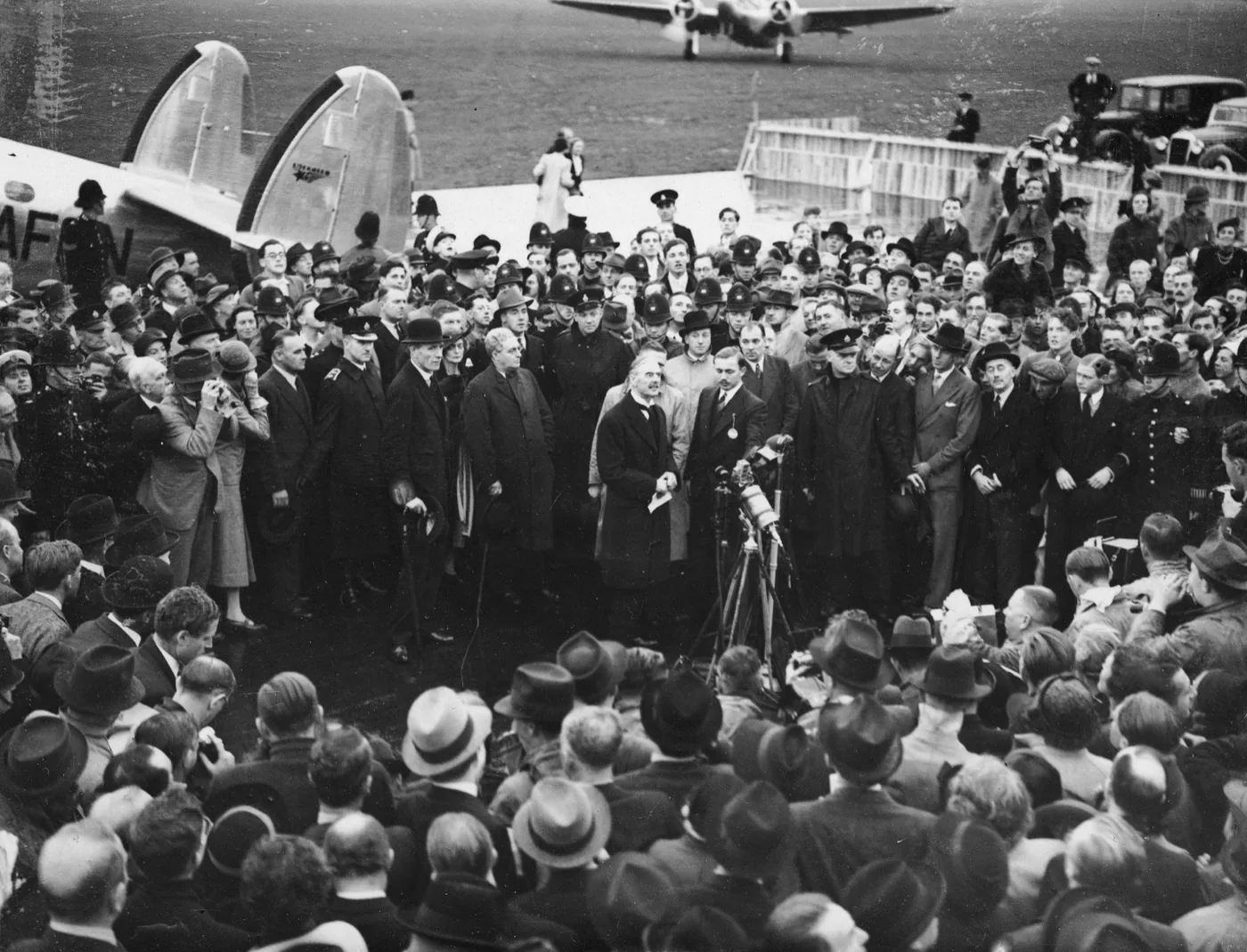
Appeasement means giving in to an aggressor's demands to keep the peace, betting that each concession will be the last one needed. The word was neutral until 1938, when the Munich Agreement made it a byword for dangerous weakness. Neville Chamberlain, Britain's prime minister, and France's premier, Édouard Daladier, let Adolf Hitler take the Sudetenland, a German-speaking region of Czechoslovakia, in exchange for his promise to stop there. Chamberlain flew home and told a cheering crowd he had won "peace for our time." Less than six months later Hitler seized the rest of Czechoslovakia, and within a year Europe was at war.
How Hitler reached Munich unopposed
The Treaty of Versailles that ended the First World War placed strict limits on Germany's military. Hitler broke them almost as soon as he took power in 1933, rebuilding Germany's army, navy, and air force. In 1936 he sent troops into the Rhineland, the demilitarized zone along Germany's western border. Britain and France protested but did nothing. In March 1938 Germany annexed Austria in what Hitler called the Anschluss. Again there was no resistance. Each time, the democracies complained and then accepted what had happened, and each time Hitler learned that he could push further.
By autumn 1938 his target was the Sudetenland, the border region of Czechoslovakia where about three million ethnic Germans lived. Czechoslovakia was a democracy. It had a military alliance with France and was shielded by mountain fortifications along the German border. Hitler presented himself as the defender of oppressed Germans and threatened war.
Chamberlain was 69 years old and had come to politics late. He had spent six years of his twenties on a failed sisal plantation in the Bahamas before returning to Birmingham, where he went into business and then local government. He did not enter Parliament until he was 49. But he was determined to prevent another war like 1914, and he had never been on an airplane before September 1938. He flew to Germany three times in two weeks to negotiate with Hitler in person.
On the night of September 29-30, 1938, Hitler, Chamberlain, Daladier, and Italy's Benito Mussolini gathered in Munich and agreed to transfer the Sudetenland to Germany. Czechoslovakia was not invited to the conference and was simply handed the result. Without its mountain defenses, Czechoslovakia had no way to stop a future German attack.
Chamberlain returned to Heston Aerodrome near London. That evening, speaking from a Downing Street window, he declared that the agreement meant "peace for our time."
Winston Churchill, one of the few senior Conservatives to oppose the deal, responded on October 5 in the House of Commons. Britain, Churchill said, had suffered "a total and unmitigated defeat."
How Munich led to war
The policy assumed that Hitler had limited, nationalist aims: to gather ethnic Germans into one state and then stop. Five months after Munich, in March 1939, Hitler sent his army into Prague and took what remained of Czechoslovakia, a country with no German majority. That act proved the assumption wrong. British opinion turned sharply against appeasement, and Chamberlain gave a military guarantee to Poland.
Germany invaded Poland on September 1, 1939. Britain and France entered the war two days later.
The year of delay had made Germany stronger. Germany gained the Czech army's equipment and the Škoda works in Pilsen, one of Europe's largest arms factories. Between August 1938 and September 1939, the Škoda works produced nearly as much military equipment as all of Britain's arms factories combined. The Soviet Union, deliberately excluded from the Munich conference, concluded that the Western powers would not fight Hitler. Within a year the Soviet leader Joseph Stalin agreed to the Molotov-Ribbentrop Pact with Germany, which cleared Hitler's way into Poland without a two-front war.
Defenders of the policy argue that Britain was not ready to fight in 1938. The public still remembered the slaughter of the First World War, the Dominions were reluctant, and the radar network and the Spitfire fighter were only just entering service. The extra year gave Britain time to prepare. But the same year gave Germany far more.
Why did appeasement fail?
Appeasement failed because it treated Hitler as a leader with limited, reasonable goals when he was not. Each concession, from accepting rearmament to tolerating the Rhineland occupation to giving away the Sudetenland, taught Hitler that aggression carried no cost. He did not stop after getting what he said he wanted. He used each gain to prepare the next demand.
The policy also rested on the belief that war was the worst possible outcome. For Chamberlain and for millions of Europeans who had lived through the First World War, almost any price seemed worth paying to avoid another one. But making concessions to a leader whose demands kept growing did not prevent war. It postponed war on terms that favored the aggressor.
The Munich analogy in politics
After 1938, calling a diplomatic concession "appeasement" became one of the strongest arguments in foreign policy. Britain's prime minister Anthony Eden compared Egypt's president, Gamal Abdel Nasser, to Hitler during the Suez crisis in 1956. President Lyndon Johnson cited Munich to justify sending combat troops to Vietnam in 1965. President George H. W. Bush invoked it before the 1991 Gulf War, and supporters of the 2003 invasion of Iraq used it again.
The analogy is often stretched beyond what Munich actually shows. Not every adversary has unlimited aims, and not every concession leads to a wider war. What 1938 actually demonstrates is narrower: concessions to a leader who demands more after each success do not buy peace. They raise the cost of the war that follows.