
Ayatollah
Ayatollah is the senior rank in Shia Islam, earned by scholarly reputation rather than appointment by any central authority.
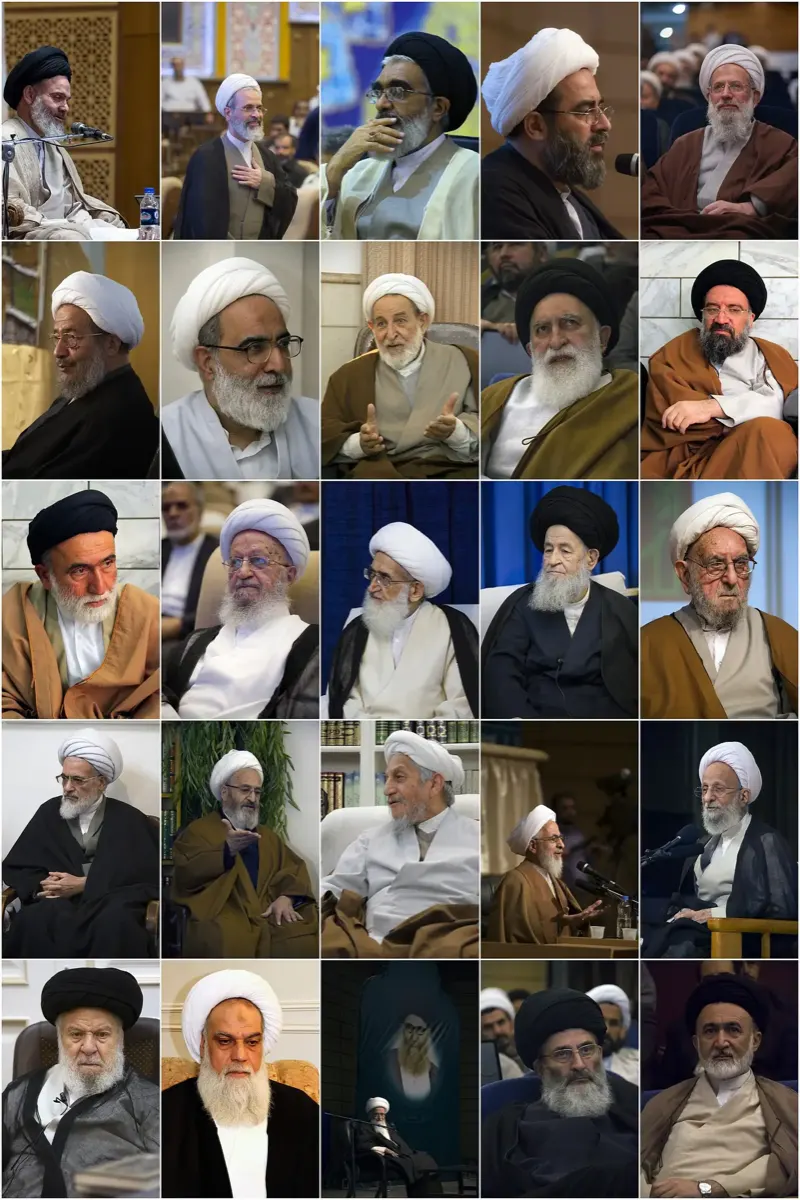
Ayatollah is the senior academic rank in Shia Islam. In Arabic, the word translates to "sign of God." The title is not a government position, and no authority grants it. Shia Islam has no equivalent of the papacy, no institution that controls who holds the rank. A scholar earns the title when his peers and a broad following of ordinary believers accept his learning. The modern use of the word spread in the early 1900s. Since 1979, it has become closely associated with Iranian politics, but the rank belongs to a scholarly network that spans multiple countries and is older than any modern government.
How a scholar becomes an ayatollah
The path begins at a hawza, a Shia seminary, usually in Qom, Iran, or Najaf, Iraq. These two cities have served as the main centers of Shia scholarship for about a century. Students spend years, often more than a decade, working through Arabic grammar, logic, Islamic jurisprudence, and legal reasoning. Those who finish the most advanced level of study, known as the dars al-kharij, can reach the status of mujtahid, someone qualified to derive rulings from Islamic sources through independent analysis rather than deferring to another scholar. Ayatollah designates a senior mujtahid whose learning is broadly recognized. No examination board certifies the result. A scholar's reputation rises or falls on the quality of his teaching, his published rulings, and the judgment of his peers.
Above ayatollah is the rank of grand ayatollah. A grand ayatollah is also called a marja al-taqlid, meaning "source of emulation." This emulation system is one of the distinctive institutions of Shia Islam. An ordinary believer who is not a scholar picks a living marja and follows his rulings on practical questions of religious law. Choosing a marja who has already died is generally forbidden, a rule that pushes each generation to produce its own authorities. The follower also directs his religious taxes to his chosen marja. A widely followed marja commands a large, voluntary income that crosses national borders and depends on no government. That financial independence is why the Shia clergy could oppose governments when almost no other institution could afford to.
How Khomeini brought ayatollahs into politics
For centuries, the prevailing view among senior Shia scholars was that the clergy should focus on religious law and remain apart from government. Without the Hidden Imam present, no political authority could be fully just. Ruhollah Khomeini rejected this quietist tradition in a series of lectures in Najaf in 1970. His argument, known as velayat-e faqih ("guardianship of the jurist"), held that the most learned Islamic scholar should govern the state until the Hidden Imam's return. Few senior clerics agreed with him at the time.
In 1979, Khomeini's revolution wrote velayat-e faqih into Iran's constitution as the foundation of the Islamic Republic. Qom, Iran's main seminary city, became the center of a system that merged religious authority with political power. Najaf stayed loyal to the older, quietist path. Grand Ayatollah Ali al-Sistani, who holds the largest marja following in the Shia world, is based in Najaf. Born in Mashhad, Iran, in 1930, Sistani moved to Najaf as a young man to study and has lived there for more than seventy years. He is 96 years old, holds no political office, and rarely receives visitors. Yet in June 2014, a single religious ruling from Sistani urging Iraqis to take up arms against the Islamic State brought tens of thousands of volunteers forward within days. Sistani's authority comes entirely from scholarly reputation.
Not all ayatollahs accepted the merger of religion and government. Hossein-Ali Montazeri, who had been picked to succeed Khomeini as Supreme Leader, was placed under house arrest in 1997 after publicly criticizing the system Khomeini had built. The Iranian government has spent more than four decades working to place the seminaries under state control.
The tension between scholarly rank and political power resurfaced in 2026. Ali Khamenei, who had led Iran as Supreme Leader since 1989, died when US and Israeli strikes began on February 28, 2026. On March 8, the Assembly of Experts chose Khamenei's son, Mojtaba, to succeed him. Mojtaba holds the clerical rank of hojjat al-Islam, one step below ayatollah. A similar gap had opened in 1989, when Ali Khamenei himself became Supreme Leader despite lacking the scholarly credentials the role was meant to require. Iran's constitution was amended that year to accommodate him. In both cases, the succession transferred political power rather than scholarly standing.
How many grand ayatollahs are there?
There is no official count, because no central authority decides who qualifies. As of the mid-2020s, more than fifty scholars are recognized as maraji (the plural of marja) by at least some following. Almost all are based in Iran or Iraq. The number changes as senior scholars die and new ones are recognized. Because the title depends on reputation rather than appointment, different communities may recognize different scholars, and no single list is accepted by all Shia Muslims. The broader rank of ayatollah, which covers a larger group of senior scholars below the marja level, is even harder to count. A marja's authority rests on scholarly reputation, not on any government's backing, and his following crosses national borders.