
Ayatollah Khomeini
Ruhollah Khomeini was the Shia cleric who led Iran's 1979 revolution and ruled the Islamic Republic as its first Supreme Leader.
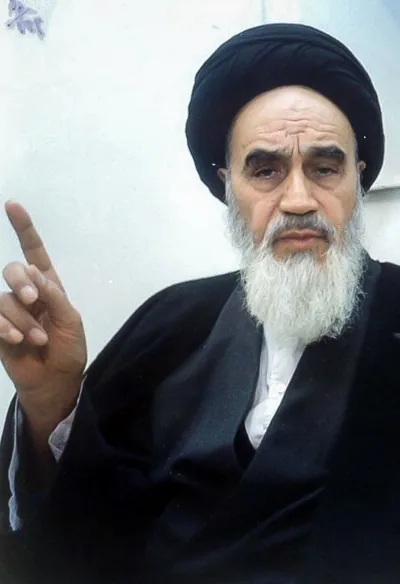
Ruhollah Khomeini (1902–1989) was a Shia ayatollah who led the revolution that overthrew Iran's monarchy in 1979 and founded the Islamic Republic of Iran. He served as the country's first Supreme Leader, an office he created and held until his death. When Khomeini returned to Tehran on February 1, 1979, he was 76 years old. He had spent nearly fifteen years in exile. He held no military command and led no political party, yet within weeks his allies controlled the government. He had built his following on cassette tapes and sermons.
How Khomeini turned against the Shah
Khomeini was born on September 24, 1902, in the town of Khomein in western Iran. His father, a cleric, was murdered five months after Khomeini's birth, reportedly on the orders of a local landlord. The killer was later publicly executed in Tehran after Khomeini's mother traveled to the capital to demand justice. Khomeini was raised by his mother and an aunt, both of whom died when he was a teenager. He studied Islamic law and theology in Qom, Iran's center of Shia scholarship, where he became a marja. The title meant that his followers considered his religious rulings binding.
For decades Khomeini stayed out of politics, as most Shia clerics traditionally did. That changed in the early 1960s, when Iran's Shah, Mohammad Reza Pahlavi, launched a program called the White Revolution. It redistributed farmland, gave women the vote, and expanded secular schooling. Khomeini attacked the program publicly, calling it a threat to Islam and a sign of American control over the monarchy. When Khomeini was arrested on June 5, 1963, protests broke out across several Iranian cities. The Shah's forces put them down by force. The government released Khomeini after several months but in November 1964 sent him into exile.
How Khomeini led a revolution from exile
Khomeini spent eleven months in Bursa, Turkey, where he was forbidden from wearing clerical dress or receiving visitors. In October 1965 he moved to Najaf, a Shia shrine city in Iraq, and stayed for thirteen years. His followers recorded his sermons on cassette tapes and smuggled them into Iran, where they passed from hand to hand. It was in Najaf, in early 1970, that Khomeini delivered the lectures that laid out his most important idea: velayat-e faqih, the guardianship of the Islamic jurist.
In October 1978, Saddam Hussein expelled Khomeini from Iraq. Khomeini moved to a rented house in the village of Neauphle-le-Chateau, about 40 kilometers west of Paris. The move gave him something he had lacked in Najaf: easy access to international phone lines and foreign journalists. He sat on a rug under an apple tree in the garden and gave 132 interviews in four months, making his face and his message known around the world.
Inside Iran, mass protests against the Shah had been building all year. Many Iranians still remembered the 1953 CIA coup that restored the Shah to power, and decades of repression had weakened the monarchy. On January 16, 1979, the Shah left the country. Two weeks later, on February 1, Khomeini flew to Tehran on a chartered Air France jet. Millions of people filled the streets to greet him. On February 11, the armed forces declared themselves neutral and the Shah's last prime minister resigned. Khomeini's supporters took control of government buildings, military bases, and the state radio.
Khomeini wrote the doctrine of velayat-e faqih into the new constitution and became the Islamic Republic's first Supreme Leader. The Supreme Leader holds more power than the elected president and controls the military, the courts, and state broadcasting.
What is velayat-e faqih?
Velayat-e faqih is a Persian phrase that translates to "guardianship of the jurist." In Shia Islam, the Twelfth Imam went into hiding in the ninth century and is expected to return. Khomeini argued that until the Imam's return, ultimate political authority should rest with a senior Islamic scholar qualified to interpret God's law, not with monarchs or parliaments. This was a break with centuries of Shia tradition. Most senior clerics before Khomeini had avoided direct involvement in government. Khomeini made it the foundation of the state.
Under the Islamic Republic's constitution, the Supreme Leader has the final word on all major matters of state. The office has no term limit. When Khomeini died, Ali Khamenei succeeded him and held the position for more than three decades.
The hostage crisis, the Iran-Iraq War, and Khomeini's death
Confrontation followed almost immediately. In November 1979, pro-Khomeini students stormed the American embassy in Tehran. They held 52 Americans captive for 444 days. The crisis severed diplomatic relations between the two countries.
In September 1980, Iraq invaded Iran, beginning the Iran-Iraq War. The fighting lasted until August 1988 and cost several hundred thousand lives on both sides.
In February 1989, months before his death, Khomeini issued a fatwa ordering Muslims worldwide to kill British novelist Salman Rushdie for writing The Satanic Verses. The fatwa drew worldwide condemnation and showed that Khomeini's authority could reach beyond Iran's borders.
Khomeini died on June 3, 1989. His funeral drew an estimated ten million mourners to Tehran, roughly one sixth of Iran's population. No modern country before Iran had been built on the principle that a religious scholar, not a monarch or an elected leader, should hold supreme power. That system still governs Iran.