
Hidden Imam
The Hidden Imam is the twelfth Shia imam, believed hidden by God since 874, whose absence shaped a thousand years of Shia politics.
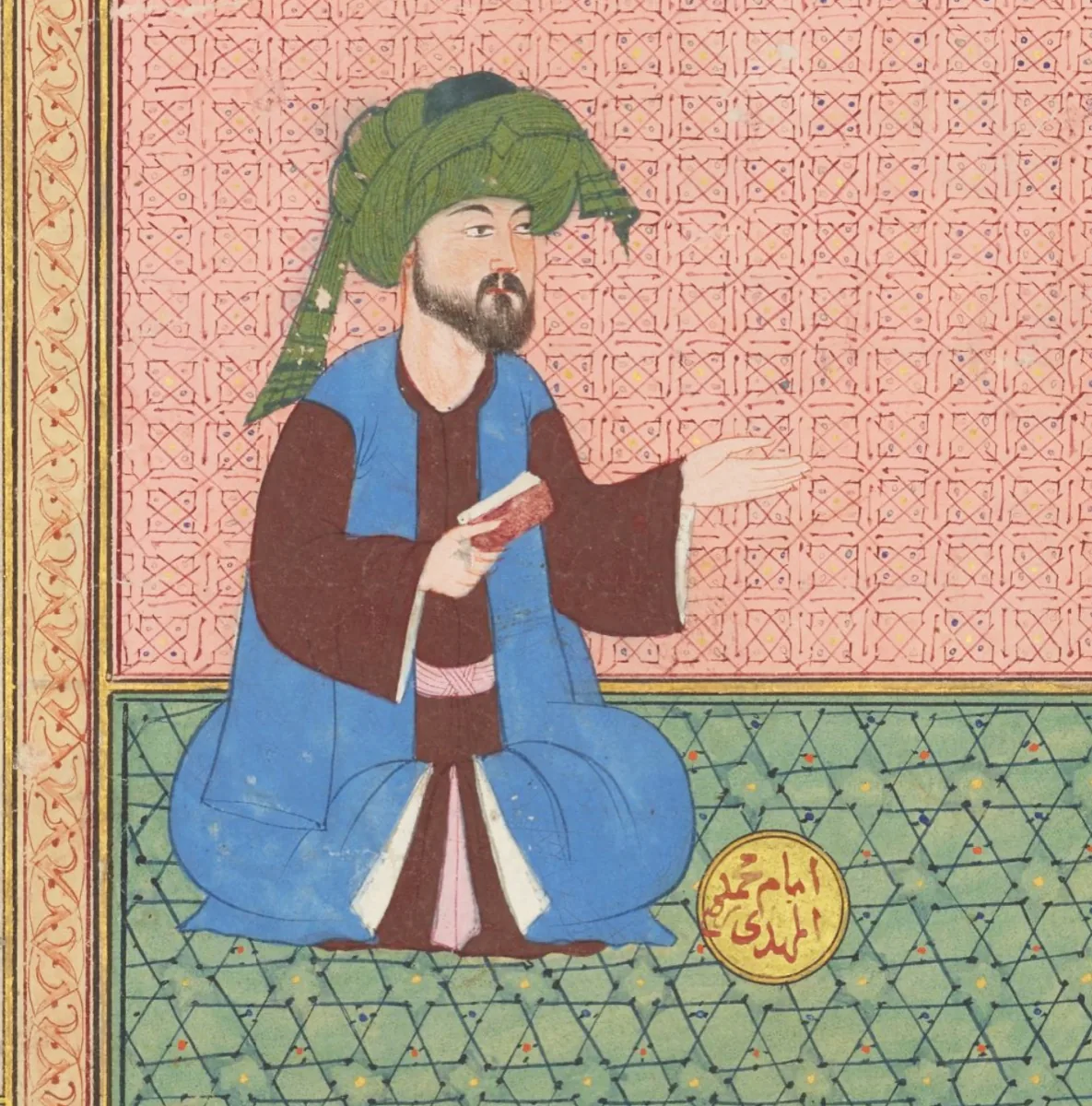
The Hidden Imam is Muhammad al-Mahdi, the twelfth in a line of imams that Twelver Shia Muslims trace from Ali ibn Abi Talib, the Prophet Muhammad's cousin and son-in-law. Twelvers believe he was born around 869, went into hiding as a young child, and is still alive today. They also call him the Mahdi, the guided one, and expect him to return at the end of time to fill the world with justice. Twelver Shia is the biggest denomination within Shia Islam, making up about 85 percent of all Shia Muslims, and it is the state religion of Iran. The question of what to do while the imam is absent has shaped Shia politics for over a thousand years. It produced centuries of withdrawal from government, and then, in 1979, a theocracy built on the claim to govern in his name.
How the twelfth imam disappeared
In Shia Islam, religious and political authority passed from the Prophet Muhammad through Ali and then through a line of Ali's descendants, each one designated by the last. These leaders, the imams, were held to be infallible, guided by God, and the only legitimate rulers of the Muslim community. In practice, most of them held little power. They lived under surveillance by the Sunni caliphs who actually ruled the Islamic world, and Twelvers believe that most of them were poisoned.
The eleventh imam, Hasan al-Askari, died in the city of Samarra in Iraq in 874, while under close watch by the Abbasid caliphate. His community reported that he had a young son named Muhammad, born around 869. The boy had been concealed since birth to keep him safe from the Abbasids. His followers said God had now hidden him from the world entirely. Shia Muslims call this the occultation (ghayba in Arabic).
For about seventy years after 874, a stretch known as the Minor Occultation, four men served in succession as deputies who claimed to relay messages between the hidden imam and the Shia community. When the fourth deputy died in 941, he left a final letter, attributed to the imam, saying there would be no more deputies. This began the Major Occultation, which Twelvers believe continues today.
How the Hidden Imam's absence shaped Shia politics
The imam's disappearance created a problem that has never been fully resolved. If no one but the imam can rightfully rule, and the imam is gone, then no existing government has real authority.
For centuries, the Shia response to this problem was quietism. The faithful accepted whatever ruler held power. Shia clerics limited themselves to interpreting law, running schools, and collecting the community's religious dues. They set the question of rightful government aside until the imam's return.
The Safavid dynasty changed this arrangement. Starting in the early 1500s, the Safavid shahs forcibly converted Iran from Sunni to Shia Islam. They traced their lineage to the imams and presented themselves as the Hidden Imam's representatives on earth. Over the following centuries, senior Shia clergy gradually expanded their own role. They claimed to serve as the imam's general deputies, with the authority to issue legal rulings, collect taxes, and lead believers while he was gone.
In early 1970, Ruhollah Khomeini, then in exile in Najaf, Iraq, gave a series of lectures later published as Islamic Government. Khomeini argued that the clergy's deputyship extended to political rule itself. His reasoning was direct: since someone must apply the imam's law and the imam is not here to do it, the most qualified religious scholar should rule. He called this doctrine velayat-e faqih, meaning guardianship of the jurist. After the 1979 Iranian Revolution, velayat-e faqih became the founding principle written into Iran's post-revolution constitution. It is why Iran's highest office is held by a religious scholar, not an elected politician or a military officer.
Many senior Shia clerics, especially in Najaf, have never accepted velayat-e faqih. They hold the older quietist view: clerics should guide believers in religious matters but should not claim political power. This disagreement between Najaf and the Iranian establishment in Qom remains an active political division across the Shia world, from Iraq to Lebanon.
When will the Hidden Imam return?
Twelver teaching holds that no one but God knows when the imam will reappear. Traditional Shia scholars warn against setting dates or claiming special knowledge of the return. When the imam does return, Twelvers believe he will appear alongside Jesus and establish justice across the world.
The expectation has political weight. Mahmoud Ahmadinejad, Iran's president from 2005 to 2013, repeatedly invoked the Mahdi's coming in speeches at the United Nations. In Iraq after the 2003 American invasion, the cleric Muqtada al-Sadr named his militia the Mahdi Army. Over the centuries, various claimants have declared themselves the returned imam or his herald.
Do all Shia Muslims believe in the Hidden Imam?
No. The Hidden Imam is a specifically Twelver belief. The Ismailis, most of whom are led today by the Aga Khan, follow a different line of imams that diverged after the sixth. The Zaydis, found mainly in Yemen, diverged even earlier. Neither group accepts the idea of a twelfth imam in hiding, and both developed very different forms of religious authority.
Twelvers make up the vast majority of Shia Muslims. For them, the Hidden Imam is the starting point of every argument about who may rule, who may interpret religious law, and what kind of government counts as legitimate while the imam is absent.