
Bank of England
The Bank of England is the United Kingdom's central bank, founded in 1694 to fund a war and now responsible for setting interest rates.
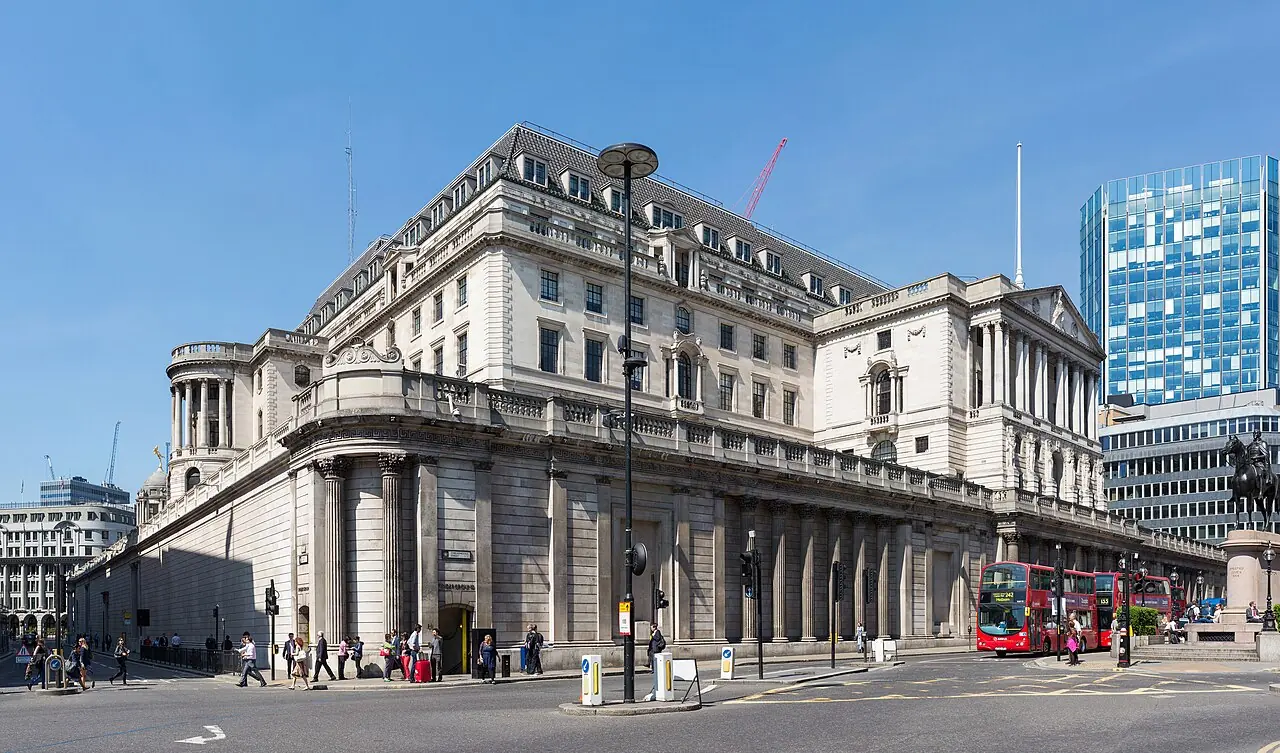
The Bank of England is the central bank of the United Kingdom, and no central bank in a large economy has been operating longer. It was created in 1694 to raise money for England's war against France. Today it sets interest rates for the British economy, issues banknotes, and acts as the lender of last resort to the financial system. Its headquarters sit behind a windowless curtain wall on Threadneedle Street in the City of London, which is why it has been called the "Old Lady of Threadneedle Street" since a 1797 cartoon gave it the nickname.
Why Britain created the Bank of England
In 1689, after the Glorious Revolution, England found itself fighting Louis XIV's France. The Royal Navy needed rebuilding, and the government had no good way to raise the money. William Paterson, a Scottish merchant who had made a fortune trading in the Caribbean, came up with a plan. He and a group of London investors would lend the government £1.2 million at 8 percent interest. In exchange, they would receive a royal charter creating the Bank of England, with permission to print banknotes and manage the government's accounts.
The subscription opened on June 21, 1694, and filled in twelve days. Paterson became one of the Bank's original twenty-four directors, though he left after less than a year over a disagreement with the others. He later lost most of his fortune on the Darien scheme, Scotland's failed attempt to build a trading colony in Panama. His wife and child died on the expedition.
The structure of the deal is what made Britain a financial power. Parliament, not the king, voted the taxes that serviced the debt. Many of the members of Parliament who approved those taxes were the creditors themselves. That made default close to unthinkable. Over the following century, Britain could raise loans at rates far below France's. France's crown had repeatedly defaulted, and its tax system leaked revenue through exemptions for the nobility. Britain, with a population of five million, matched the war spending of France, with a population of twenty million, because it could borrow more cheaply. By the Napoleonic Wars, Britain carried a much larger national debt than France while servicing it comfortably. France's inability to match Britain's borrowing power was one of the pressures that forced the French crown to summon the Estates-General in 1789. That assembly began the French Revolution.
How the Bank of England became a central bank
The Bank was not designed as a central bank. It became one gradually, over two centuries.
It gained a monopoly on printing banknotes across England and Wales over the course of two centuries. By the 1800s, a Bank of England note was what people meant when they talked about money. In 1844, Parliament passed the Bank Charter Act, which linked the printing of new notes to the Bank's gold reserves. The idea was to prevent financial crises by law. The law had to be suspended during financial panics in 1847, 1857, and 1866, because in each crisis the rigid limit on new notes made things worse.
The most severe test came in 1866, when Overend, Gurney and Company, the largest discount house in London, collapsed. Dozens of banks failed in the panic that followed. Walter Bagehot, the editor of The Economist, explained what had gone wrong in his 1873 book Lombard Street. When a financial panic hits, the central bank should offer loans without limit, charge a high interest rate for them, and accept only sound assets as security. Unlimited lending stops the panic. A high rate discourages borrowing for anything except genuine need. Requiring sound security means the bank rescues solvent institutions, not reckless ones. Central bankers quoted Bagehot's formula during the 2008 financial crisis and again in 2020.
In 1925, Britain returned to the gold standard at its prewar exchange rate. John Maynard Keynes warned in a pamphlet that the rate was too high. He was right: the overvalued pound made British exports too expensive and helped cause the 1926 General Strike.
Who owns the Bank of England?
The Bank was privately owned for its first 252 years. In 1946, Clement Attlee's Labour government nationalized it, paying the 17,000 shareholders in government bonds. Since then, the Bank has been wholly owned by the British government, with its capital held by the Treasury Solicitor on behalf of HM Treasury.
For the next fifty years the Bank operated under Treasury control, with elected officials making interest rate decisions. In May 1997, Chancellor of the Exchequer Gordon Brown transferred that power to a nine-member Monetary Policy Committee at the Bank. The committee, made up of Bank officials and outside economists, sets interest rates to keep inflation near a 2 percent target. The government still owns the Bank, but it no longer decides interest rates. Most of the world's major central banks moved toward the same model.
The Bank of England today
The Bank's main tool is Bank Rate, the interest rate it charges on lending to commercial banks. In September 2026, Bank Rate stands at 3.75 percent. The Monetary Policy Committee meets eight times a year to decide whether to raise, lower, or hold it, based on whether inflation is above or below its 2 percent target. The governor, Andrew Bailey, has held the post since 2020.
After the 2008 financial crisis, the Bank began buying government bonds on a large scale, a policy called quantitative easing. It expanded the program during the COVID-19 pandemic in 2020, eventually purchasing £895 billion in bonds. The Bank has since begun selling those bonds back. The purchases were the largest in the Bank's history, and they renewed debate over how close a central bank should stand to the government whose debt it buys.