
Cuban Missile Crisis
The Cuban Missile Crisis was a thirteen-day standoff in October 1962 between the United States and the Soviet Union over nuclear missiles in Cuba.
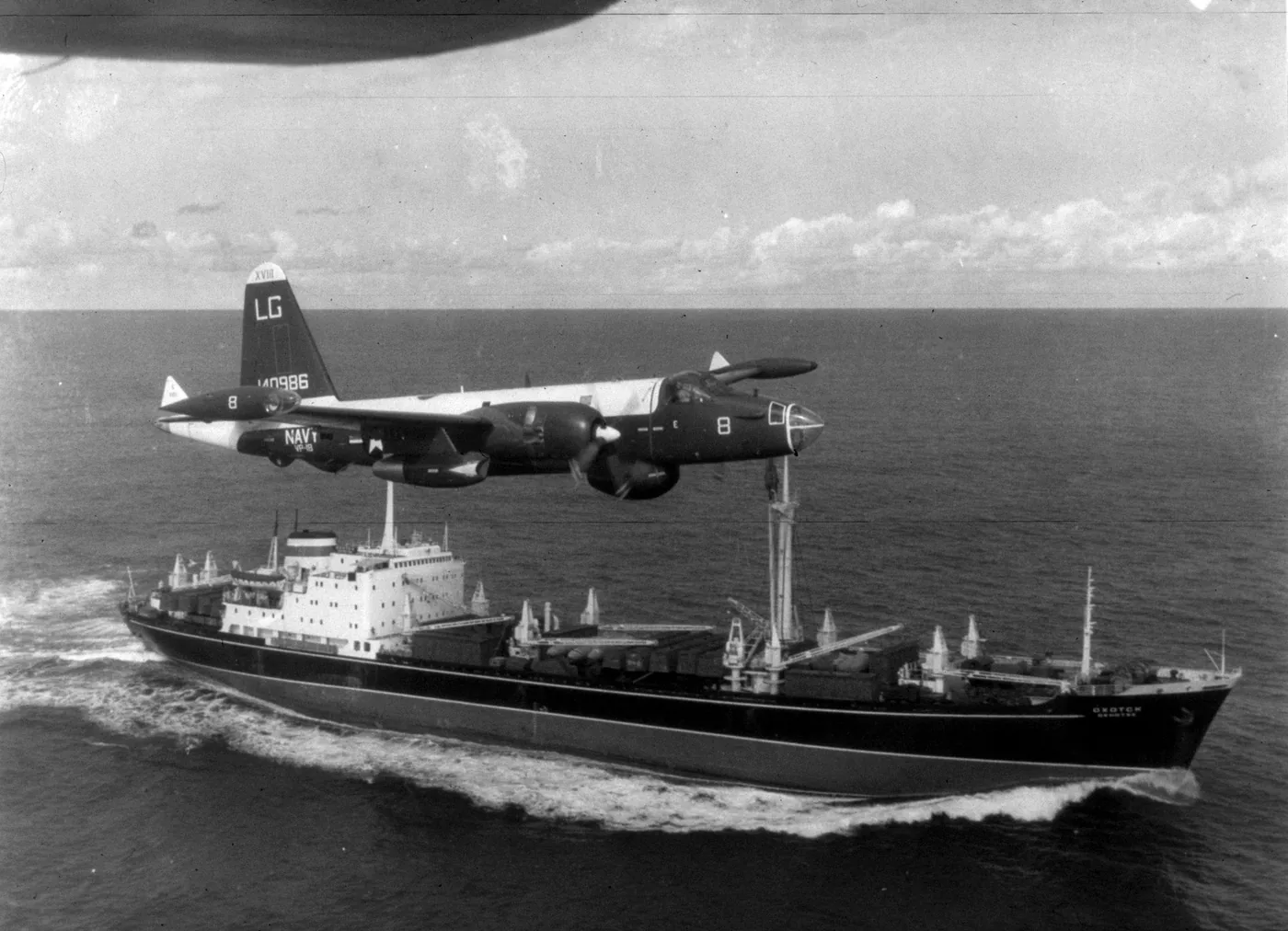
The Cuban Missile Crisis was a thirteen-day nuclear standoff between the United States and the Soviet Union in October 1962. The Soviet government had secretly placed nuclear missiles in Cuba, about ninety miles off the coast of Florida, and the American government discovered them before they were ready to fire. President John F. Kennedy learned of the missiles on October 16, announced a naval blockade on October 22, and on October 28 Soviet leader Nikita Khrushchev agreed to pull them out. In return, the United States promised not to invade Cuba and privately agreed to withdraw its own nuclear missiles from Turkey. The confrontation ended through diplomacy, but at several points during those two weeks it nearly turned into a nuclear war by accident.
How the Soviet Union secretly moved nuclear missiles to Cuba
In May 1962, Khrushchev decided to send nuclear missiles to Cuba. The United States had a far larger nuclear arsenal and had already stationed Jupiter missiles in Turkey, close enough to hit Moscow with almost no warning. Placing Soviet missiles in Cuba would partly even the balance. Khrushchev also wanted to shield Fidel Castro's government after the failed American-backed Bay of Pigs invasion of April 1961.
The Soviets called the operation Anadyr. The name came from an Arctic river, part of a cover story implying the troops were bound for cold-weather exercises. Around 42,000 Soviet soldiers crossed the Atlantic aboard merchant ships, hidden below decks with their equipment. Many captains were not told where they were going and learned the destination only after opening sealed envelopes at sea. The weapons included medium-range R-12 missiles capable of reaching Washington and warheads for longer-range R-14 missiles with enough range to hit cities across the United States. Soviet forces also brought short-range tactical nuclear warheads, including Luna rockets, that American intelligence never picked up. By the time the naval quarantine began, roughly 158 nuclear warheads were already on the island.
The thirteen days of the Cuban Missile Crisis
On October 14, 1962, Major Richard Heyser flew a U-2 reconnaissance plane over western Cuba and brought back photographs of a launch site being built near San Cristobal. CIA photo analysts recognized the structures as medium-range missile launchers. Two days later, National Security Advisor McGeorge Bundy showed the pictures to President Kennedy.
Kennedy pulled together a secret group of advisors called the ExComm, the Executive Committee of the National Security Council. The Joint Chiefs of Staff urged an immediate air strike against the missile sites. Kennedy turned that down. The military could not promise that a strike would destroy every missile, and his brother Robert told the other advisors that bombing a small country without warning reminded him of Pearl Harbor. On October 22, he went on national television to reveal the Soviet buildup and announce a naval "quarantine" of Cuba. He chose the word quarantine because declaring a blockade amounts to an act of war under international law.
On October 23, Soviet cargo ships heading toward the quarantine line slowed, stopped, and turned around.
The crisis nearly broke open on Saturday, October 27, the day later called Black Saturday. Soviet air defense troops in Cuba fired a surface-to-air missile at a U-2 flown by Major Rudolf Anderson, killing him. The local Soviet commanders made that call on their own, without approval from Moscow. Anderson was the only person killed in combat during the confrontation.
Later that day, U.S. Navy destroyers dropped depth charges near the Soviet submarine B-59 to signal it to come to the surface. The Americans did not know the submarine was armed with a nuclear torpedo. Unable to reach Moscow by radio and convinced that fighting had begun, the boat's captain, Valentin Savitsky, wanted to fire the torpedo. Launching it required three senior officers aboard to agree. Two did. The third, Vasili Arkhipov, the brigade chief of staff, refused, and the submarine rose to the surface instead. Arkhipov's refusal may have stopped a nuclear war.
How did the Cuban Missile Crisis end?
On October 26 and 27, Khrushchev sent Kennedy two letters. The first proposed withdrawing the missiles if the United States promised not to invade Cuba. The second also required Washington to pull its Jupiter missiles out of Turkey.
Kennedy publicly accepted the first letter and ignored the second. Behind the scenes, his brother Robert Kennedy passed a message to Anatoly Dobrynin, the Soviet ambassador: the Jupiters would leave Turkey, but quietly and with no public link to the agreement. On October 28, Khrushchev told the world that Soviet missiles would come out of Cuba. The American Jupiters left Turkey the following April.
What changed after the Cuban Missile Crisis?
The crisis drove both governments to build safeguards against accidental war. The following year they set up a direct communication channel between Washington and Moscow, known as the hotline, so that leaders could reach each other in minutes rather than waiting hours for decoded messages. In August 1963, three nuclear powers agreed to the Partial Nuclear Test Ban Treaty, which stopped weapons tests in the atmosphere.
The crisis is usually remembered as a triumph of presidential decision-making. The unauthorized shootdown of Anderson's plane and the near-launch of a nuclear torpedo from B-59, both on the same day, show that the outcome also depended on people neither government controlled.