
Golden Horde
The Golden Horde was the Mongol khanate that ruled the Russian lands from the 1240s until 1480.
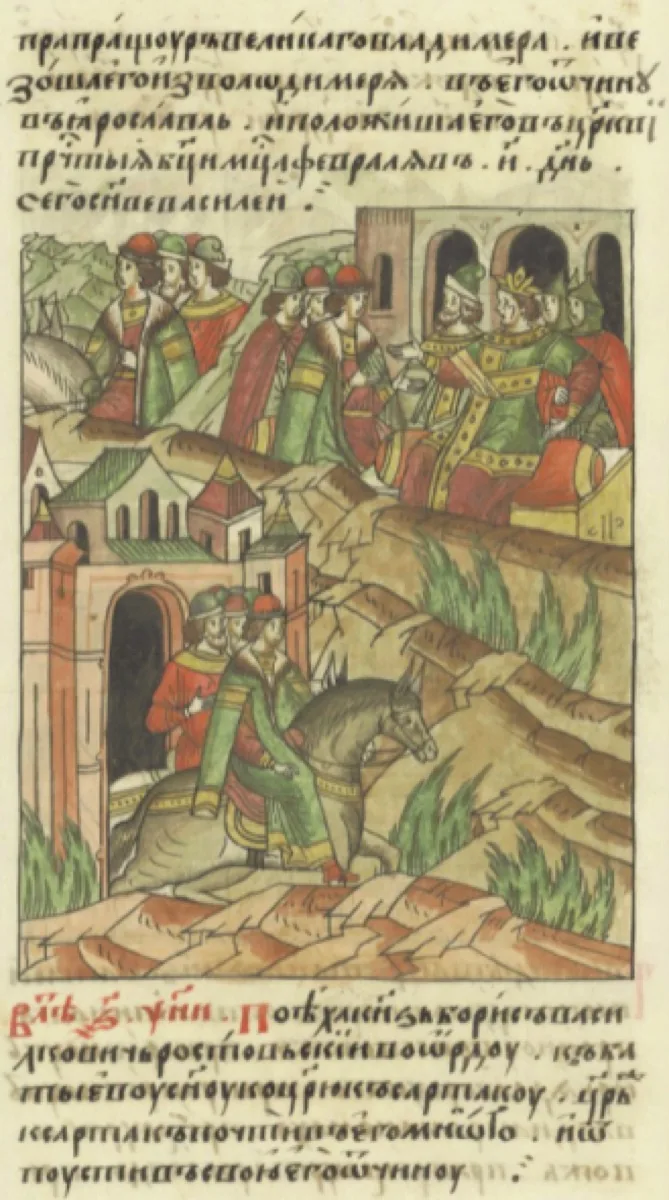
The Golden Horde was the western part of the Mongol Empire, and for about 240 years it ruled the Russian lands. It was founded by Batu Khan, a grandson of Genghis Khan, after his armies swept through the Rus principalities between 1237 and 1240, burning their cities one after another. The Golden Horde did not occupy the territory it conquered. It taxed it, demanded obedience, and let local princes govern as long as they paid. The khan ruled from Sarai, a city he built on the lower Volga, where he issued licenses to govern and ran the first systematic censuses in Russian history. The Mongols rewarded princes who cooperated and destroyed the ones who resisted. By the time the Golden Horde weakened in the fifteenth century, the small town of Moscow had used Mongol backing to become the strongest state in Russia.
How Batu Khan conquered the Russian lands
Genghis Khan divided his empire among his sons. The western share went to his eldest, Jochi, who died before it was fully conquered. Jochi's son Batu finished the job. In the winter of 1237, Batu's armies arrived at Ryazan, a city southeast of Moscow, and demanded submission. The prince refused. After six days of siege the Mongols took Ryazan and destroyed it.
Batu moved north and burned Vladimir, the capital of the most powerful Rus principality, in February 1238. Over the next two years his forces worked through the Rus lands, city by city. In December 1240 they stormed Kiev, the oldest and most important city in the region, and left it in ruins.
From there Batu's armies pushed into Poland and Hungary, defeating European armies at Legnica and Mohi in April 1241. They turned back when the Great Khan Ogedei died, because Batu needed to be involved in the succession. He settled on the lower Volga, founded the city of Sarai, and ruled a territory stretching from the Urals to the borders of Hungary.
How Moscow rose under the Golden Horde
The Mongols ran their Russian territories through a system of licenses. A Rus prince who wanted to rule his city needed a document called a yarlyk, issued by the khan at Sarai. To get one, the prince had to travel to the Mongol capital and kneel before the khan. Some princes who made the trip never came home.
The khan also needed someone to collect tribute from the Russian cities. Moscow's princes volunteered. In 1327, the people of Tver, a rival city, killed a Mongol tax collector and his guards. Moscow's prince Ivan I helped the Mongol punitive army burn Tver to the ground. The khan rewarded him with the right to collect taxes from all the Russian lands. Ivan became known as Kalita, "the moneybag." He kept a share of everything he collected, loaned money to other princes, and took their land when they could not repay.
Ivan also persuaded the head of the Russian Orthodox Church to move to Moscow. By the time his descendants ruled, Moscow had the largest treasury in Russia, the backing of the Orthodox Church, and the political strength to dominate its neighbors. Moscow owed its rise to the Golden Horde's system of rule.
The Golden Horde and Islam
The early rulers of the Golden Horde practiced Tengrism, the traditional Mongol religion centered on the sky god Tengri. Berke Khan, Batu's brother, changed that when he converted to Islam around 1252, becoming the first major Mongol ruler to adopt the faith. His conversion had political consequences. When his cousin Hulagu sacked Baghdad in 1258, destroying the capital of the Islamic caliphate, Berke went to war with him. The conflict split the Mongol Empire for good.
Under Ozbeg Khan, who ruled from 1313 to 1341, Islam became the Golden Horde's official state religion. Ozbeg's reign was also the Golden Horde's peak of prosperity. Silk Road trade flowed through its territory to Italian merchant colonies on the Black Sea, especially the Genoese port of Kaffa in Crimea. That same trade route carried the Black Death westward in the 1340s.
How did the Golden Horde end?
The Golden Horde's decline took more than a century. In 1380, Prince Dmitry of Moscow defeated a Horde army at the Battle of Kulikovo, near the Don River. It was the first major Russian victory over the Mongols in open battle, and Dmitry earned the nickname Donskoy, "of the Don." But the victory did not end Mongol authority. Two years later, in 1382, a Horde army sacked Moscow in reprisal, and the city went back to paying tribute.
The blow that broke the Golden Horde came from the east. In 1395, Timur, the Central Asian conqueror, invaded the Golden Horde's territory, destroyed Sarai, and wrecked the trading cities that had been its main source of wealth. Timur deported Sarai's craftsmen to Central Asia. The Golden Horde never recovered, and over the following decades it broke apart into rival khanates at Kazan, Astrakhan, Crimea, and Sibir.
The formal end of Mongol authority over Russia came in 1480. Ivan III of Moscow refused to pay tribute. When the khan Akhmat marched to the Ugra River to force the issue, the two armies faced each other for weeks. Akhmat waited for Lithuanian allies who never arrived, and in November he withdrew. No battle was fought, but the Great Stand on the Ugra ended about 240 years of Mongol rule.
Moscow then conquered the successor khanates one by one. Ivan the Terrible took Kazan in 1552 and Astrakhan in 1556, beginning the expansion that made Russia the largest country on Earth. The Crimean Khanate lasted longest, protected by the Ottoman Empire, and kept launching slave raids into Russia and Ukraine until 1769. Catherine the Great took it over in 1783.