
Boxer Rebellion
The Boxer Rebellion was an anti-foreign uprising in China in 1900 that besieged Beijing's foreign legations and drew an eight-nation army.
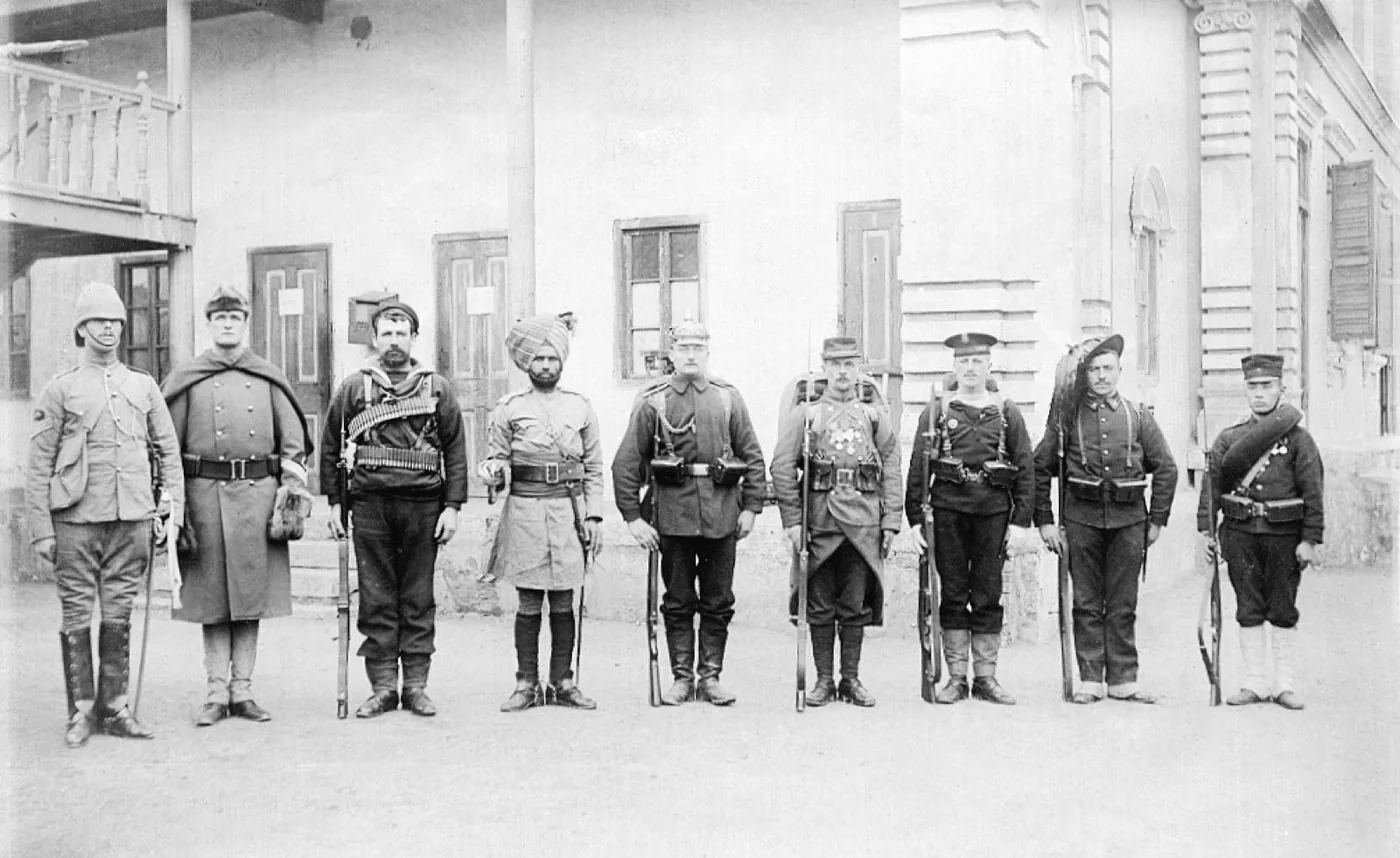
The Boxer Rebellion was an anti-foreign uprising in northern China from 1899 to 1901. It was led by a militia movement called the Society of Righteous and Harmonious Fists. Foreigners called them "Boxers" because their members practiced martial arts rituals that looked like shadow-boxing. The Boxers believed these rituals made their bodies immune to bullets. They burned churches, tore up railway lines, killed foreign missionaries, and killed tens of thousands of Chinese Christians. In June 1900, Empress Dowager Cixi, the ruler of the Qing dynasty, chose to back the uprising and declared war on every foreign power with a presence in China. A joint force of about 20,000 soldiers from eight countries fought their way to Beijing, broke a 55-day siege of the foreign diplomatic quarter, and forced China to pay one of the largest indemnities in history.
How foreign control set the stage for the Boxer Rebellion
By the 1890s, foreign nations had been forcing open China's doors for half a century. The Opium Wars in the 1840s and 1850s had compelled China to sign a series of unequal treaties that gave foreign governments control of Chinese ports, customs revenue, and legal authority over their own citizens on Chinese soil. By the late 1890s, Britain, France, Germany, Russia, and Japan had each carved out spheres of influence across the country, running railways, mines, and military bases with little regard for Chinese authority.
Foreign Christian missionaries added to the resentment. They built churches on land that local communities considered sacred, and Chinese converts sometimes used their foreign connections to win legal disputes against non-Christian neighbors. In 1899 and 1900, a severe drought hit the North China Plain and left millions of people starving. The Boxers, who had been active in Shandong province since the late 1890s, channeled that desperation against the foreigners and the Chinese who had joined them.
How Empress Dowager Cixi backed the Boxers
The Boxers moved north out of Shandong in the spring of 1900, heading toward the capital. They burned churches and killed Chinese Christians as they went. Young men joined in growing numbers, drawn by the promise that their rituals would protect them from foreign weapons. At the height of the violence, the Boxers had killed over 200 foreign missionaries and members of their families.
Empress Dowager Cixi, 64 years old in 1900, had spent decades maneuvering between foreign demands and her own court. She had entered the imperial household as a low-ranking concubine, then rose to become the most powerful person in China by placing a series of young emperors on the throne and ruling through them. Faced with the Boxer movement, she had a choice: crush it, or use it against the foreigners she despised.
She chose to use it. In June 1900, Cixi's government opened Beijing's gates to the Boxers and ordered its armies to fight alongside them. On June 20, the German minister, Clemens von Ketteler, was shot and killed by a Qing soldier while riding in a sedan chair to the Chinese foreign office. That same day, Boxer and Qing forces surrounded the Legation Quarter, the district where the foreign diplomatic missions stood side by side.
The 55-day siege of Beijing's Legation Quarter
Inside the Legation Quarter were roughly 470 foreign civilians, about 400 soldiers from eight countries, and some 3,000 Chinese Christians who had taken shelter there. They built barricades from furniture and sandbags, rationed food and water, and buried their dead inside the compound walls. For 55 days they held out under rifle fire and occasional shelling, from June 20 until a relief column arrived on August 14.
Eight countries formed a military alliance to break the siege: Japan, Russia, Britain, the United States, France, Germany, Austria-Hungary, and Italy. They gathered roughly 20,000 troops at the coast, then fought their way inland from the port city of Tianjin. The column reached Beijing on August 14, 1900, and the siege was over. Cixi and the emperor fled the capital in disguise, heading west. The occupation that followed was brutal. Alliance soldiers looted homes, palaces, and temples, and carried out killings of civilians in Beijing and the surrounding countryside.
What did the Boxer Rebellion cost China?
China's punishment was formalized in the Boxer Protocol, signed September 7, 1901. The terms required China to execute officials who had backed the Boxers and to accept foreign soldiers permanently stationed along the route from the coast to the capital. China also had to pay 450 million taels of silver, an amount chosen to equal about one tael per person in the empire. With interest over 39 years, the bill grew to nearly a billion taels. It consumed a large share of China's government revenue for a generation.
The Boxer Rebellion was the last crisis the Qing dynasty survived. The indemnity, combined with the presence of foreign troops permanently stationed on Chinese soil, badly weakened what remained of the dynasty's authority. Ten years after the Boxer Protocol, the Qing collapsed in the revolution of 1911, ending over two thousand years of imperial rule in China. For Chinese nationalists who came after, the Boxer Protocol joined the long list of unequal treaties that defined what they called China's century of humiliation.