
Empress Dowager Cixi
Empress Dowager Cixi ruled China for nearly fifty years, from 1861 until her death in 1908, during the Qing dynasty's final decades.
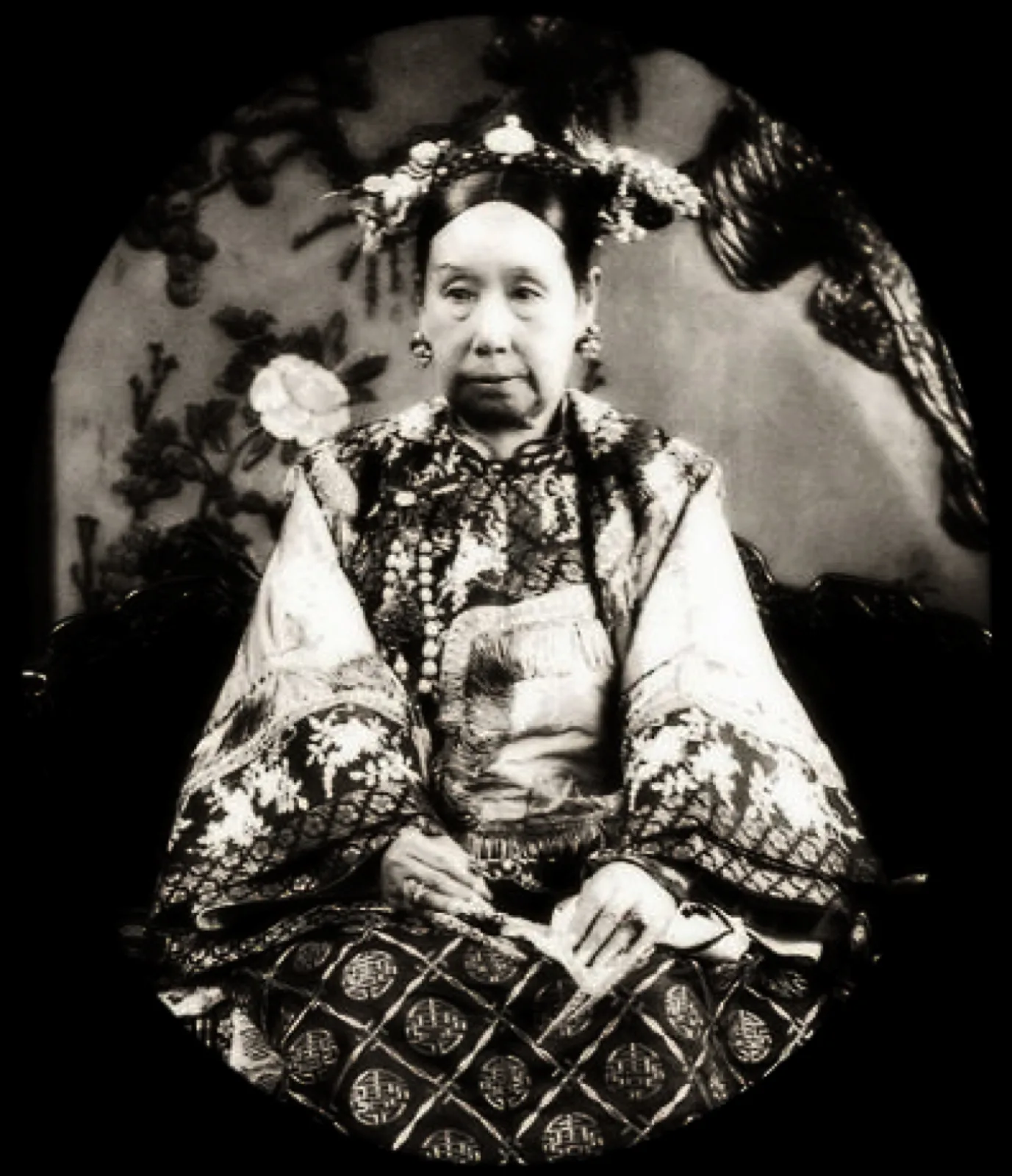
Empress Dowager Cixi was a low-ranking concubine who became the most powerful person in China for nearly half a century. Born in 1835 to a minor Manchu official, she entered the Forbidden City in 1852 as a sixth-rank concubine, near the bottom of eight ranks, one of many in the Xianfeng Emperor's court. In 1856 she had a son, the emperor's only male heir to survive infancy. After Xianfeng's death in 1861, Cixi used her position as the new emperor's mother to take control of the government. She was twenty-five. For the next forty-seven years she governed China through the final years of the Taiping Rebellion, wars with France and Japan, and the Boxer Rebellion. She died on November 15, 1908, one day after the emperor she had kept under house arrest for a decade.
How Cixi took control of the Qing dynasty
When the Xianfeng Emperor died in August 1861, he left the throne to his five-year-old son, the Tongzhi Emperor, and appointed eight regents to govern until the boy came of age. Cixi moved quickly. She allied with Empress Dowager Ci'an, the emperor's senior widow, and with Prince Gong, the dead emperor's brother. Together they staged what became known as the Xinyou Coup. They removed all eight regents from office. Three were sentenced to death: one was beheaded and two were ordered to kill themselves.
Cixi and Ci'an became co-regents. No woman could sit on the Dragon Throne, so Cixi placed a silk screen behind it and ruled from the other side, listening and giving orders while ministers spoke to the young emperor. The screen hid her from the court. It did not limit her authority.
The Tongzhi Emperor died in 1875 at eighteen without an heir. Cixi overrode the normal line of succession and placed her nephew, a three-year-old, on the throne as the Guangxu Emperor, giving herself another long regency. When Ci'an died in 1881, Cixi became the sole power behind the throne.
Cixi and the Hundred Days' Reform
Through the 1860s and 1870s, Cixi's government backed a modernization effort called the Self-Strengthening Movement, which built arsenals, shipyards, and China's first modern navy. But Cixi diverted funds meant for the Beiyang Fleet, the navy's main force, into rebuilding the Summer Palace outside Beijing. The rebuilt palace included a marble boat on the shore of its lake, a two-story structure that could never sail. When Japan attacked in 1894, it destroyed much of the underfunded Chinese fleet. China's defeat in the First Sino-Japanese War forced it to cede Taiwan to Japan and pay a large indemnity, adding to a growing list of unequal treaties with foreign powers.
In 1898, the Guangxu Emperor, now twenty-six, launched a reform campaign that became known as the Hundred Days' Reform. For about a hundred days that summer, he issued edicts to modernize the military, restructure the government, and overhaul the education system. Cixi saw the reforms as reckless. On September 21, 1898, she staged a coup, placed Guangxu under house arrest on a small island in a palace lake, reversed most of his edicts, and had six of the leading reformers executed.
Two years later, in 1900, Cixi endorsed the Boxer movement, a violent anti-foreign uprising whose fighters laid siege to the diplomatic quarter in Beijing. A joint force from eight countries defeated the Boxers and occupied the capital. Cixi fled the city disguised as a peasant. The resulting settlement, the Boxer Protocol, required China to pay 450 million taels of silver and allow foreign troops to station in Beijing.
The defeat changed Cixi's direction. After 1901, she authorized many of the reforms she had blocked three years earlier. She abolished the 1,300-year-old civil service examination system in 1905, ordered the building of railways and modern schools, and began drafting a constitution. She had imprisoned the Guangxu Emperor for proposing changes like these. Now she carried them out herself.
Did Cixi have the Guangxu Emperor poisoned?
The Guangxu Emperor died on November 14, 1908, at thirty-seven, still under house arrest. Cixi died the following day. The timing raised suspicion for a century.
In 2008, Chinese researchers working with the Beijing police tested samples from Guangxu's tomb. They found arsenic levels in his hair 2,000 times higher than normal, above a lethal dose. The finding confirmed that Guangxu was deliberately poisoned. The study did not identify who ordered it. Cixi is the most widely suspected, because she had the motive and the access, and because she died just one day later. Some historians have pointed to Yuan Shikai, a powerful general who feared that Guangxu would punish him for siding with Cixi during the 1898 coup. No proof has settled the question.
Before she died, Cixi chose her great-nephew Puyi, a two-year-old, as the next emperor. Three years later, revolution ended the Qing dynasty and two thousand years of imperial rule. Cixi held power longer than almost any Chinese ruler of her era. Whether she delayed China's modernization or held a failing empire together longer than anyone else could have is still debated.