
Unequal Treaties
The unequal treaties were one-sided agreements imposed on China by Western powers and Japan from 1842 to 1915 that gave foreigners special legal privileges.
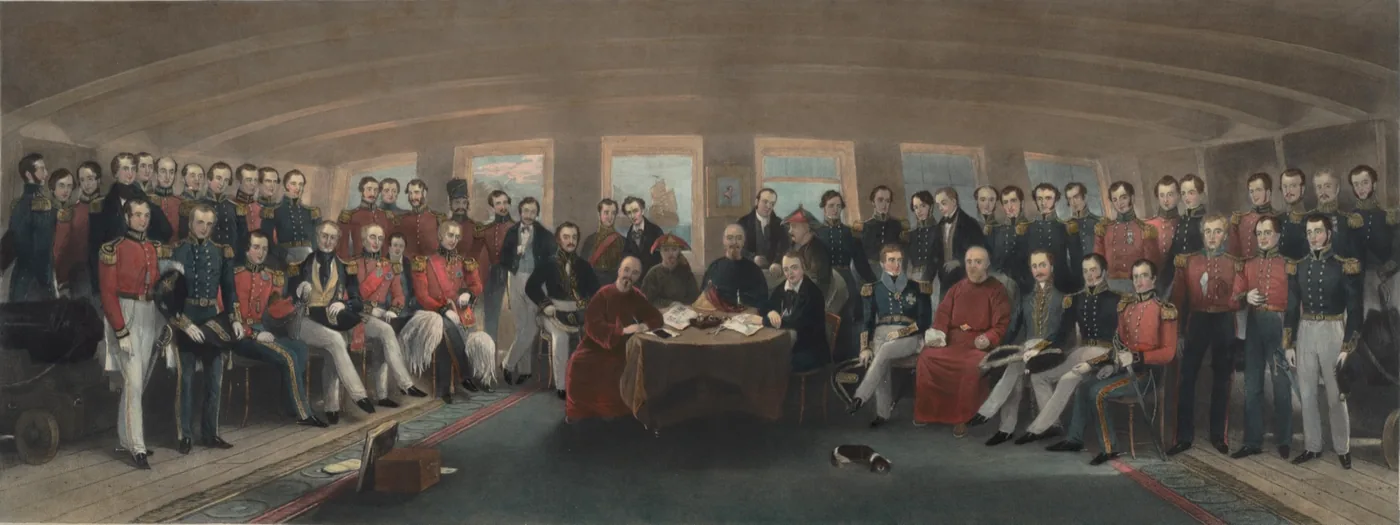
The unequal treaties were a series of agreements imposed on China by Western powers and Japan between 1842 and 1915. They are called "unequal" because China signed them under military pressure and received nothing in return. The treaties gave foreign governments rights that China did not get back. Foreign powers locked in low tariffs that China could not raise, claimed the right to trade in designated ports, won legal immunity for their citizens on Chinese soil, and took control of pieces of Chinese territory. Britain, Russia, France, the United States, and Japan imposed dozens of these agreements over roughly seventy years. The phrase gained wide use through Chinese nationalist movements in the 1920s, but the one-sidedness was written into the very first agreement in 1842. China calls this era the "century of humiliation."
How the Treaty of Nanking set the pattern
The First Opium War ended with the Treaty of Nanking, signed aboard the British warship HMS Cornwallis on August 29, 1842. China had tried to stop British merchants from selling opium to its people. Britain sent a fleet, won the war in two years, and dictated terms. The treaty ceded Hong Kong Island to Britain, opened five ports to British trade, and imposed an indemnity of $21 million on the Qing government.
Within about two years, follow-up agreements with Britain in 1843 and with the United States and France in 1844 introduced the provisions that shaped every unequal treaty after them. Tariffs were fixed at about 5 percent, too low for China to protect its own industries. Most-favored-nation clauses meant that any privilege granted to one foreign power automatically extended to all the others. Extraterritoriality placed foreigners outside Chinese jurisdiction. If a British citizen broke the law in China, the case went to a British consul who applied British law, not to a Chinese court.
How the treaty system grew
Each new war brought new treaties with worse terms. The Treaties of Tientsin in 1858 and the Convention of Peking in 1860, both forced on China during the Second Opium War, opened more ports, legalized the opium trade, and allowed foreign missionaries to travel freely inside the country.
Japan's victory over China in 1895 produced the Treaty of Shimonoseki. It ceded Taiwan and the Pescadores Islands to Japan, forced China to recognize Korean independence from Chinese suzerainty, and imposed an indemnity of 200 million taels. That sum equaled several years of the Qing government's revenue.
The Boxer Rebellion brought the worst terms. After the rebellion failed, the 1901 Boxer Protocol forced China to pay 450 million taels, about $333 million at the time. With interest, the total came to nearly a billion taels, to be paid over 39 years. Foreign troops won the right to station themselves permanently between Beijing and the coast.
In 1915, Japan issued the Twenty-One Demands to China's president, Yuan Shikai. The demands sought Japanese control over Manchuria, Shandong, and much of China's mining and industry. Yuan was forced to accept most of them under threat of war. The demands provoked a wave of anti-Japanese anger that helped fuel the nationalist movements of the following decade.
What made the unequal treaties unequal
Three features set these treaties apart from ordinary agreements between countries.
Extraterritoriality meant that foreigners in China lived under their own countries' laws, not China's. A French citizen who committed a crime in Shanghai would face a French consul, not a Chinese judge. The arrangement said plainly that Chinese law was not good enough for foreign citizens.
Foreign concessions were carved out of Chinese cities and run by foreign governments. Shanghai alone had two, the International Settlement and the French Concession, each with its own police, courts, and municipal council. Chinese law did not apply inside them. More than a dozen Chinese cities had foreign-run districts where China was sovereign in name only.
China even lost control of its own tariff revenue. The Chinese Maritime Customs Service collected the import duties that were China's largest source of government income. For nearly half a century, the service was run by Robert Hart, an Irishman who arrived in China at nineteen. Hart served as Inspector General from 1863 to 1911, collecting China's own money and sending much of it to the foreign powers to pay the indemnities the treaties had imposed.
How did the unequal treaties end?
Abolishing the unequal treaties became the central demand of Chinese nationalism. Sun Yat-sen made it part of his political program in the 1920s. Both the Kuomintang and the Chinese Communist Party made treaty abolition a core promise.
Real progress took a world war. On January 11, 1943, while China was fighting Japan alongside Britain and the United States, Chiang Kai-shek's government signed treaties with both countries ending extraterritoriality.
When Mao Zedong proclaimed the People's Republic of China in 1949, his government declared the entire system of unequal treaties void. One of the last traces of the system ran until 1997, when Britain returned Hong Kong to China. Hong Kong Island had been ceded under the Treaty of Nanking in 1842. The much larger New Territories had been leased for 99 years in 1898. When that lease expired, Britain handed back all of Hong Kong together.
The memory of the unequal treaties still shapes Chinese foreign policy. When Beijing frames outside pressure as an attempt to impose terms on China, it is invoking the specific history of a period when foreign governments wrote their own laws on Chinese soil and China could not stop them.