
Century of Humiliation
The Century of Humiliation is China's name for the period from 1839 to 1949 when foreign powers defeated and carved up the country.
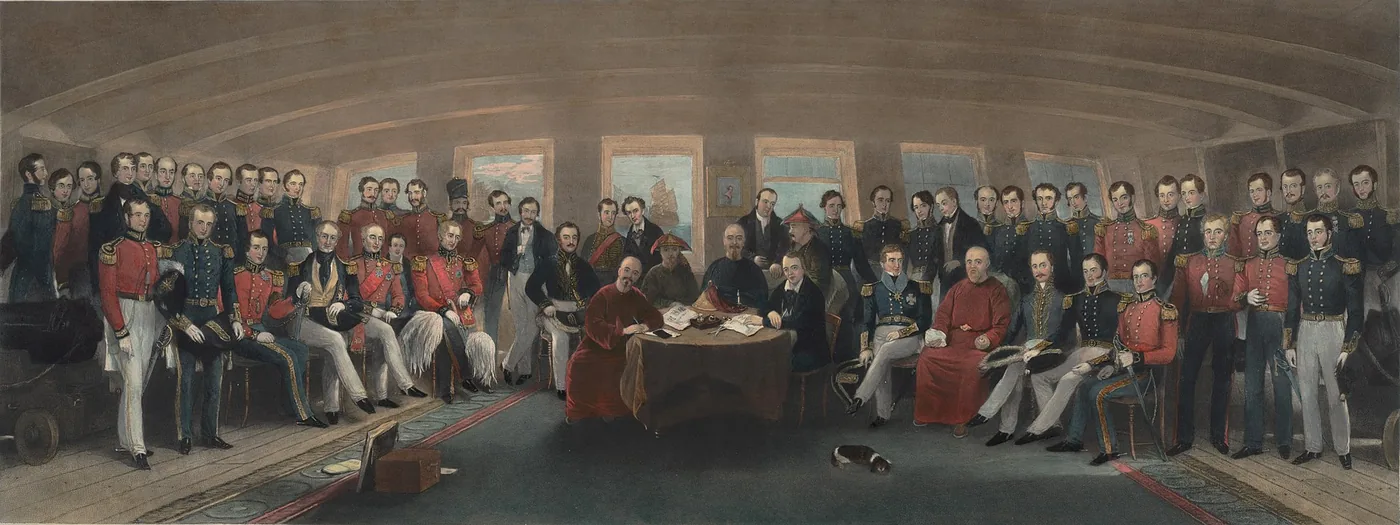
The Century of Humiliation is China's name for the period from the First Opium War in 1839 to the Communist victory in 1949. In those 110 years, foreign powers repeatedly defeated China in war, forced it to sign treaties that gave away territory and sovereignty, and divided its port cities into foreign-run zones. Britain took Hong Kong. Japan took Taiwan, then invaded the mainland and killed between 14 and 20 million people. An eight-nation military force sacked Beijing. For a country that had considered itself the center of civilization for two thousand years, these defeats changed how China saw itself and the world. The Communist Party treats the Century of Humiliation as a founding story, and Chinese leaders invoke it to explain why China will not accept outside pressure on its sovereignty.
How foreign powers carved up China
The period began with opium. In the 1830s, Britain was buying huge quantities of tea, silk, and porcelain from China but had little China wanted in return. British merchants closed the gap by smuggling opium grown in India into Chinese ports. When Lin Zexu, an imperial commissioner sent by the Qing emperor, seized and destroyed roughly 20,000 chests of opium near Canton in 1839, Britain sent warships. China lost the First Opium War and signed the Treaty of Nanking in 1842, giving up Hong Kong and opening five ports to foreign trade.
Other powers demanded their share. France, Germany, Russia, Japan, and the United States each forced China to sign what are now called unequal treaties. These agreements took tariff control from China, exempted foreigners from Chinese law, and created concession zones in Chinese cities where foreign governments held authority. Russia took large territories in the northeast. In 1860, soldiers from Britain and France looted and destroyed the Old Summer Palace outside Beijing, one of the largest royal compounds in the world.
Japan did the most damage. In 1895 it defeated China in the First Sino-Japanese War and took Taiwan under the Treaty of Shimonoseki. In 1900 an eight-nation force crushed the Boxer Rebellion, and in 1901 the foreign powers imposed an indemnity of 450 million taels of silver, payable over 39 years. With interest, the total came to nearly one billion taels, more than the Qing government earned in a year. In 1931 Japan seized Manchuria. In 1937 it invaded the rest of China, beginning an eight-year war that killed between 14 and 20 million Chinese.
Through all of this, China's own governments kept signing the terms. The Qing dynasty, and later the Republic under Sun Yat-sen and Chiang Kai-shek, accepted because refusing meant worse terms or outright conquest.
Why is it called the century of humiliation?
The phrase came later than the events. It appeared around 1915, when Japan presented China with the Twenty-One Demands, a set of conditions that would have given Japan broad control over China's economy and territory. China's president, Yuan Shikai, accepted most of them on May 9. Students and intellectuals declared that date National Humiliation Day, and the phrase guochi, national shame, entered public life.
The anger grew after the 1919 Paris Peace Conference. China had entered World War I on the Allied side, expecting to recover Germany's concessions in Shandong province. Instead, the Treaty of Versailles transferred the territory to Japan. Protests erupted across China on May 4, 1919, in what became known as the May Fourth Movement. Both the Kuomintang and the Communists built the phrase into their politics in the 1920s, and each promised to end the humiliation. On September 21, 1949, Mao Zedong told the opening session of the Chinese People's Political Consultative Conference that the Chinese people "have now stood up," a line every Chinese schoolchild still learns.
The century of humiliation in Chinese politics today
The narrative did not retire after 1949. It came back on a much larger scale after 1989. That year the Communist Party was shaken by the Tiananmen Square protests and by the fall of communist governments across Eastern Europe. It needed a source of legitimacy beyond Marxism. The Party turned to nationalism based on historical memory.
In 1991 the Party launched the Patriotic Education Campaign. New textbooks, museums, films, and public commemorations put national humiliation at the center of how Chinese students learned history. The campaign expanded further in 1994. Chinese students who went through the new curriculum came of age with a far more detailed picture of nineteenth-century events than the generation before them.
The century of humiliation now shapes how China explains its foreign policy. Taiwan is presented as an unhealed loss from the Japanese war, not as a political dispute. South China Sea claims are framed as restoring territory, not expanding into it. When foreign governments criticize Chinese domestic policy, the Party treats the criticism as a continuation of the old habit of outside powers telling China what to do. When Hong Kong was returned in 1997, the government presented the handover as reversing what Britain had done in 1842.
The century of humiliation is based on real events that have been selected and emphasized, not invented. That is what makes the narrative durable. A country that teaches its people that weakness led to dismemberment will spend heavily on defense, resist outside pressure, and treat any concession forced under threat as the start of further losses.