
Bushido
Bushido is the Japanese warrior code, largely assembled in modern times and used by militarist Japan to demand sacrifice in war.
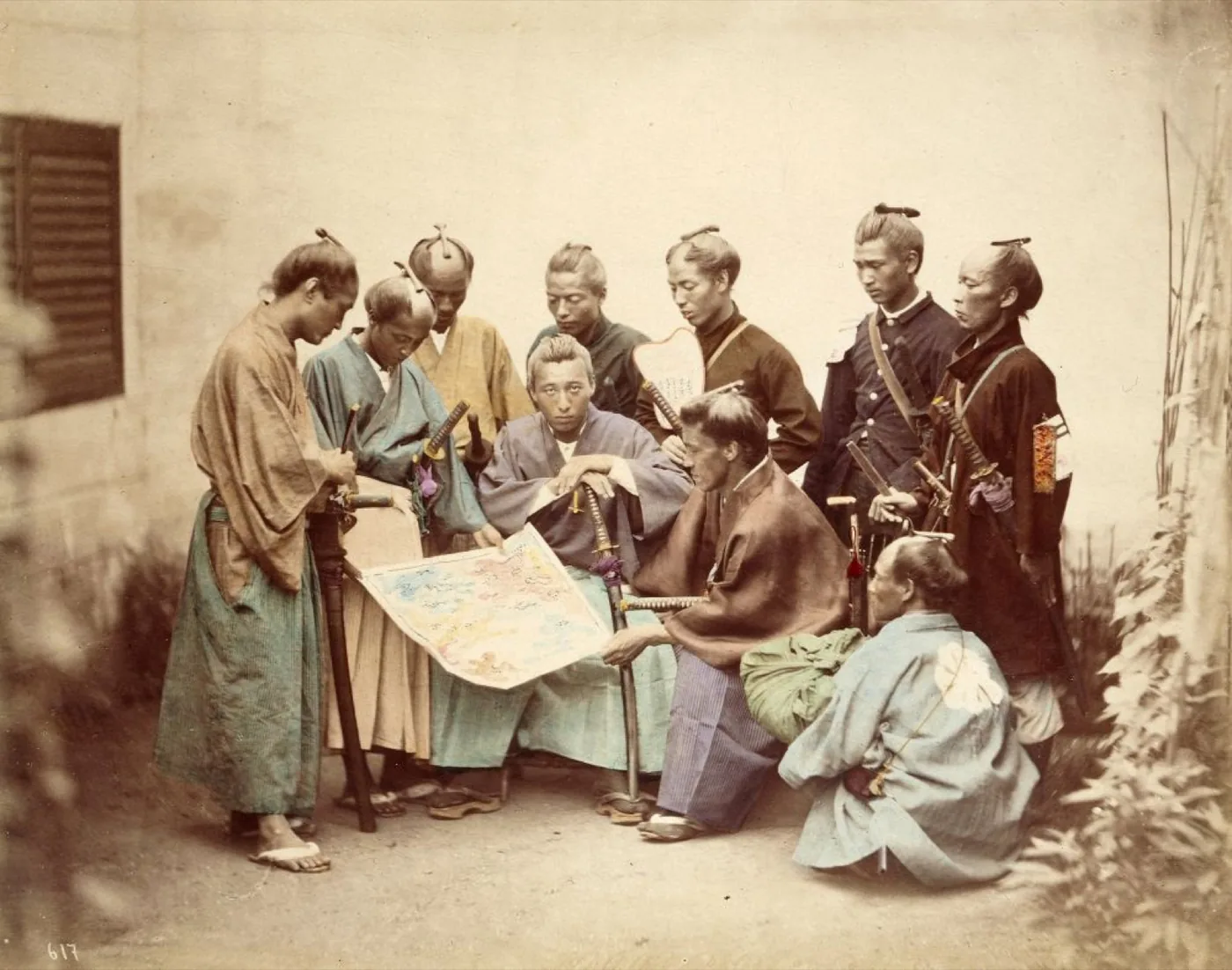
Bushido means "the way of the warrior." It is popularly understood as an ancient code of honor that governed Japan's samurai for centuries, demanding loyalty, courage, and a willingness to die rather than face disgrace. But medieval Japanese texts rarely use the word, and there was no shared code that bound the samurai class. The bushido that most people picture was assembled mostly during Japan's peaceful Edo period. It reached the English-speaking world in 1900, when a Japanese Quaker living in the United States published it as a coherent ethical system. In the twentieth century, Japan's military took this idea and turned it into a demand for death in battle.
How bushido was assembled
Medieval samurai prized loyalty to a lord and courage in battle, and they feared disgrace. But they followed no single standard, and lords switched sides often enough that the historical record is full of it.
The idea of a unified warrior ethic took shape during the Edo period (1603-1868), when the Tokugawa shogunate kept Japan at peace and samurai became administrators. Scholars who no longer fought romanticized the warrior past. The most famous text from this era is the Hagakure, dictated between 1710 and 1716 by Yamamoto Tsunetomo, a retired samurai of the Nabeshima clan. Tsunetomo had served his lord from the age of nine for thirty years. When the lord died in 1700, Tsunetomo wanted to follow him in death, as custom sometimes demanded, but the lord had forbidden the practice. Tsunetomo became a monk instead and dictated his reflections in a mountain hermitage. The Hagakure declares early on that a samurai must live as though already dead. But it was one man's philosophy, not a national standard, and for nearly two centuries it circulated only within the Nabeshima domain.
Bushido reached the wider world in 1900, when Nitobe Inazo, a Japanese educator and diplomat, brought out his English-language book "Bushido: The Soul of Japan." Nitobe had grown up in a samurai family, converted to Quakerism, and married an American Quaker named Mary Elkinton in Philadelphia. Writing from California, he presented bushido as a system of seven virtues and compared it to European chivalry. The book was a bestseller. Theodore Roosevelt read it and ordered copies for his friends. Nitobe later became Under Secretary General of the League of Nations, and his face appeared on Japan's 5,000-yen note from 1984 to 2004. But historians now treat much of what he described as a modern construction, an idealized portrait of something that had never existed as a unified code.
How Japan's military turned bushido into a weapon
In the late 1800s, as Japan modernized and began building an empire, the government reshaped bushido to serve the state. The old loyalty to a feudal lord became absolute loyalty to the emperor. The old horror of disgrace narrowed into a specific horror of surrender. Japan's conscript soldiers, drawn overwhelmingly from farming and working families with no samurai background, were told they were carrying on the samurai tradition.
In January 1941, War Minister Hideki Tojo issued the Senjinkun, a pocket-sized field-service code given to every soldier in the Imperial Japanese Army. It told soldiers that allowing themselves to be captured was an unforgivable disgrace. The results shaped the Pacific War: banzai charges against impossible odds, suicide attacks by pilots who crashed their aircraft into enemy warships, and cruelty toward Allied captives, whom Japanese soldiers looked down on for having let themselves be taken alive. The military held up a soldier's death in battle as the ultimate proof of loyalty to the emperor.
This wartime version of bushido was not something the samurai had passed down intact. Japan's leaders had chosen the pieces of history that served their goals, and the version they built disappeared with Japan's defeat in 1945.
What are the seven virtues of bushido?
The seven virtues come from Nitobe's 1900 book, not from any medieval source. They are gi (righteousness), yu (courage), jin (benevolence), rei (respect), makoto (honesty), meiyo (honor), and chu (loyalty). Nitobe chose them to make bushido legible to Western readers, and he framed them as the Japanese equivalents of Christian and chivalric virtues. The list caught on because it was clean and memorable. Today it appears on martial arts dojo walls and in self-help books around the world. No medieval samurai would have recited these seven words as a code. They are a modern summary of values that Nitobe believed Japanese warriors had practiced, assembled by a man who was himself a Quaker.
Bushido today
Postwar Japan stripped bushido of its wartime meaning. The state cult ended, but the word survived. Today bushido appears most often in martial arts, where disciplines like kendo and judo treat it as a philosophy of discipline and respect. It shows up in books about Japanese business culture and in films, games, and anime worldwide. The version of bushido that most people encounter now, focused on honor, loyalty, and self-improvement, has more in common with Nitobe's 1900 book than with any code that medieval samurai actually followed.