Emperor Hirohito
Hirohito was Emperor of Japan from 1926 to 1989, the longest-reigning Japanese emperor and the sovereign in whose name the Pacific War was fought.
Hirohito was Emperor of Japan from 1926 to 1989, a reign of 62 years, the longest of any Japanese emperor. In Japan he is known posthumously as Emperor Shōwa. Before 1945, he held the title of supreme commander of Japan's armed forces, and official doctrine held that he descended from the sun goddess Amaterasu. Japanese soldiers went to war in his name. After Japan's defeat in World War II, the United States kept him on the throne but stripped him of all political power. He spent the rest of his life as a constitutional figurehead who toured factories, met foreign leaders, and devoted his free time to marine biology. He built a laboratory on the grounds of the Imperial Palace in Tokyo and published scientific papers on hydrozoans, a group of small sea creatures, describing dozens of new species over the course of his career. He died on January 7, 1989, at the age of 87.
How Hirohito became emperor
Hirohito was born on April 29, 1901, the eldest son of Crown Prince Yoshihito, who later became Emperor Taishō. His early education was overseen by General Maresuke Nogi, a celebrated hero of the Russo-Japanese War. In 1921, Hirohito became the first Japanese crown prince to travel abroad, spending six months visiting Britain, France, Italy, and several other European countries. He later said the trip was the most memorable experience of his life. He particularly valued his time with King George V and the British royal family.
When he returned, he became regent because his father was suffering from a mental illness that left him unable to govern. Emperor Taishō died in December 1926, and Hirohito became the 124th emperor of Japan. The Meiji Constitution gave the emperor sovereign authority over Japan. Hirohito held the positions of head of state and supreme commander of the military, and state doctrine declared him divine. This gave him enormous formal authority, though how much he personally exercised it became one of the most debated questions in modern Japanese history.
Hirohito and Japan's surrender
Japan fought its wars across Asia and the Pacific in Hirohito's name, from the invasion of Manchuria in 1931 to the attack on Pearl Harbor in 1941. By August 1945, the country faced destruction. The United States had dropped atomic bombs on Hiroshima on August 6 and Nagasaki on August 9. The Soviet Union declared war on Japan and invaded Manchuria. Japan's cabinet met to decide whether to accept the Allies' surrender terms but could not agree. The military leadership refused to accept defeat.
Hirohito broke the deadlock. In a rare and constitutionally irregular step, later called his "sacred decision," he told the cabinet that Japan must surrender. On the night of August 14, he recorded his announcement in a room at the Imperial Palace. It was the first time a Japanese emperor's voice had been captured for the public to hear. That night, a group of army officers stormed the palace to find and destroy the recording, but it had already been hidden. At noon on August 15, the recording was broadcast across Japan. Hirohito, speaking in formal court Japanese that many listeners struggled to understand, told his subjects to "endure the unendurable" and stop fighting. Many who heard it cried.
Why Hirohito was not tried for war crimes
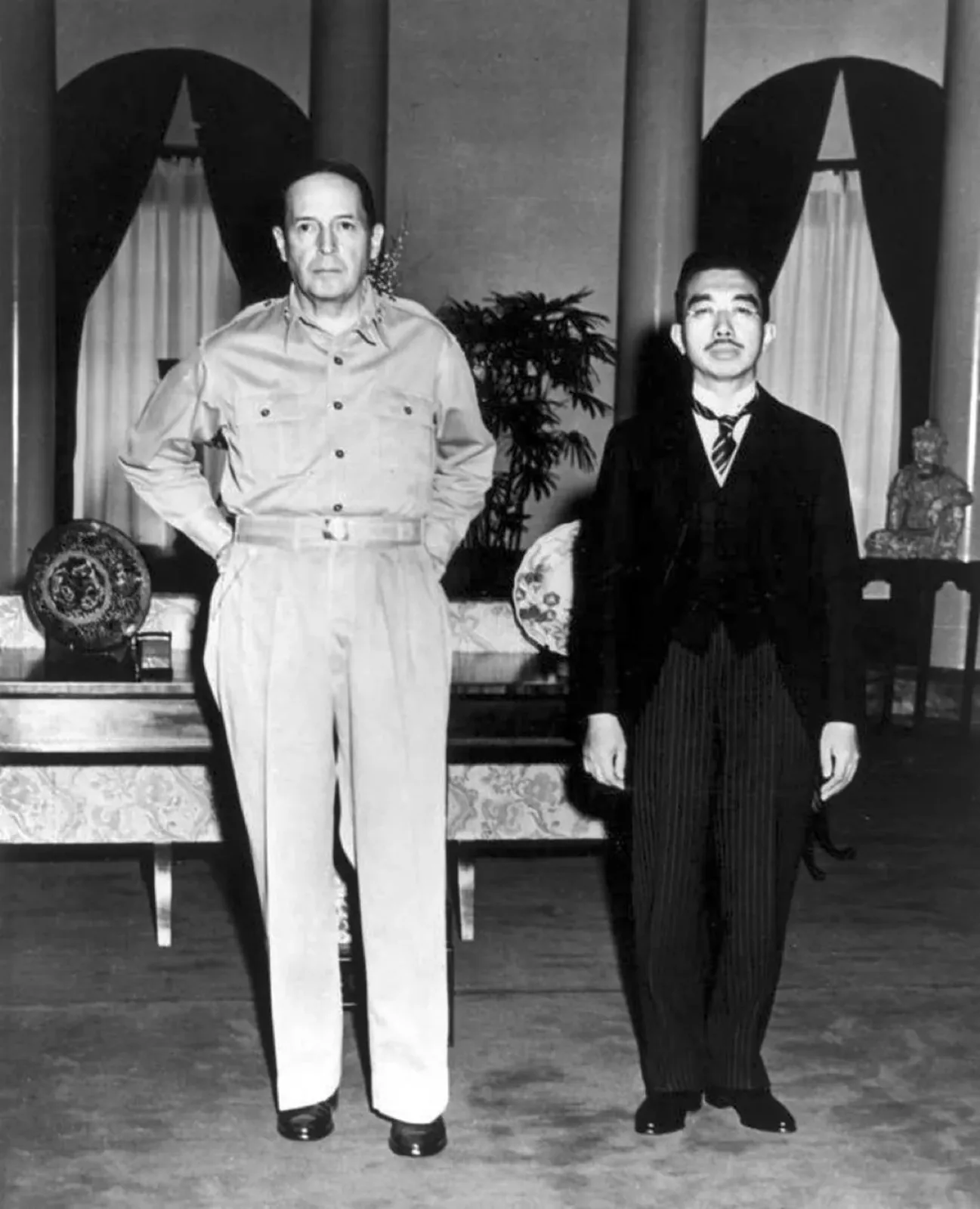
After the war, the United States occupied Japan and put its military leaders on trial. Japan's wartime prime minister, Hideki Tojo, was convicted and executed. But the United States did not charge Hirohito. General Douglas MacArthur, who commanded the occupation, concluded that putting the emperor on trial would risk mass unrest and require far more troops to keep order. A cooperative emperor on the throne made governing Japan far simpler.
MacArthur shielded Hirohito from prosecution. On January 1, 1946, Hirohito issued what became known as the Humanity Declaration, a statement published in newspapers across Japan in which he rejected the idea that the emperor was divine. The 1947 constitution went further, making the emperor a "symbol of the state" with no political power. Hirohito reigned for four more decades as a constitutional figurehead. He toured factories and coastlines, received foreign leaders, and worked in his marine biology laboratory on the palace grounds. When he died in 1989, millions of Japanese mourned him. Critics abroad questioned whether he had escaped accountability for the war.
Was Hirohito responsible for the war?
Historians have debated this for decades without settling it. The historian Herbert Bix, in his book Hirohito and the Making of Modern Japan, argues that Hirohito actively directed policy and supported the military's push toward war. In Bix's account, the emperor was not a passive figurehead but someone who bore real responsibility for the decisions Japan made.
The opposing view holds that Hirohito was a cautious constitutional sovereign, constrained by military leaders and by the long-standing convention that the emperor should not overrule his ministers. In this reading, the generals and admirals drove Japan's expansion, and Hirohito mostly approved decisions that had already been made.
The surviving record allows both interpretations. Hirohito's private papers have never been fully released, and American occupation authorities worked after the war to minimize his public role in wartime decisions. What he knew and what he chose remain open questions. What is clear is his role at the end: when the cabinet could not agree on surrender, Hirohito made the decision himself.