
Hideki Tojo
Hideki Tojo was Japan's prime minister during most of the Pacific War and was executed as a war criminal in 1948.
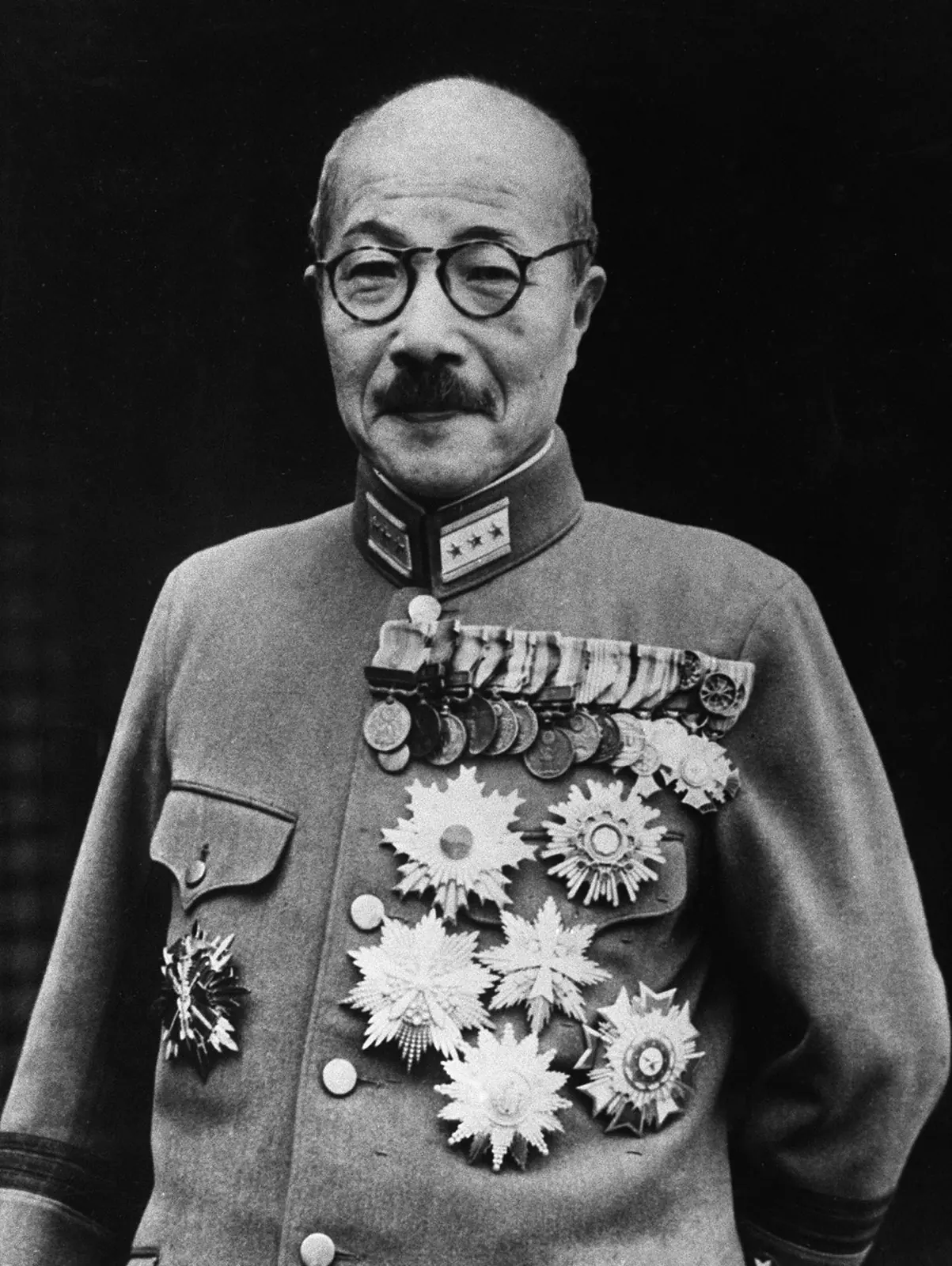
Hideki Tojo was a Japanese general who served as prime minister of Japan from October 1941 to July 1944. He led Japan when it attacked Pearl Harbor in December 1941, and for Americans and their allies he became the most recognizable figure of the Japanese enemy during World War II. He was nicknamed "the Razor" for his precise, by-the-book style of work. After Japan's surrender in 1945, Tojo was tried as a war criminal by an international tribunal in Tokyo and hanged on December 23, 1948.
How Tojo rose to power
Tojo was born on December 30, 1884, in Tokyo. His father, Hidenori Tojo, was an army officer who reached the rank of lieutenant general. Tojo graduated from the Japanese Army Academy in 1905 and from the Army War College in 1915. He was known as disciplined, tireless, and exacting, more a bureaucrat and organizer than a field commander.
In the late 1930s Tojo was chief of staff of the Kwantung Army, the Japanese force based in Manchuria and at the center of Japan's expansion into China. He rose to vice minister of war and then, in July 1940, to minister of war. As war minister he argued that Japan should secure oil and raw materials in Southeast Asia even at the risk of war with the United States and Britain.
On October 17, 1941, Emperor Hirohito asked Tojo to form a government. Tojo kept the war ministry for himself and at various points held other cabinet posts as well, including home affairs, foreign affairs, and munitions. Weeks after taking office, with his backing, Japan attacked Pearl Harbor on December 7, 1941.
Tojo and the Pacific War
In the first months after Pearl Harbor, Japanese forces conquered the Philippines, Malaya, Singapore, the Dutch East Indies, and Burma in rapid succession. Tojo presided over these conquests and became the most visible figure of Japan's war effort, both inside the country and to its enemies.
His authority depended on Japan winning. By mid-1943 Japan was losing, and American forces were advancing island by island across the Pacific. In July 1944, Saipan fell to the Americans. The island was close enough for American B-29 bombers to reach the Japanese home islands. Its loss showed that Japan could no longer hold its defensive perimeter. Senior military and political figures blamed Tojo, and he was forced to resign on July 18, 1944.
Japan fought on for another year and surrendered on August 15, 1945. By then Tojo had been out of power for more than a year.
Was Hideki Tojo a dictator?
Allied wartime propaganda often called Tojo a dictator and compared him to Adolf Hitler. The comparison was misleading. Tojo held real power, but his authority was limited in ways that Hitler's and Mussolini's were not.
Japan's wartime government required cabinet consensus for major decisions. Rival factions within the army and navy checked Tojo's influence, and the emperor held a higher position in the system than any prime minister. Tojo could not make war or peace on his own. He rose because he represented the views of the military establishment, and when that establishment decided he had failed, he was removed. Hitler held on until Berlin fell. Tojo was forced out more than a year before Japan surrendered.
Tojo was a powerful wartime prime minister, not a totalitarian ruler. His power came from the military institution he served, and it lasted only as long as that institution wanted him.
What happened to Hideki Tojo after the war?
On September 11, 1945, American soldiers arrived at Tojo's house in Tokyo to arrest him. Tojo locked himself in his study and shot himself in the chest with a pistol. He had asked a doctor beforehand to mark a spot over his heart with charcoal so he could aim accurately, but the bullet missed. American military doctors treated him and saved his life.
Tojo was charged as a Class A war criminal and stood trial in Tokyo before an international tribunal, the Far Eastern counterpart to the Nuremberg trials in Germany. The trial ran from May 1946 to November 1948. Tojo accepted broad responsibility for Japan's decision to go to war. He insisted that he had committed no crime under international law as he understood it. At one point during his testimony he made statements that seemed to implicate Emperor Hirohito in the decision for war, then walked them back.
The tribunal sentenced Tojo to death along with six other defendants. On December 23, 1948, all seven were hanged at Sugamo Prison in Tokyo.
After the war, both Japan and its former enemies found it useful to concentrate blame on Tojo and the other convicted war criminals. Japan could move on by treating the war as the work of a few individuals rather than a national project. The United States could justify keeping Emperor Hirohito on the throne by directing guilt elsewhere. Tojo bore real responsibility for Japan's war. But the decision to fight was made by a system of military, political, and imperial institutions that was larger than any one person in it.