
Charlemagne
Charlemagne was the Frankish king who united most of Western Europe and was crowned Emperor of the Romans on Christmas Day in 800.
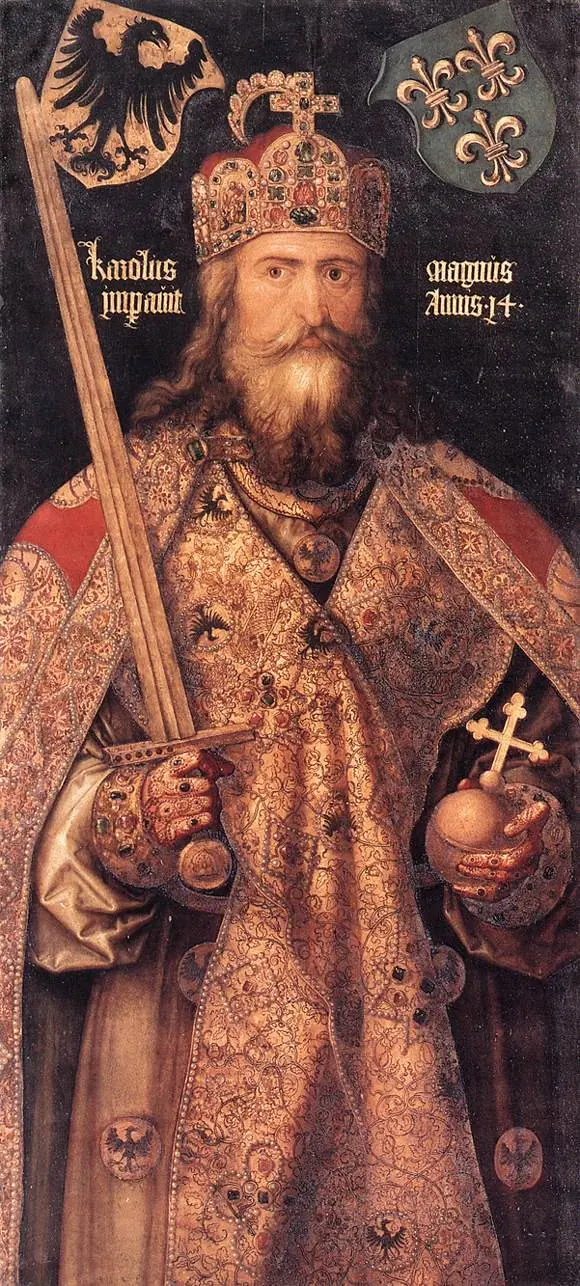
Charlemagne, also known as Charles the Great, was the king of the Franks who conquered much of western and central Europe and was crowned Emperor of the Romans by Pope Leo III on Christmas Day in the year 800. His empire stretched from the Pyrenees to the Elbe River. It was the largest territory in Europe under one ruler since the fall of Rome. He could barely write his own name, but he funded a revival of learning that saved much of ancient Latin literature from being lost. Both France and Germany claim Charlemagne as a founding figure. The city of Aachen awards a prize in his name most years to leaders who work toward European unity.
How Charlemagne conquered Western Europe
In 768, Charlemagne inherited the Frankish throne, sharing it at first with his brother Carloman. When Carloman died in 771, Charlemagne took sole control and spent the next four decades in almost continuous war. He defeated the Lombards in northern Italy in 774, absorbed Bavaria, and pushed his borders east. His longest campaign was against the Saxons, a pagan people in what is now northern Germany. Charlemagne fought them for about thirty years to conquer and forcibly convert them to Christianity. In 782, after a Saxon rebellion, he ordered the beheading of about 4,500 Saxon prisoners in a single day at Verden.
A 2010 study of his skeleton found he stood about six feet tall (1.84 meters), in the tallest one percent of men in medieval Europe. He had at least eighteen children by several wives and concubines. According to his biographer Einhard, Charlemagne refused to let any of his daughters marry during his lifetime.
By the late 790s, Charlemagne controlled more of Europe than anyone had since the Roman emperors. Pope Leo III, who needed a military protector, crowned Charlemagne Emperor of the Romans at the old Saint Peter's Basilica in Rome on December 25, 800. The coronation joined three traditions: Germanic warrior kingship, Roman imperial authority, and the sponsorship of the Latin Church. That fusion produced the claim that western Europe should form one Christian state, and it gave rise to the Holy Roman Empire, which survived across central Europe until Napoleon dissolved it in 1806.
Charlemagne and the revival of learning
Charlemagne struggled with writing all his life. His biographer Einhard wrote that Charlemagne kept tablets and notebooks under his pillow so he could practice forming letters in his spare time. He had started too late and never made much progress. That did not stop him from building a network of schools across his empire.
From his capital at Aachen, Charlemagne launched what historians call the Carolingian Renaissance. He brought scholars from across Europe to his court, including the Englishman Alcuin of York. He ordered monasteries to set up schools. He had monks track down deteriorating manuscripts of ancient Latin texts and recopy them. Much of what survives of classical Latin literature exists only because Carolingian scribes made these copies.
The revival also changed how people write. Charlemagne's scribes developed a new script called Carolingian minuscule, a clean, rounded handwriting with spaces between words and distinct lowercase letters. It was much more legible than the dense scripts used before it. Centuries later, Renaissance scholars found these manuscripts and mistakenly believed the handwriting was authentic ancient Roman writing. They revived it, and early printers adopted it for their typefaces. The lowercase letters on every screen and printed page today trace back to Charlemagne's scriptoria.
What happened after Charlemagne died?
Charlemagne died at Aachen on January 28, 814. His son Louis the Pious inherited the empire, but after Louis died in 840 his three sons went to war with each other. In 843, the Treaty of Verdun divided the empire into three parts. Charles the Bald received the western portion, which became France. Louis the German received the eastern portion, which became Germany. Their brother Lothair received a narrow corridor stretching from the Low Countries through Burgundy to northern Italy.
That middle strip was too thin to defend and too valuable to ignore. France and Germany fought over parts of it for the next eleven centuries. The borders of modern Belgium, the Netherlands, Luxembourg, Alsace, and Lorraine sit largely inside what was once Lothair's kingdom.
Why is Charlemagne called the Father of Europe?
Charlemagne is called the Father of Europe because his empire was the first time since Rome that most of Western Europe was governed as one state. The idea that Europe should be a unified Christian community survived long after his empire broke apart.
Both France and Germany claim Charlemagne. The French call him Charlemagne and count him among the founders of their nation. The Germans call him Karl der Grosse and do the same. Neither country existed in his lifetime. The Franks were a Germanic-speaking people who ruled territory that would become both countries. Napoleon staged his 1804 coronation as a deliberate echo of Charlemagne's. He even commissioned a crown he called the "Crown of Charlemagne." Since 1950, the city of Aachen has given the Charlemagne Prize to leaders who champion European unity. Recipients have included Winston Churchill and, in 2026, the former Italian prime minister Mario Draghi.
Charlemagne's empire lasted one generation after his death. The idea that Europe should be united, which his reign did more than any other to create, has lasted twelve centuries.