
Conquistadors
The conquistadors were Spanish adventurers who conquered the Aztec and Inca empires in the early 1500s, funded by debt and licensed by the crown.
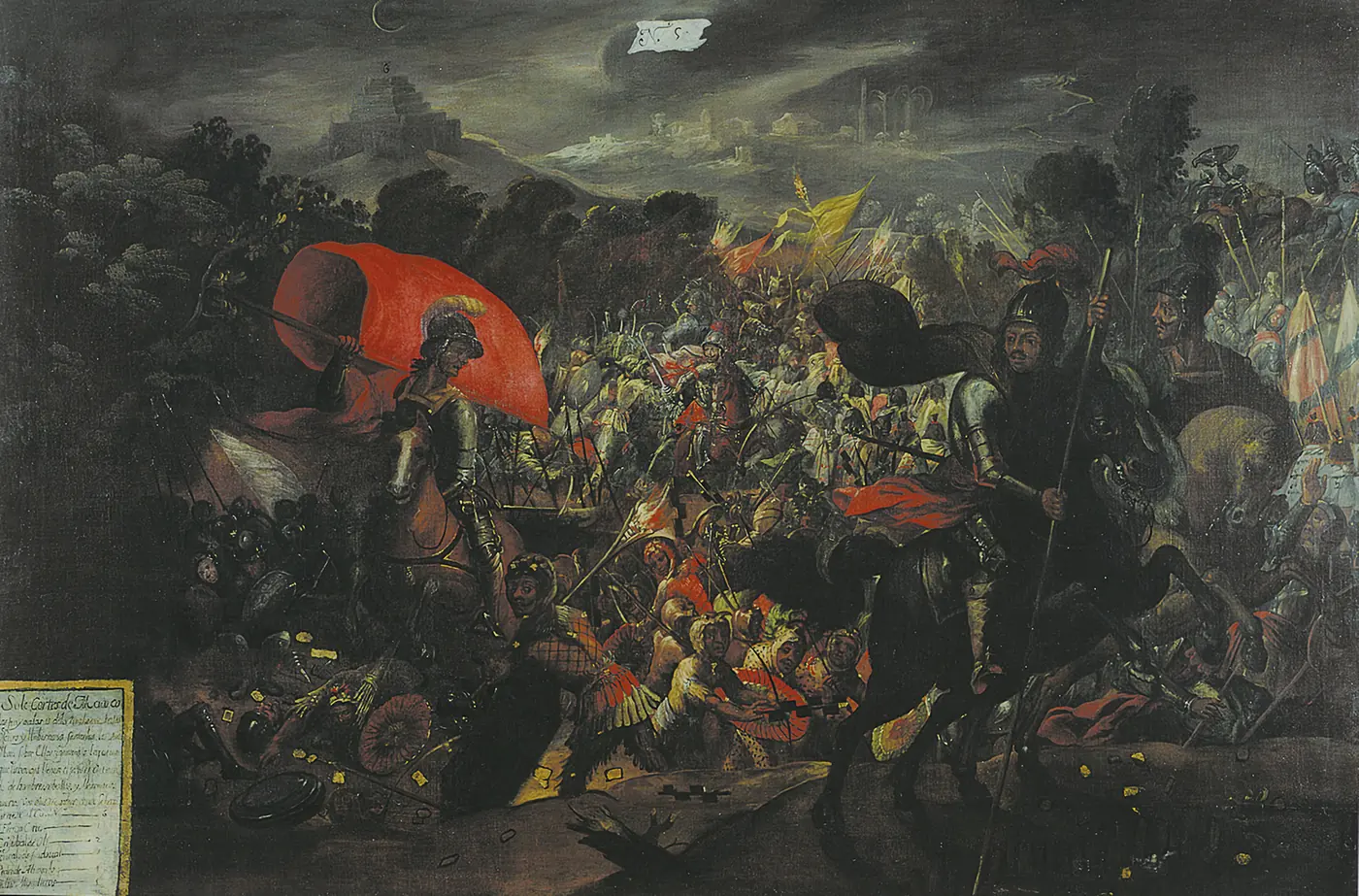
The conquistadors were Spanish soldiers and adventurers who conquered large parts of the Americas in the early 1500s. They were not a royal army. They were private operators who borrowed money, recruited their own men, and sailed at their own risk under a royal license called a capitulacion. Every man who joined agreed to work for a portion of whatever was taken, and the crown took a cut called the quinto real, the royal fifth, off the top. Because everyone involved had borrowed against future spoils, they took large risks rather than negotiate or wait. The two most famous conquistadors, Hernan Cortes and Francisco Pizarro, destroyed the two largest empires in the Americas within thirteen years of each other.
How Cortes and Pizarro toppled two empires
Hernan Cortes was the son of a minor noble family in Medellin, Spain. He studied in Salamanca, went home after two years, and sailed for the Caribbean at nineteen. In 1519, he landed on the Mexican coast with about 500 soldiers and 16 horses. Spain's claim to the territory rested on the Treaty of Tordesillas, but Cortes himself had little real authorization from the governor of Cuba, who tried to recall him. To prevent his men from turning back, Cortes had his own ships scuttled and sunk.
He then marched inland toward Tenochtitlan, the capital of the Aztec empire and the largest city in the Americas. Cortes was not fighting alone. Tens of thousands of Tlaxcalan warriors, along with subject peoples who resented Aztec rule, joined him. From their perspective, the war was a rebellion against the Aztec empire that used the Spanish as useful allies. Smallpox swept through the city in 1520 and killed thousands of its defenders. After a long siege, Tenochtitlan fell in August 1521.
Francisco Pizarro came from humbler beginnings. He was the illegitimate son of an infantry officer, never learned to read or write, and spent part of his youth herding pigs. In 1532, he entered the Inca highlands with about 168 men. At the town of Cajamarca, he ambushed the Inca emperor Atahualpa and seized him in a single afternoon. Atahualpa offered to fill a large room with gold and two more with silver to buy his freedom. Pizarro took the ransom, roughly 6,000 kilograms of gold and 12,000 kilograms of silver, and then had Atahualpa executed.
Why were the conquistadors successful?
Steel weapons, horses, and gunpowder gave the Spanish an advantage in open battle, especially cavalry charges against infantry. But these were not enough on their own against tens of thousands of experienced Aztec and Inca warriors. Three other factors mattered more.
The first was disease. Smallpox, part of the Columbian Exchange, devastated populations with no immunity to it. In 1520, the disease killed the Aztec emperor Cuitlahuac and tens of thousands of defenders in Tenochtitlan. In the Andes, smallpox arrived before the Spanish did. It killed the Inca ruler Huayna Capac around 1525, along with his chosen heir, and triggered a civil war between his sons Atahualpa and Huascar. Pizarro arrived just after that war ended, entering an empire that had already torn itself apart.
The second was indigenous alliances. The Tlaxcalans and other peoples who fought alongside Cortes provided the numbers that made the conquest possible. A few hundred Spaniards could not have taken a city of more than 200,000 people on their own.
The third was the capture of the ruler. Both the Aztec and Inca empires concentrated authority in a single sacred figure. When Cortes held the Aztec ruler Moctezuma as a hostage, and when Pizarro seized the Inca emperor Atahualpa, each empire lost the person around whom all political authority was organized. A European kingdom with an established nobility could keep functioning after its king died. The Aztec and Inca states could not.
How Spain ruled the conquered peoples
Starting in 1513, Spanish law required conquistadors to read aloud a document called the Requerimiento before attacking. Written in Spanish, it declared its listeners subjects of the Spanish crown and warned that any resistance would be treated as grounds for a just war. In practice, conquistadors often read it to empty beaches, from aboard ships, or in the middle of the night, where nobody could hear or understand it.
Conquered populations were distributed to Spanish colonists under a system called the encomienda. The system granted a colonist the labor of an indigenous community in return for an obligation to convert its members to Christianity. In practice, the encomienda was forced labor.
Bartolome de las Casas, a Dominican friar, spent years recording how conquistadors and colonists killed and mistreated indigenous peoples. His work helped produce the New Laws of 1542, which tried to restrict the encomienda. In 1550, at a debate in Valladolid, las Casas argued that indigenous peoples possessed reason and deserved the same protections as any other people. The debate produced no formal ruling, but his arguments helped keep the New Laws in place. The laws limited some of the worst abuses on paper, but enforcement was uneven, and exploitation continued for generations.
Conquistador silver and the global economy
In 1545, an indigenous miner struck silver at Potosi in present-day Bolivia. A year later, Spaniards found more at Zacatecas in Mexico. At its peak, Potosi alone produced roughly 60 percent of the world's silver. The metal did not remain in Spain. It moved through European markets and on to China, where demand for silver was enormous. This flow financed Spanish wars, caused inflation across Europe, and helped create the first truly worldwide commercial network.
The basic arrangement, a crown granting private adventurers the right to conquer in exchange for a cut of the profits, became a model for later colonial ventures. England's East India Company adopted the same structure a century later, as did the Dutch East India Company, both with tighter administration. The conquests of the early 1500s permanently reshaped the Americas and set the pattern for European colonization worldwide over the next three centuries.