
Treaty of Tordesillas
The Treaty of Tordesillas was a 1494 agreement in which Spain and Portugal divided the world outside Europe between them.
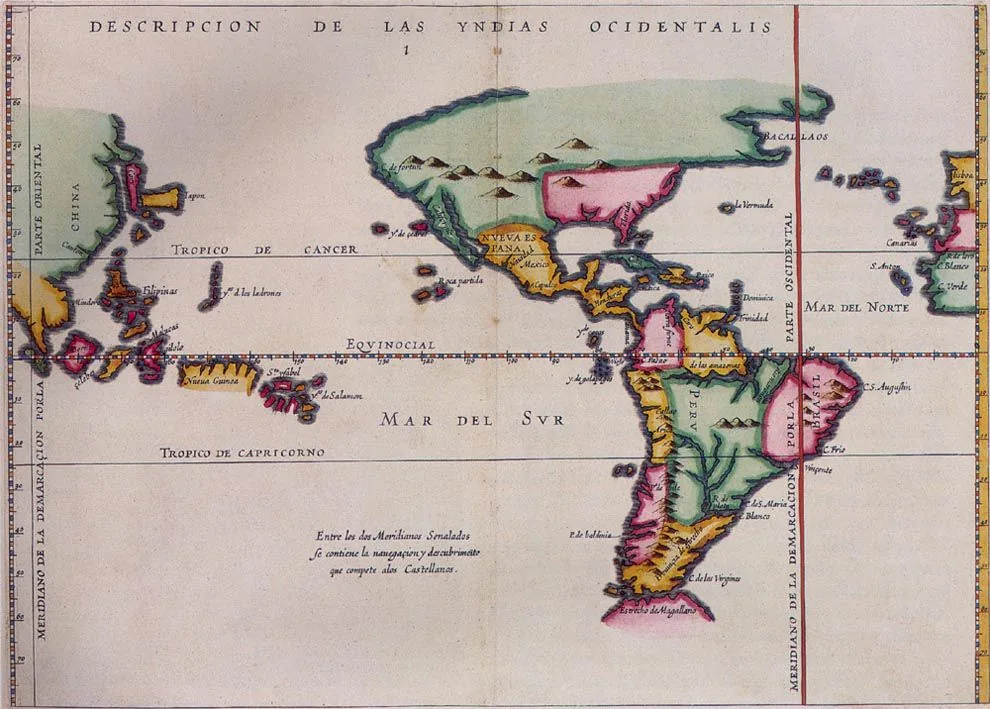
The Treaty of Tordesillas was an agreement signed on June 7, 1494, between Portugal and Castile (which soon became Spain) that divided the world outside Europe between them. The two kingdoms drew a north-south line through the Atlantic Ocean, 370 leagues west of the Cape Verde Islands, at roughly 46 degrees west longitude. Everything east of the line belonged to Portugal. Everything west belonged to Castile. The pope approved the arrangement. Neither kingdom had explored most of the lands it was claiming, and the peoples who lived in those lands were never consulted. The treaty's most lasting consequence was unintended. The line fell west of South America's eastern bulge, placing the eastern part of what is now Brazil in Portugal's half. That is why more than 200 million Brazilians speak Portuguese today, while Spanish became the language of most other countries on the continent.
How Columbus's voyage led to the Treaty of Tordesillas
Christopher Columbus returned to Spain in March 1493 after his first voyage across the Atlantic. He believed he had reached Asia. Ferdinand and Isabella, the rulers of Castile and Aragon, wanted the Church to confirm their claim to whatever Columbus had found. They asked Pope Alexander VI, and he obliged. In May 1493, Alexander issued the papal bull Inter caetera, which drew a line 100 leagues west of the Cape Verde Islands and granted Castile everything west of it.
Alexander VI, born Rodrigo Borgia in Valencia, was not a neutral party. Portugal's King João II objected. Portugal was the leading seafaring power in Europe, with decades of exploration along the African coast. João II was not willing to accept a line drawn by a Spanish-born pope that excluded Portugal from the western Atlantic.
João II proposed direct negotiations. Talks began in the Castilian city of Medina del Campo in March 1494, then moved to the nearby town of Tordesillas in May. On June 7, 1494, envoys from both kingdoms signed the treaty. The line moved to 370 leagues west of Cape Verde, far enough west to satisfy Portugal. Spain ratified the treaty in July, and Portugal ratified it in September.
Why does Brazil speak Portuguese?
The 370-league line fell at roughly 46 degrees west longitude. No European had mapped the coast of South America at that point, so neither side knew that the continent's eastern bulge crossed the line. When the Portuguese navigator Pedro Alvares Cabral made landfall on the Brazilian coast on April 22, 1500, the land he found sat on Portugal's side of the Tordesillas line.
Brazil became a Portuguese colony while most of the rest of South America, from Venezuela to Argentina, came under Spanish rule. That division still shapes the continent. More than 200 million Brazilians speak Portuguese today. Most of their South American neighbors speak Spanish.
Some historians believe João II already suspected there was land to the southwest when he pushed the line further west. There is no proof, but the result was convenient for Portugal.
How the Treaty of Tordesillas reached the Pacific
A line drawn through the Atlantic only works until you reach the other side of the globe. After Vasco da Gama rounded Africa and reached India in 1498, Portugal built trading posts from Mozambique to Malacca. Spain sent conquistadors west across the Americas and eventually reached the Pacific. Both kingdoms arrived at the Spice Islands (the Moluccas, in present-day Indonesia) from opposite directions. The Tordesillas treaty did not say who owned them.
In 1529, Spain and Portugal signed the Treaty of Zaragoza, which set a second dividing meridian in the Pacific. Spain gave up its claim to the Moluccas in exchange for 350,000 gold ducats from Portugal. The same agreement technically placed the Philippines on Portugal's side of the Pacific line, but Spain colonized the Philippines anyway and held them for more than three centuries.
When did the Treaty of Tordesillas end?
Only Spain and Portugal recognized the Treaty of Tordesillas. The rest of Europe never accepted it. Francis I of France reportedly asked to see "the clause in Adam's will" that gave Spain and Portugal the right to divide the world between themselves. England and the Netherlands ignored the treaty entirely. By the 1600s, English, Dutch, and French traders, privateers, and settlers were operating on both sides of the Tordesillas line.
The Reformation weakened the treaty further. Once much of northern Europe no longer recognized the pope's authority, the claim that a pope had the power to grant continents lost its force. Spain and Portugal did not formally abandon the Tordesillas line until the 1750 Treaty of Madrid. Long before that, it had stopped mattering as other powers built their own colonial empires.
The Treaty of Tordesillas was one of the first times European powers drew lines across lands they had never seen and divided them between themselves. The pattern repeated for centuries, from chartered monopolies like the East India Company to the 1884 Berlin Conference, at which European governments set the rules for dividing Africa among themselves around a table. In every case, the people who actually lived in the divided territories had no part in the agreement.