
Cossacks
The Cossacks were communities of armed riders who governed themselves on the steppe borderland between Russia, Poland, and the Tatar khanates.
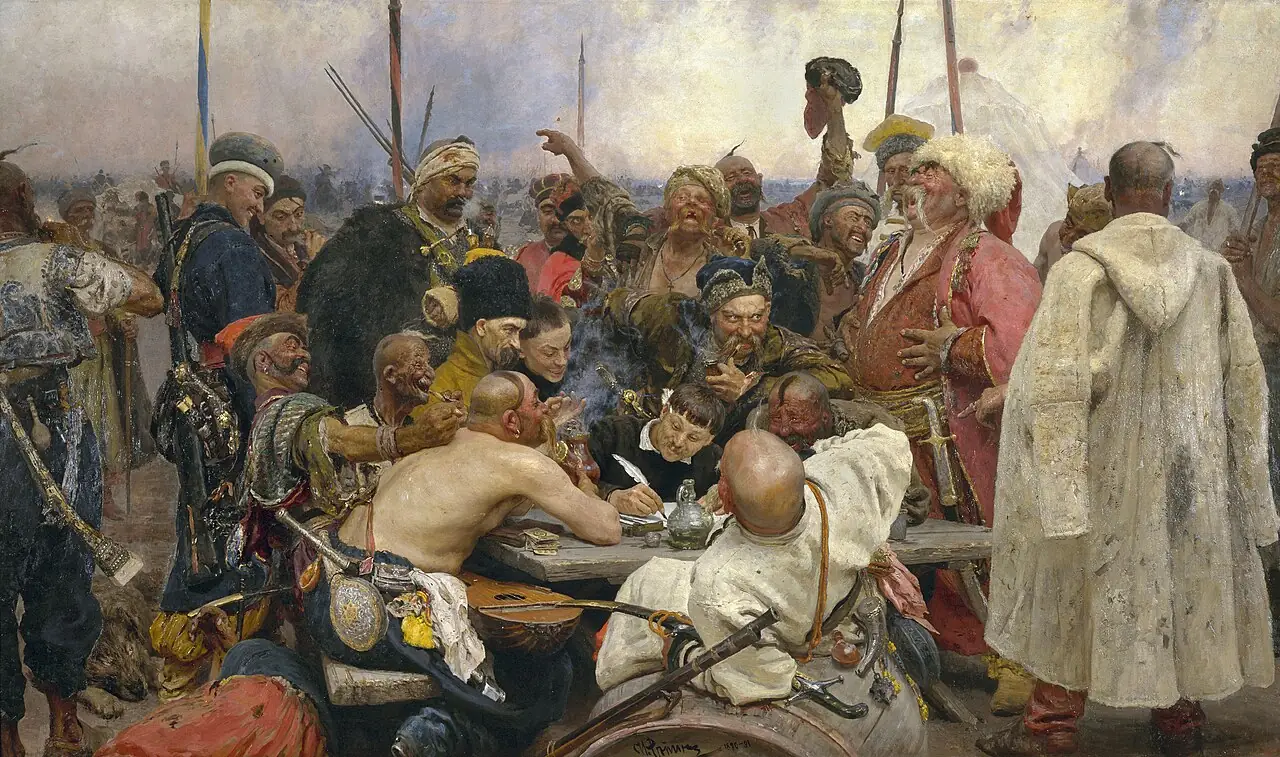
The Cossacks were communities of armed riders who governed themselves on the steppe, in the borderland where Russia, Poland-Lithuania, and the Crimean Tatar khanates met. Beginning in the 1400s, escaped serfs, prisoners, religious outcasts, and wanderers moved south into the valleys of the Don and the Dnipro, a region no state could fully control. They attacked Ottoman and Tatar settlements, launched raids across the Black Sea in flat-bottomed boats, and sold their services as frontier cavalry to the Polish and Muscovite crowns. The name "Cossack" derives from a Turkic word for "free man" or "adventurer." Their central rule was that anyone who arrived at a Cossack settlement was considered free, and no one would hand them back. That principle made the Cossacks useful to the states around them as soldiers, but dangerous to every landowner whose serfs fled south.
How the Cossack communities formed
Two Cossack centers became the most important. The Don Host occupied the lower Don valley, in the region that is today southern Russia. The Zaporozhian Sich grew up below the Dnipro rapids, in today's south-central Ukraine. The Sich was a fortified camp of men only. Its members elected their leader, known as the hetman, and voted on decisions in a general council. In practice, it was a military republic. Cossack war parties struck south into Ottoman and Tatar lands for captives and loot, and the kings of Poland and the tsars of Muscovy paid them to patrol the frontier. But each escaped serf who found safety with the Cossacks meant one fewer laborer for a landlord. Neighboring states needed Cossack soldiers, but they also needed their serfs to stay put. That contradiction ran through every arrangement the Cossacks made with the powers on their borders.
Bohdan Khmelnytsky and the turn toward Russia
In 1648, Bohdan Khmelnytsky, an officer of the Zaporozhian Cossacks, started a war against Polish rule in Ukraine that drew in tens of thousands of Cossack fighters and peasants. His grievance began as a personal one. A Polish nobleman named Daniel Czapliński had seized his land and beaten his son. Khmelnytsky escaped to the Sich, gathered the Cossacks, formed an alliance with the Crimean Tatars, and beat the Polish army in battle after battle.
The revolt created a Cossack-ruled state, but that state could not defend itself without a powerful ally. In 1654, at the town of Pereiaslav, Khmelnytsky pledged allegiance to Tsar Alexei of Muscovy in return for military protection. The meaning of that pledge is still disputed. Khmelnytsky saw it as a temporary military alliance. Moscow saw it as surrender. When Khmelnytsky asked the tsar's envoy to swear a reciprocal oath, the envoy refused, saying the tsar did not take oaths to his subjects. In the years that followed, Poland and Muscovy divided Ukraine between them, and the Cossack state gradually lost its autonomy.
How Russia absorbed the Cossacks
Russia took the Cossacks apart slowly. It confirmed their privileges, paid them, stationed them on the frontier, and then stripped away their rights piece by piece. When Cossacks fought back, the punishment was severe. In 1670 and 1671, Stenka Razin, a Don Cossack, led a revolt that swept the Volga region. A century later, from 1773 to 1775, Yemelyan Pugachev rallied Cossacks and serfs by pretending to be the dead tsar Peter III and pledging to end serfdom. Both uprisings were enormous, among the biggest Russia had ever seen, and both ended with the leaders executed and thousands punished.
In 1775, Catherine the Great sent troops to destroy the Zaporozhian Sich. The Sich had harbored Pugachev's followers and still accepted escaped serfs. After the Sich fell, a deal took shape across the Russian empire. The remaining Cossack hosts kept their lands, paid no taxes, and ran their own local affairs. In return, every Cossack man owed the tsar years of military duty and had to report with his own horse, uniform, and weapons. By 1900, eleven hosts were spread across the empire, from southern Russia to the Pacific coast. Cossack horsemen guarded the borders, scouted for the army, and put down protests at home. The lasting image of a Cossack on horseback, whip in hand, breaking up a crowd, comes from the 1905 revolution.
Do Cossacks still exist?
When the Russian Civil War began, the majority of Cossack hosts joined the White forces against the Bolsheviks. In January 1919, the Bolshevik Central Committee issued a secret directive calling for mass terror against Cossacks who had opposed Soviet power. The campaign that followed, known as decossackization, brought executions, forced removals, and the destruction of every Cossack host as an institution. Historians estimate that between 300,000 and 500,000 Cossacks were killed or deported in 1919 and 1920. Soviet collectivization and the famine that swept Ukraine and southern Russia in the early 1930s hit Cossack regions hard. In the Second World War, a number of Cossacks joined the German side. At the war's end, British forces at Lienz, Austria, turned over thousands of these Cossacks to the Soviet Union. Most were sent to labor camps or executed.
After 1991, Cossack organizations reappeared in both Russia and Ukraine. Some were folklore groups. Others registered as paramilitary units. Starting in 2014, Cossack fighters joined the Russian-backed separatists in eastern Ukraine. After Russia invaded Ukraine on a larger scale in 2022, organized Cossack battalions fought alongside the Russian army. Ukraine reads the same history differently. Its national anthem calls Ukrainians "brothers of Cossack kin." For Ukrainians, the Zaporozhian Sich is an early example of their own tradition of self-rule and armed independence. For more on why both countries claim the Cossack legacy, see Why Russia and Ukraine Both Claim the Cossacks.