
Russian Serfdom
Serfdom was Russia's system of bonded labor that tied 23 million peasants to the land as property until Alexander II freed them in 1861.
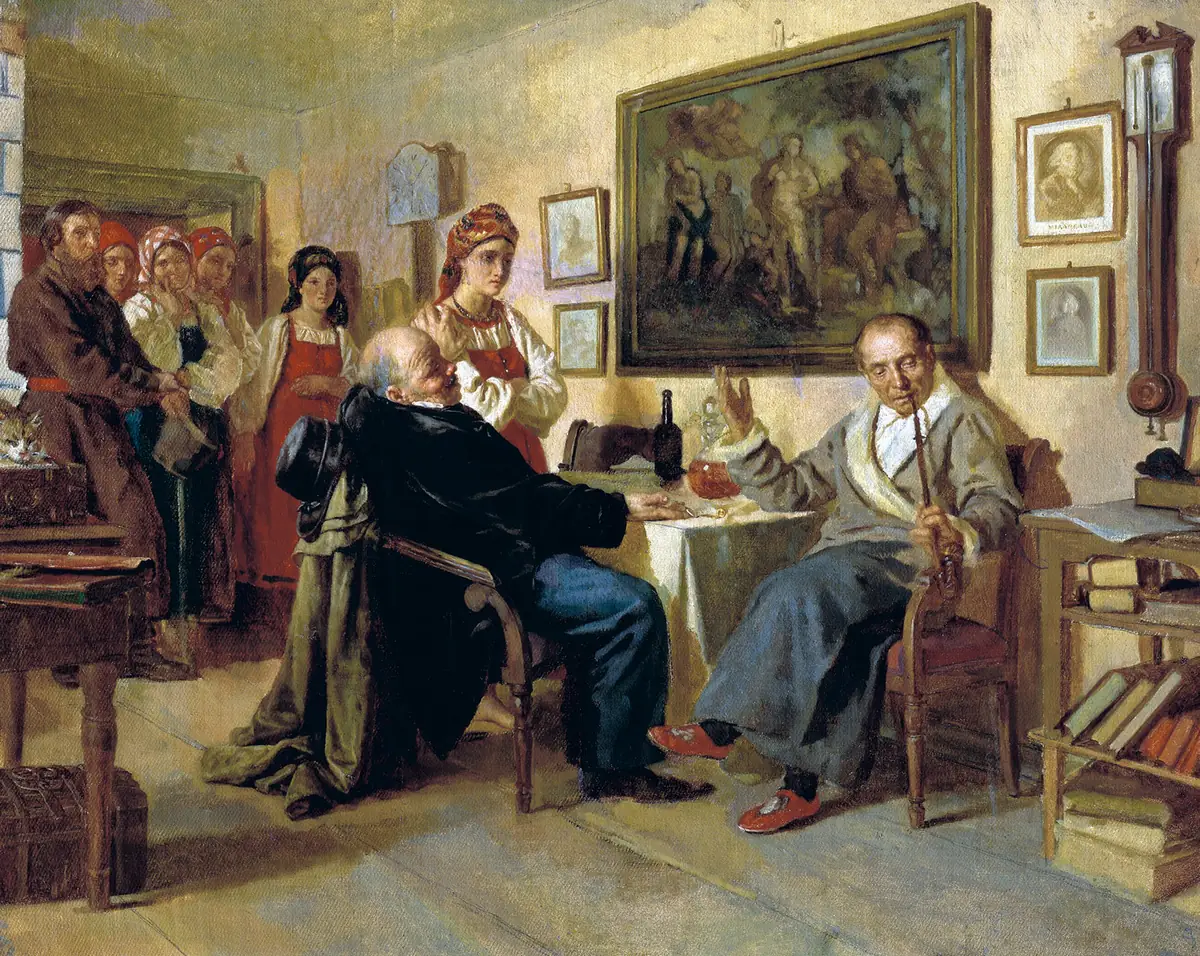
Serfdom was a system of bonded labor in the Russian Empire that tied peasants to the land they worked on and to the nobleman who owned it. In 1858, about 23 million people, roughly a third of Russia's population, were privately owned serfs. Some noble families owned tens of thousands of serfs across several estates. A landowner could sell serfs, flog them, marry them off, or exile them to Siberia. Landowners sometimes gambled serfs away in card games and advertised them for sale in newspapers alongside horses and hounds. The system lasted more than two centuries in its harshest legal form, from a law code in 1649 to the emancipation decree of 1861. Russia was tightening serfdom at the same time Western Europe was letting it die out.
How serfdom became law in Russia
Russian peasants lost their freedom gradually. In the fifteenth century, a peasant could leave a landowner's estate once a year, during a two-week window around St. George's Day in late November. Over the next two centuries, the tsars restricted that right until it disappeared.
The decisive step came in 1649, after riots broke out in Moscow the year before. Tsar Alexis issued a sweeping legal code called the Sobornoye Ulozhenie. The code permanently bound peasants and their descendants to the estate where they were registered and eliminated the existing deadline for recovering runaways. In 1658, flight from the land became a crime.
Over the next century and a half, the system tightened further. Peter the Great gave entire villages to favored nobles. Catherine the Great, who ruled from 1762 to 1796, expanded serfdom into Ukraine and the Cossack lands and gave nobles the right to sentence their serfs to hard labor. By the time she died, roughly 18 million Russians were serfs. In theory, serfs belonged to the land, not to the landowner. By the eighteenth century, that distinction had disappeared. Nobles bought and sold individual serfs, and Russian law no longer distinguished between serfs and slaves.
The arrangement served the tsars well. Serfs gave them a captive tax base, soldiers for the army, and a nobility that owed everything to the crown. What the system did not produce was a modern economy. Russian farms still relied on wooden plows while Britain was building factories and railways.
When was serfdom abolished in Russia?
Tsar Alexander II abolished serfdom on February 19, 1861, when he signed the Emancipation Manifesto. More than 23 million serfs gained their personal freedom, including the right to marry without their landlord's permission, to own property, and to start a business. It was the largest act of emancipation in the nineteenth century, two years before Abraham Lincoln signed the Emancipation Proclamation.
The trigger was military defeat. Russia fought Britain and France in the Crimean War from 1853 to 1856, on its own soil, and lost. Its weapons were outdated. Supplies took months to reach the front because Russia had almost no railways to move them. Russia's educated class had debated abolition for decades. The war turned the debate into an emergency.
Alexander took the throne in 1855 at age 36. He had been tutored as a boy by the poet Vasily Zhukovsky, a liberal romantic. Alexander kept some of his teacher's idealism, but he was cautious by nature and not a reformer by instinct. What pushed him toward abolition was the practical case: Russia would keep falling behind unless it freed its labor force. He warned the nobility: if they did not end serfdom themselves, the peasants would end it for them.
What the freed serfs actually received
Emancipation gave serfs their freedom. It did not give them much else. Freed peasants could buy their land from the landlords, but the government set the price high. The government paid the landlords up front and then charged the peasants back, with interest, in installments spread over 49 years. In many cases, the land went not to individual families but to the village commune, which decided how to divide it among households. The allotments were often too small and too poor to support a family. Many former serfs ended up paying more for their plots than the land was worth.
The result was a class of people who were legally free but economically trapped. They owed the state money they could not repay, on land that could not feed them. Tsar Nicholas II canceled the redemption payments in 1907, forty-six years after emancipation, but only because rural unrest had grown too dangerous to ignore.
Alexander II did not live to see that unrest reach its peak. He survived several assassination attempts before a revolutionary killed him with a bomb in St. Petersburg in 1881. His reforms had raised expectations faster than they met them. By 1917, peasant anger over land and debt was one of the forces that ended the Romanov dynasty and put Lenin and the Bolsheviks in power.
Serfdom shaped Russia for more than two centuries, and the terms on which it ended shaped the country for decades after that.