
Why Russia and Ukraine Both Claim the Cossacks
The Cossacks began as runaways who elected their own leaders on the steppe. Within three centuries Russia turned them into the empire's mounted enforcers.
The word "Cossack" comes from a Turkic root meaning free man. By the nineteenth century, Cossacks were the horsemen the Russian tsar sent to ride down protesters and clear Jewish villages. That transformation took about three centuries, and it is the reason Russia and Ukraine are still fighting over who the Cossacks belonged to. Ukraine's national anthem calls its people "of the Cossack nation." Russian-registered Cossack paramilitaries have fought in eastern Ukraine since 2014. Both claims have a case, because the Cossacks genuinely were both things: free communities that governed themselves and frontier soldiers who served the Russian crown. Their story runs from the fifteenth century to the present war, and it shows how Russia turned the people it could not defeat into the people who fought its wars.
Runaways on the steppe
From the fifteenth century, peasants fleeing serfdom in Poland-Lithuania and Muscovy drifted south into the river valleys of the open steppe. They were joined by escaped prisoners, religious dissenters, and adventurers. The land they settled was a no-man's zone between the settled kingdoms to the north and the Crimean Tatar khanate to the south. It was dangerous and ungoverned. That was the point.
The two largest communities formed along two rivers. The Don Cossacks settled the lower Don in what is now southern Russia. The Zaporozhian Cossacks built a fortified camp called the Sich below the rapids of the Dnipro, in what is now central Ukraine. The Sich was an all-male warrior republic. Leaders were elected in open assembly. Any man who reached the Sich was declared free and would not be returned to his former master. That principle made the Cossacks permanently useful to the neighboring kingdoms, which hired them as frontier soldiers, and permanently dangerous, because every serf who escaped south was a loss to a landlord.
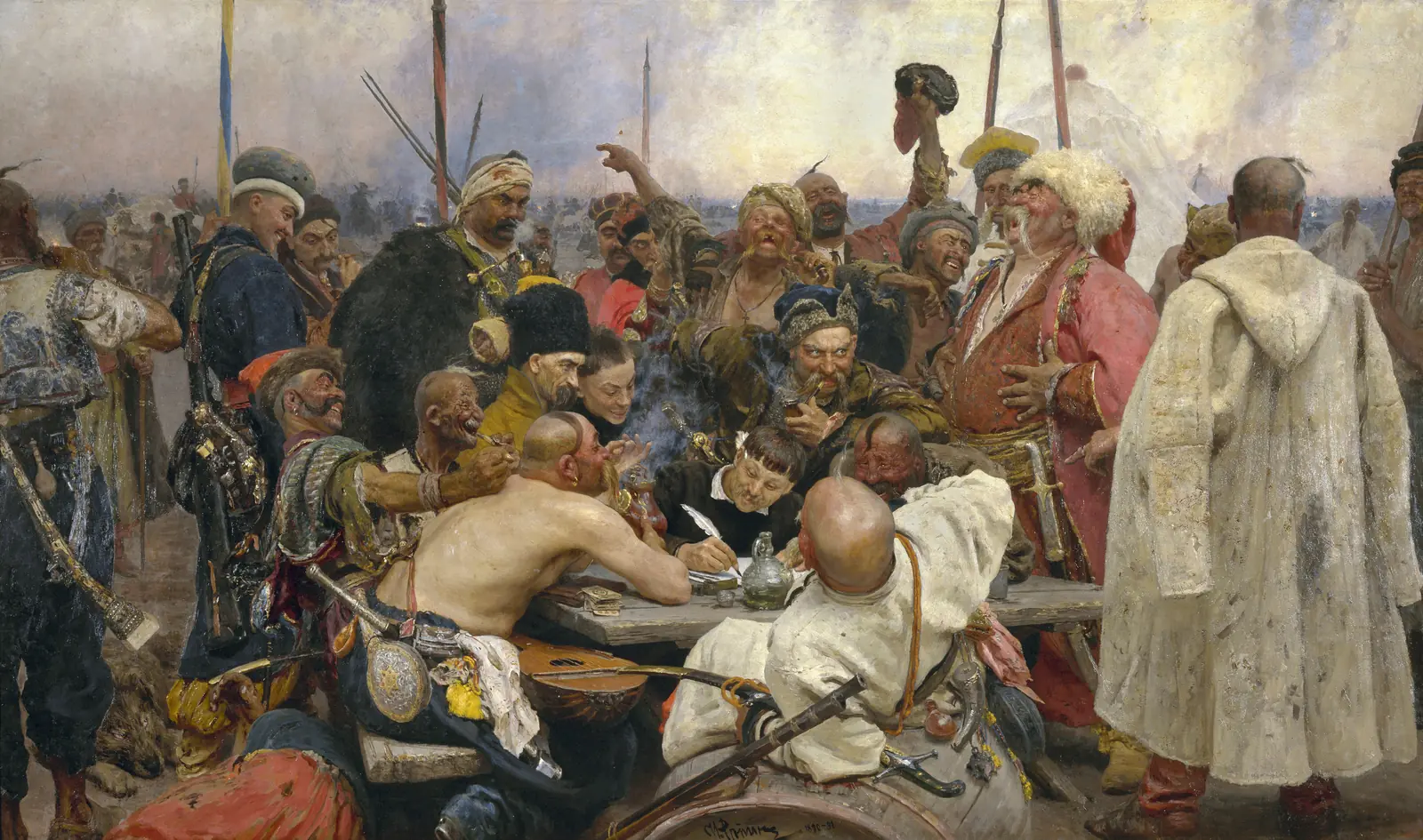
The Cossacks survived by raiding. They hit Ottoman and Crimean Tatar settlements, sailed the Black Sea in shallow boats to sack coastal towns, and sold their military services to the Polish and Muscovite crowns. By the early seventeenth century, Cossack fleets were raiding Ottoman ports across the Black Sea and had reached the outskirts of Constantinople. According to legend, when Sultan Mehmed IV sent the Zaporozhians a letter demanding their surrender in the 1670s, they sent back a reply so obscene that the painter Ilya Repin spent eleven years recreating the scene of them composing it.
The revolt that tied Ukraine to Russia
The event that changed everything started with a personal grudge. Bohdan Khmelnytsky was a Cossack officer in the Polish-Lithuanian Commonwealth, a literate man who spoke several languages and owned a small estate at Subotiv. In the mid-1640s, a Polish nobleman named Daniel Czaplinski raided the estate, had Khmelnytsky's young son beaten nearly to death in the local marketplace, and took his wife. Khmelnytsky sought justice through the Polish courts and got none. He fled to the Zaporozhian Sich, where the Cossacks elected him hetman. Before launching his campaign, he traveled to the Crimean Khanate and persuaded Khan Islam III Giray to provide Tatar cavalry.
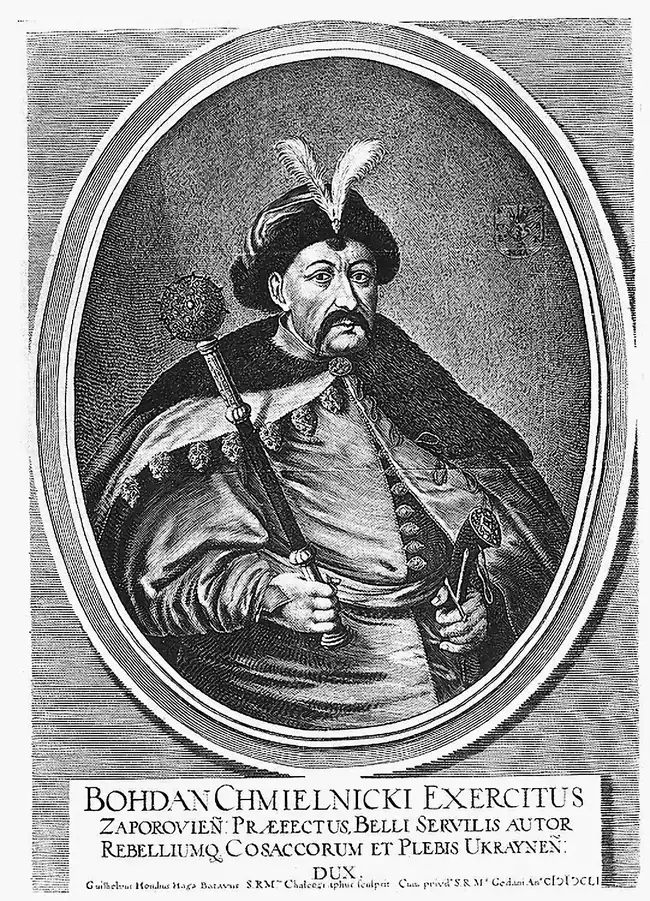
In 1648, Khmelnytsky launched an uprising against Polish rule that became the largest war in eastern Europe that decade. His Cossack and Tatar armies crushed the Polish forces at the battles of Zhovti Vody and Korsun. The uprising also produced one of the worst massacres of Jews in European history before the twentieth century. Cossack forces and their allies killed an estimated 15,000 to 20,000 Jews across Ukraine. The killings entered Jewish collective memory as a defining catastrophe and are still commemorated.
Khmelnytsky could win battles but could not hold the territory alone. In 1654, he signed the Treaty of Pereiaslav, accepting the protection of Muscovite tsar Alexis I. The two sides understood the deal differently from the start. Khmelnytsky's officers asked the Russian ambassador to swear a reciprocal oath on the tsar's behalf. The ambassador refused, saying the tsar's word was sufficient. The Cossacks saw an alliance between equals. Moscow saw new subjects. The immediate result was the partition of Ukraine: under the 1667 Treaty of Andrusovo, Poland kept the right bank of the Dnipro and Russia took the left, and the Cossack polity's autonomy was steadily eaten away over the following century.
That disagreement has never been settled. Russian historians cited Pereiaslav for centuries as proof that Ukraine voluntarily joined Russia. Ukrainian historians call it a treaty signed under pressure that Moscow violated almost immediately. The argument matters because it was part of Vladimir Putin's stated justification for the 2022 invasion, and part of the Ukrainian counter-argument that the country's right to independence predates Russia's claim.
From rebels to enforcers
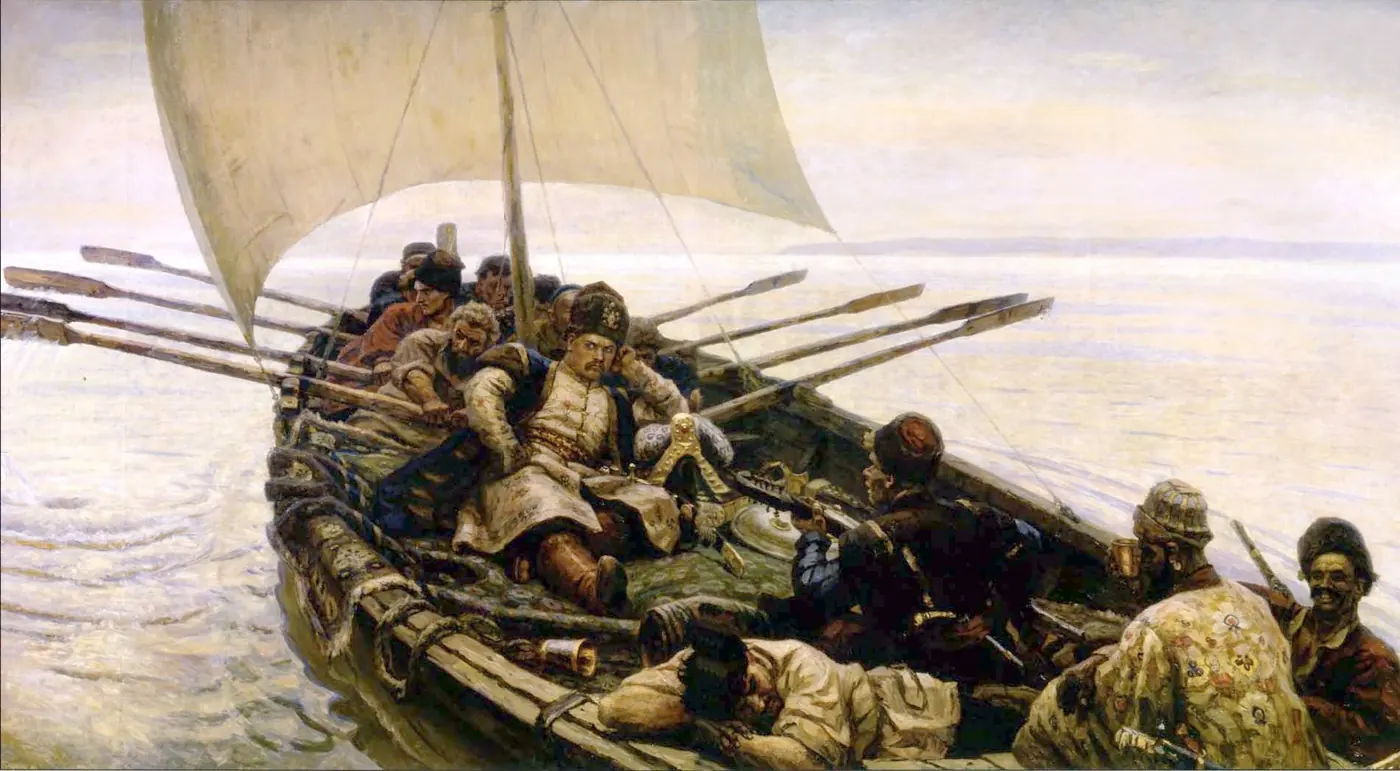
Russia's method for absorbing the Cossacks followed a pattern: recognize their privileges, pay them, use them on the frontier, and remove their independence one step at a time. When the Cossacks resisted, the response was extreme. In 1670, a Don Cossack named Stenka Razin led a revolt up the Volga. A Russian folk song still sung today claims he threw a captured Persian princess into the river as an offering. When the rebellion failed, he was quartered alive on Red Square. A century later, Yemelyan Pugachev claimed to be the dead Tsar Peter III, assembled roughly 30,000 followers, and burned the city of Kazan before his own Cossacks betrayed him.
Catherine the Great drew the conclusion. In June 1775 she sent artillery to surround the Zaporozhian Sich. The Cossacks surrendered without a fight. Catherine dissolved the Sich, deported its population, and renamed the Yaik River the Ural, trying to wipe the rebellion from the map.
What replaced the free communities was a deal. Cossack hosts kept their land and self-government. In return, every male owed decades of military service, arriving with his own horse, uniform, and sword. By 1900, eleven hosts stretched from the Don to the Pacific, serving as the empire's frontier garrison and riot police. Cossack cavalry charged crowds during the 1905 revolution and took part in pogroms against Jewish communities across the Pale of Settlement. The men whose ancestors fled serfdom were now the enforcers.
Destruction and the fight over the name
That loyalty cost them everything. Most Cossack hosts sided with the Whites after 1917. On January 24, 1919, Yakov Sverdlov signed a directive ordering "mass terror against wealthy Cossacks, exterminating all of them." What followed was decossackization: mass executions, deportations, and the dismantling of the hosts. The famine of the early 1930s, which struck the Don and Kuban regions alongside the Holodomor in Ukraine, destroyed much of what remained. During the Second World War, some Cossack units fought for Germany. At the war's end, roughly 45,000 Cossacks and their families were handed over by the British to Soviet forces at Lienz in Austria. Most were sent to labor camps or shot.
The identity survived anyway. After the Soviet Union collapsed, Cossack associations revived on both sides. In Russia, the government registered Cossack paramilitaries that fought in the Donbas from 2014 and in Russian formations after 2022. Ukraine claims the opposite inheritance: the Zaporozhian Sich, with its elected leaders and open assemblies, as a founding moment of Ukrainian democracy. The city of Zaporizhzhia, near the old Sich, became a symbol of resistance after Russian forces seized its nuclear power plant in 2022.
Both countries have a genuine claim, and that is why the argument has no resolution. The Cossacks were free communities that elected their leaders, and they were imperial cavalry that charged crowds on command. Both are true. The oath at Pereiaslav is still being fought over almost four centuries later, and the war reshaping Europe since 2022 is, among other things, a contest over which version of the Cossack story becomes the official one.
Test what you learned
5 quick questions on this article. No signup, just you against the text.