
Delhi Sultanate
The Delhi Sultanate ruled northern India from 1206 to 1526 under five Muslim dynasties before the Mughals.
The Delhi Sultanate was the series of five Muslim dynasties that ruled northern India from 1206 to 1526. A Turkic slave-general named Qutb al-Din Aibak founded it in 1206 after his master, Muhammad of Ghor, was assassinated. Over 320 years, five dynasties held the throne: the Mamluk (1206–1290), the Khalji (1290–1320), the Tughlaq (1320–1414), the Sayyid (1414–1451), and the Lodi (1451–1526). Power rarely passed peacefully, and it almost never followed a clear line of inheritance. The sultanate made Islam a governing force in India and held off the Mongol armies that had conquered nearly every other major state in their path. It also built the political framework that the Mughal Empire inherited when Babur conquered Delhi in 1526.
How the Delhi Sultanate began
In 1192, Muhammad of Ghor, a warlord from present-day Afghanistan, defeated the Rajput king Prithviraj Chauhan at the Second Battle of Tarain and took control of much of the Gangetic plain. He left a Turkic slave named Qutb al-Din Aibak in charge of his Indian territories and returned west. When Muhammad was assassinated in 1206, Aibak claimed power in his own right and became the first sultan of Delhi.
Aibak ruled only four years. He died in 1210 after falling from his horse during a polo match. The sultanate might have collapsed then, but another former slave, Iltutmish, held it together. Iltutmish was Aibak's son-in-law and had been purchased as a boy, trained in the military household, and raised into command. He ruled from 1211 to 1236, expanded the sultanate's territory, and won recognition from the Abbasid caliph in Baghdad, which gave the sultanate legitimacy across the Islamic world. Many historians consider Iltutmish, not Aibak, the real founder of the Delhi Sultanate as a stable state.
The first dynasty is known as the Mamluk or "Slave" dynasty. Its most important sultans, Aibak and Iltutmish among them, were purchased as boys and trained for military command. After Iltutmish died, his daughter Raziyya took the throne in 1236. She was the only woman ever to rule from the throne of Delhi. She appeared in public without a veil, led troops in person, and promoted an Abyssinian slave named Jamal ud-Din Yaqut to a senior court position. The Turkish nobles who dominated the court saw all of this as a challenge to their power. They deposed Raziyya in 1240, and she was killed later that year.
How the Delhi Sultanate stopped the Mongols
While the sultanate was consolidating its hold on northern India, Mongol armies were conquering much of Asia. They destroyed the Khwarazmian Empire in Central Asia, sacked Baghdad in 1258 and killed the last Abbasid caliph, and built an empire stretching from China to Persia. Mongol raiding parties attacked the Punjab repeatedly through the 1200s and early 1300s.
India was one of the few major civilizations on the Mongols' path that they never conquered. The main reason was Alauddin Khalji, the most effective military ruler the sultanate produced. Alauddin seized the throne in 1296 by murdering his own uncle and father-in-law, the reigning sultan. He was ruthless and focused entirely on control. He fixed prices in Delhi's markets by decree, banned alcohol and private gatherings of nobles, and ran a war economy with a large standing army paid in cash. Between 1298 and 1306, Mongol armies launched several major invasions of India, and Alauddin repelled every one. After some of these invasions, he had the captured Mongol soldiers executed outside Delhi.
Alauddin also pushed the sultanate's reach further south than any ruler before him. He sent his general Malik Kafur on campaigns as far as Madurai, near the tip of the Indian peninsula.
Keeping the Mongols out required a large standing army, constant heavy taxation, and permanent military readiness. The sultanate became a militarized state built around extraction, and that structure was difficult to sustain once the Mongol threat receded.
How did the Delhi Sultanate fall?
The decline began under Muhammad bin Tughlaq, who ruled from 1325 to 1351. Muhammad was well-educated and ambitious, but his plans regularly ended in disaster. He moved his capital and forced much of Delhi's population to relocate about 700 miles south to Daulatabad. The forced march killed many of the people who made it, and Muhammad eventually moved the capital back. He also introduced token coins made of brass and copper, hoping they would work like government-backed currency. His subjects forged the coins at home, and the currency collapsed.
The blow the sultanate could not recover from came in 1398. Timur, the Central Asian conqueror, crossed the Indus River and stormed Delhi. His army looted the city and massacred much of its population. Delhi was so devastated that it took generations to recover. The two dynasties that followed, the Sayyid (1414–1451) and the Lodi (1451–1526), governed a shrunken state.
The sultanate ended on April 21, 1526, at the Battle of Panipat, about 60 miles north of Delhi. Babur, a Central Asian prince who traced his ancestry to both Timur and Genghis Khan, defeated the last Lodi sultan, Ibrahim Lodi. Babur's army was smaller, but he had field artillery and matchlock guns, which the Lodi forces lacked. His victory founded the Mughal Empire.
What the Delhi Sultanate left behind
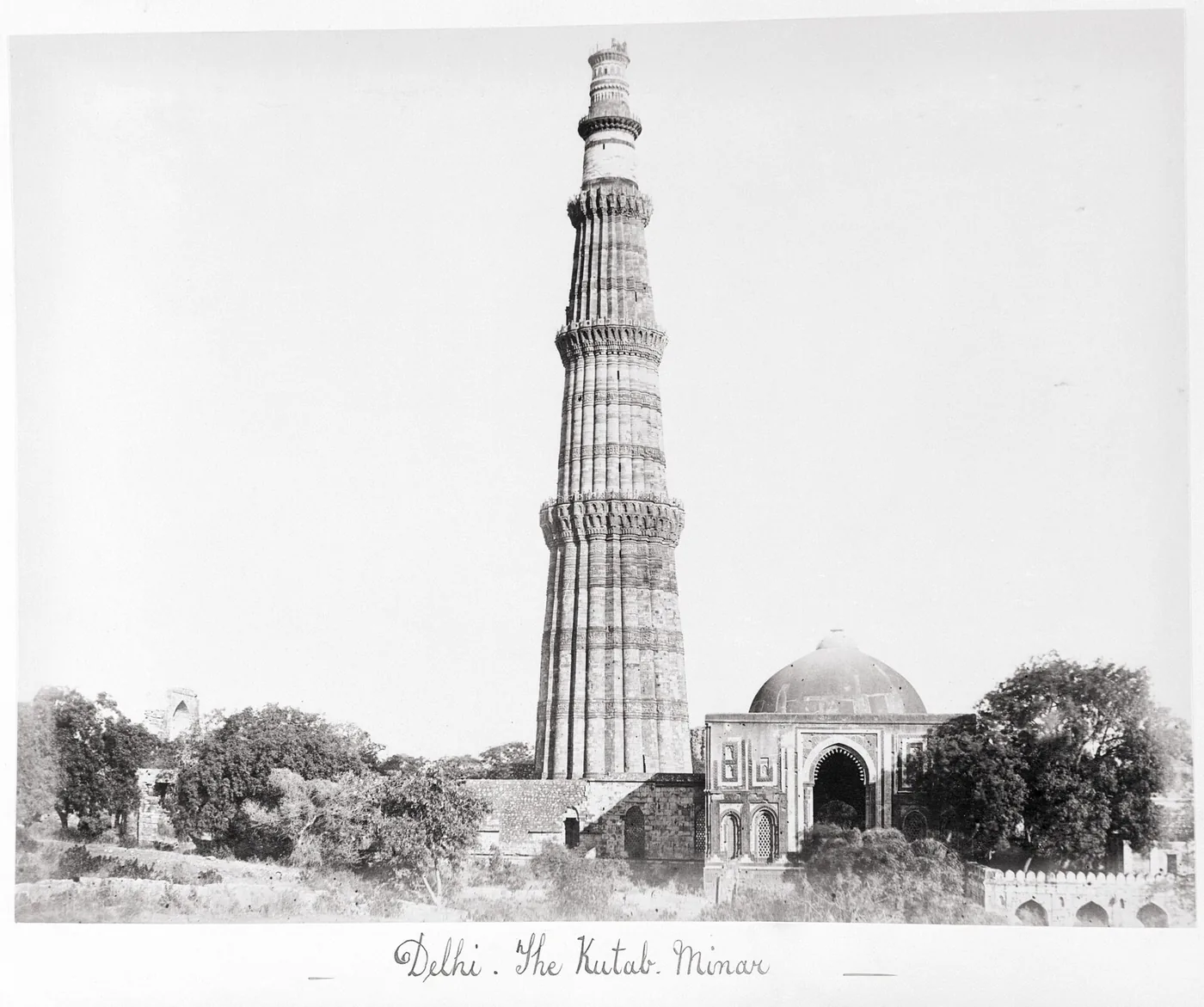
The sultanate shaped India in ways that outlasted it by centuries. It established Persian as the language of administration, and Persian served in that role for more than six centuries. The British switched India's official language to English only in 1837. It produced a distinct architectural style that merged the Central Asian arch and dome with Indian stone carving. The Qutb Minar, a 240-foot victory tower in Delhi begun under Aibak, still stands as an early example. The sultanate also gave room to Sufi orders, especially the Chishti order, which became the most widespread popular form of Islam in South Asia.
The sultanate's most lasting effect was political. It created the Delhi-centered state that the Mughals took over. When Babur won at Panipat, he took over a working state with an established capital, a revenue system, and a long history of Muslim rulers governing a Hindu-majority population. The questions that would consume the Mughals, how far to tolerate Hindu religious practice, whether to levy the jizya on non-Muslim subjects, and whether one ruler could govern all of India, were not new. The Delhi Sultanate had already wrestled with every one of them.