
Dreadnought
HMS Dreadnought was a British battleship launched in 1906 that made every other battleship in the world obsolete and started a naval arms race.
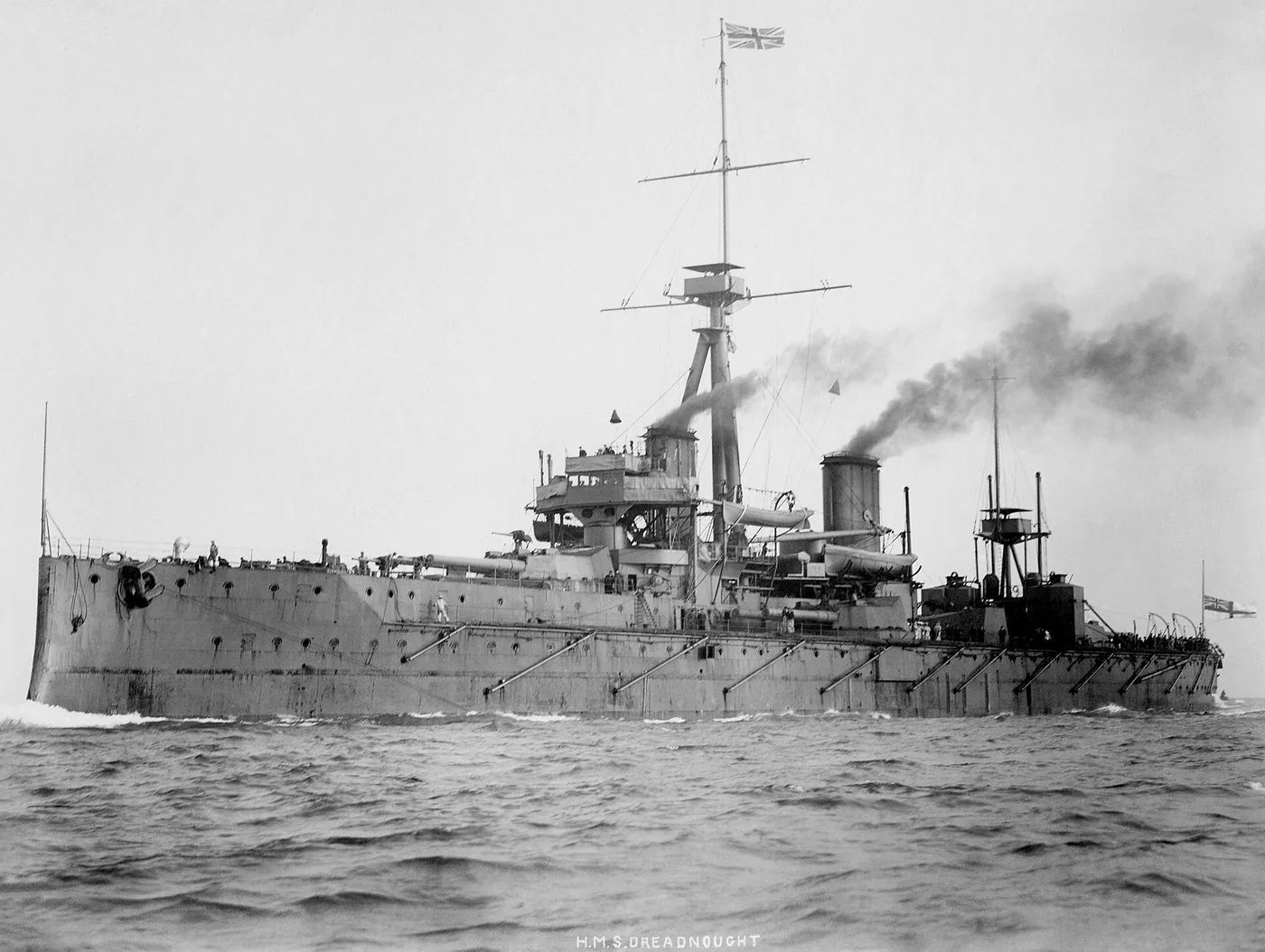
HMS Dreadnought was a British battleship launched in 1906 that made every other battleship in the world obsolete the day she entered service. She mounted ten twelve-inch guns, two per turret across five turrets, at a time when most battleships carried four large guns and a mix of smaller ones. She was the first battleship powered by steam turbines, which gave her a top speed of 21 knots, faster than any battleship afloat. That combination let her engage targets at ranges where no opponent could fire back and outrun any ship she could not outshoot. After Dreadnought, the word went from being one ship's name to the label for an entire class of warship. Every navy that wanted to remain a serious power had to build its own dreadnoughts, and the race to build them helped push Britain and Germany toward war.
How Admiral Fisher built the Dreadnought
The driving force behind the ship was Admiral John Fisher, who became First Sea Lord in 1904. Fisher was born in Ceylon in 1841 and had entered the Royal Navy at thirteen. By the time he reached the top job at sixty-three, he had spent his entire career in a navy that had gone from wooden sailing ships to steel and steam. He wanted to push it further. He pulled more than a hundred outdated vessels out of service, concentrated the fleet in home waters to face Germany, and pushed for a new kind of capital ship.
The technical argument was straightforward. Naval gunnery ranges had grown long enough that ships with mixed-caliber batteries were at a disadvantage. Shells of different sizes made different-sized splashes when they hit the water, and gunners could not tell which splash came from which gun. That made it nearly impossible to correct aim at long range. A ship armed entirely with big guns of the same caliber solved the problem. Naval experts in several countries understood this. Designers in Japan and the United States had already begun work on similar ships.
Fisher laid Dreadnought down at Portsmouth on October 2, 1905, and pushed the construction at a speed no one had matched before. She was launched four months later, in February 1906, and began sea trials roughly a year after her keel was laid. No capital ship had ever been built that fast.
The naval arms race with Germany
Dreadnought was a technical success, but it created a strategic problem for the country that built it. In 1905, Britain had roughly fifty modern battleships to Germany's twenty. Dreadnought made all of them second-rate overnight, including Britain's own. The count of modern capital ships dropped to near zero for every navy. Germany, which could never have closed a thirty-ship gap, now only needed to match Britain in new construction.
Admiral Alfred von Tirpitz, who ran Germany's naval office, built a fleet of dreadnoughts with the enthusiastic backing of Kaiser Wilhelm II. Tirpitz believed that Germany did not have to defeat Britain's fleet outright. A German navy large enough to make a fight too costly for Britain would force London to treat Berlin as a partner. The strategy backfired. Britain answered every German building program with one of its own, and the growing German fleet drove Britain closer to France and to Russia.
In 1909, reports that Germany was speeding up its shipbuilding set off a public panic in Britain. The Admiralty asked for six new dreadnoughts, the government offered four, and the public rallied behind the slogan "We want eight and we won't wait." The public won, and Britain ordered eight. Main gun calibers increased from twelve inches to 13.5, then to fifteen, and the bigger ships that resulted were called super-dreadnoughts. Germany needed to expand the Kiel Canal so its dreadnoughts could travel from the Baltic to the North Sea. The expansion finished in June 1914, weeks before the war began.
What happened at the Battle of Jutland?
The British Grand Fleet and the German High Seas Fleet met in full battle only once, at the Battle of Jutland on May 31, 1916. Germany sank more ships. Britain lost fourteen vessels totaling about 113,000 tons and more than 6,000 sailors. Germany lost eleven ships totaling about 62,000 tons and roughly 2,500 sailors. But the outcome favored Britain. The German fleet returned to port and never seriously challenged British control of the North Sea again. The British naval blockade of Germany, which eventually helped starve the country into seeking an armistice, continued unbroken.
In the end, the blockade and submarine warfare settled the naval war, not the battleship fleets the arms race had built. HMS Dreadnought herself missed the Battle of Jutland because she was in dock for a refit. Her only confirmed kill during the war was a German submarine, U-29, which she sank by ramming on March 18, 1915. She is the only battleship known to have sunk a submarine that way.
Why the Dreadnought mattered
Dreadnought is one of the best-known examples of an innovation that hurts the country introducing it most. Britain held a commanding lead in the old battleship technology and chose to make it obsolete. Fisher and his supporters argued that if Britain did not build the ship, another power would, and Britain would lose its lead anyway. That reasoning was probably correct. But by moving first, Britain gave up the thirty-ship advantage it had built over decades.
The same choice has come up with every major military technology since, including the hydrogen bomb and precision-guided missiles. The country with the strongest position in the existing technology faces the same question Fisher faced in 1905: build the thing that resets the competition, or wait and risk someone else building it first. Dreadnought saw almost no combat herself, but she changed every navy in the world by forcing them all to start over.