
Spice Trade
The spice trade was the centuries-long commerce in nutmeg, cloves, and pepper that drove European exploration and colonial conquest.
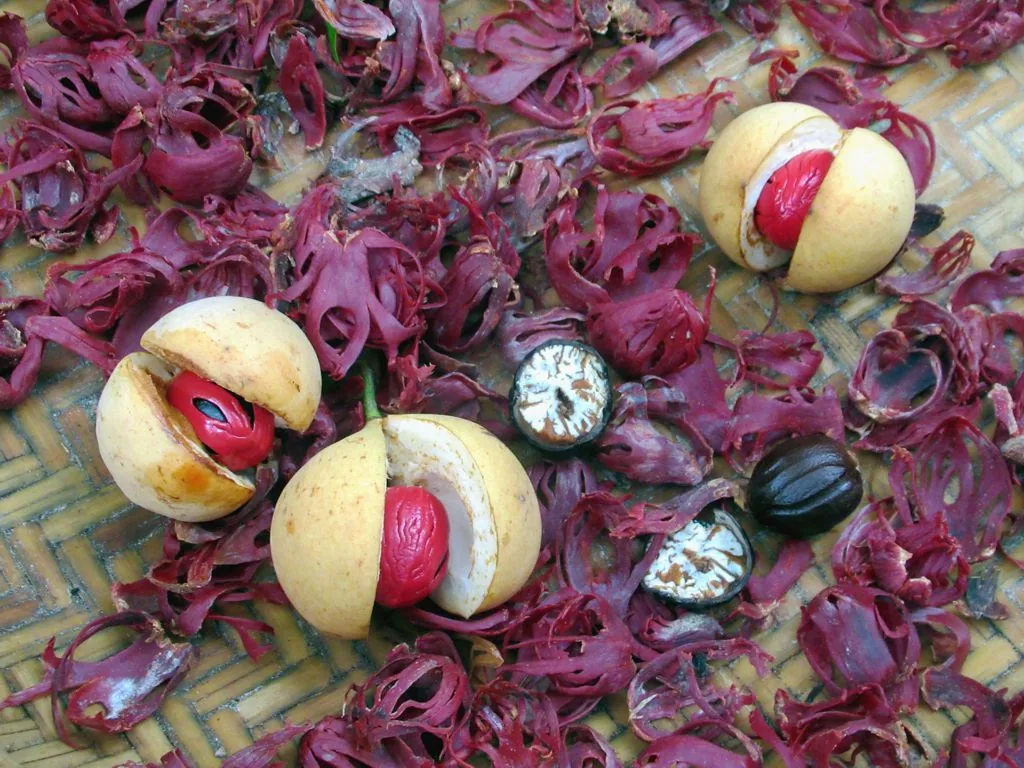
The spice trade was the commerce in nutmeg, cloves, pepper, cinnamon, and other spices that connected Asia to Europe for more than two thousand years. For centuries, nutmeg and its companion spice mace grew nowhere else on Earth except the Banda Islands, a cluster of ten small volcanic islands in eastern Indonesia whose total land area is smaller than that of many cities. Cloves came from a nearby set of islands around Ternate and Tidore. Pepper grew more widely but was concentrated on India's Malabar coast. Because the most valuable spices were pinned to a few remote islands, anyone who controlled those islands controlled a fortune. That geographic fact launched the European Age of Exploration, created the first modern corporations, and led to some of the worst colonial violence in history.
Why spices were worth a fortune
Spices were not just a cooking ingredient. In the humoral medical tradition that prevailed across Europe and much of Asia, doctors classified spices as hot and dry substances and prescribed them for conditions they understood as cold and wet, including plague and digestive problems. Demand driven by physicians' prescriptions was steadier than demand from cooks. Serving heavily spiced food was also a status symbol, a signal that the host could afford goods from the other side of the world.
Spices had another quality that made them ideal for long-distance trade: they were compact, lightweight, and did not spoil. A ship's hold of pepper could survive a two-year voyage and still be worth a fortune at the other end. The popular claim that medieval Europeans used spices to disguise the taste of rotten meat is wrong. A person rich enough to buy nutmeg had no trouble buying fresh meat.
Before Europeans sailed to the source, spices moved through a long chain of middlemen. Malay and Javanese traders carried them to Malacca, on the strait that still carries roughly a quarter of the world's trade. From there, Gujarati and Arab merchants shipped them across the Indian Ocean, through the Red Sea or the Persian Gulf, to Egypt or the Levant. Venetian galleys then carried them the last leg to European markets. Each middleman took a cut. By the time nutmeg reached a buyer in Europe, its price could be hundreds of times what the grower in Banda had received.
How Portugal and the Dutch seized the spice trade
The enormous markup made finding a direct route worth almost any risk. In 1498, Vasco da Gama reached India by sailing around Africa, and Portugal's strategy became clear: bypass the middlemen by controlling the sea route and the ports along it. Portugal took Goa in 1510, Malacca in 1511, and Hormuz in 1515, locking down the key harbors between the spice islands and Europe.
A century later, the Dutch East India Company pushed Portugal aside and went further. The Bandanese had been selling their spices to whoever paid the best price for centuries, and they refused to honor the exclusive trading rights the company demanded. In 1621, Jan Pieterszoon Coen, the company's governor-general, answered with a military campaign. Dutch soldiers killed, enslaved, or drove out nearly the entire Banda population of about 15,000 people. The company then turned the islands into its own plantations, using enslaved workers brought from elsewhere. It was one of the earliest examples of a commercial company emptying a land of its people to take control of what it produced.
The arrangement was profitable for more than a hundred years. In 1667, the Treaty of Breda settled a war between England and the Dutch Republic. England gave up its claim to Run, a small island in the Banda group, and the Dutch gave up their claim to New Amsterdam, a trading post on Manhattan. England renamed it New York. At the time, the Dutch considered it a good trade: Run completed their nutmeg monopoly, and the settlement on Manhattan looked far less valuable.
When did the spice trade start?
The trade in spices is far older than the European voyages that made it famous. Traders were moving cinnamon and cassia from Asia to the Middle East at least 4,000 years ago. By around 1000 BCE, cinnamon and pepper traveled from India and Southeast Asia to Egypt. By the first century CE, a maritime trading network stretched from the Indonesian archipelago through India to the Roman Empire.
The European chapter of the spice trade, the one that produced colonial empires and the first corporations, began in earnest in the late 1400s. The markups charged by middlemen along the routes to Asia pushed European kingdoms to search for a direct sea route. That search led to Vasco da Gama's voyage around Africa in 1498. Columbus's landing in the Americas in 1492 was part of the same effort: his expedition was originally aimed at reaching Asia by sailing west.
How the spice monopoly ended
The monopoly collapsed after a French colonial administrator named Pierre Poivre had nutmeg and clove seedlings smuggled out of the Dutch-controlled islands in 1770 and planted them on Mauritius. Within decades, growers in Zanzibar and Grenada had established their own plantations, and the Banda monopoly was finished. Once the spices could grow elsewhere, prices fell. Nutmeg now sells for a few dollars a jar.
The spice trade left behind something larger than the spices themselves. The Dutch East India Company and the English East India Company were founded to raise capital for long-distance trading voyages and to spread the financial risk. They introduced permanent capital, tradable shares, and limited liability. For a time, they even had the power to raise armies. These institutions became the model for the modern corporation, all of it created to secure the trade in spices that grew on a few small islands at the far end of the world.