
Enrico Fermi
Enrico Fermi was an Italian-American physicist who built the first nuclear reactor and achieved the first controlled chain reaction in 1942.
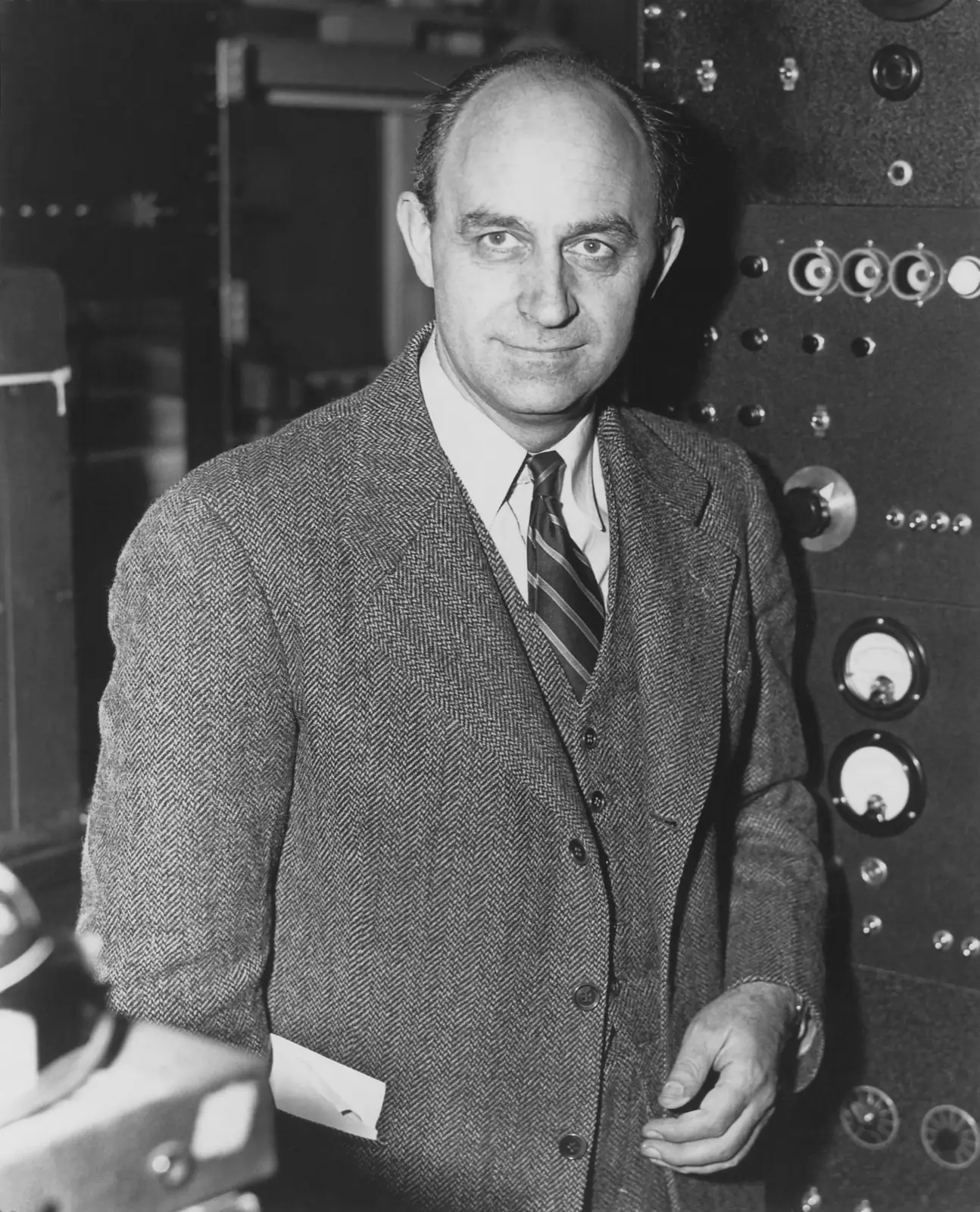
Enrico Fermi (1901–1954) was an Italian-American physicist who built the world's first nuclear reactor and produced the first nuclear chain reaction anyone had controlled and sustained. He was unusual in twentieth-century physics for working at the highest level in both theory and experiment. Most physicists specialize in one or the other. Fermi developed the statistics that describe how particles like electrons and neutrons behave, and then he designed and ran the reactor that showed a chain reaction could be controlled. He grew up in Rome, fled fascist Italy in 1938 to protect his Jewish wife, and spent the rest of his career in the United States. He died of stomach cancer in Chicago in 1954, at 53. Element 100, fermium, is named after him, and so is Fermilab, the particle physics laboratory near Chicago.
How Fermi left Italy for the United States
Fermi became Italy's leading physicist while still in his twenties. At the University of Rome in the early 1930s, he led a group of young researchers known as the Via Panisperna boys, named after the street where their laboratory stood. His colleagues called him "the Pope" because he seemed never to be wrong. The group bombarded dozens of elements with neutrons and discovered that slowing the neutrons down made them far more effective at triggering nuclear reactions. That work won Fermi the 1938 Nobel Prize in Physics.
That same year, Benito Mussolini's government passed anti-Jewish racial laws. Fermi's wife, Laura Capon, was Jewish. In December 1938, Fermi went to Stockholm to accept the prize. Instead of returning to Italy, he took his family on a ship to New York. He never lived in Italy again.
How Fermi built the first nuclear reactor
At the University of Chicago, Fermi directed a team that worked in a squash court under the bleachers of Stagg Field, an unused football stadium. They stacked blocks of graphite laced with uranium into a structure they called an atomic pile. The pile was designed so that neutrons released by splitting uranium atoms would hit other uranium atoms and split them too, creating a chain reaction. Cadmium control rods absorbed neutrons and kept the reaction from starting on its own.
On December 2, 1942, the team slowly withdrew the control rods. At 3:25 in the afternoon, the pile went critical: the chain reaction became self-sustaining. Fermi let it run for 28 minutes, then ordered it shut down.
The pile had no radiation shielding and no cooling system. The safety plan relied on a physicist standing on a platform with an axe, ready to cut a rope holding an emergency control rod. If that failed, a second crew stood by with buckets of cadmium nitrate solution to pour over the pile. Neither was needed.
Arthur Compton, the physicist overseeing the project, called James Conant at Harvard to report the result. They had no code arranged, so Compton improvised. "The Italian navigator," he told Conant, "has landed in the New World." Conant asked how the natives were. "Very friendly," Compton said.
The experiment proved that nuclear fission could be controlled, which made two things possible: a reactor that could generate power, and a bomb. Fermi went on to work at Los Alamos on the Manhattan Project. The project produced the atomic bombs the United States dropped on Hiroshima and Nagasaki in August 1945.
Did Fermi discover nuclear fission?
No. The German chemists Otto Hahn and Fritz Strassmann discovered nuclear fission in late 1938, when they found that bombarding uranium with neutrons could split the atom into lighter elements. The physicist Lise Meitner and her nephew Otto Frisch explained the physics of what was happening weeks later.
Fermi came close years earlier. In his Rome laboratory in 1934, he bombarded uranium with neutrons and observed results he could not fully explain. He believed he had created new elements heavier than uranium. Some of what he observed was actually uranium atoms splitting, but neither he nor anyone else recognized it at the time. When Hahn and Strassmann proved that the atoms were splitting, Fermi understood the implication immediately: if each split released extra neutrons, a chain reaction was possible. He spent the next four years proving it.
What is a Fermi estimate?
A Fermi estimate is a rough calculation made from very little data, designed to get an answer that is close enough to be useful. The technique is named after Fermi because he used it constantly and taught it to his students. A classic example: how many piano tuners work in Chicago? You cannot look it up, but you can estimate it by guessing the city's population, the share of households with a piano, how often each piano needs tuning, and how many pianos one tuner can handle in a year. The numbers are rough, but the answer usually lands in the right range.
Fermi gave his most famous demonstration at the Trinity test, the first nuclear bomb detonation, on July 16, 1945. Watching from a base camp roughly ten miles away, Fermi ripped a page into small pieces and let them fall when the shock wave arrived. He paced off the distance the scraps had blown and estimated the yield at about ten kilotons of TNT. Instruments eventually measured about 25 kilotons. Fermi had his answer, within a factor of three, before the instrument teams had finished their calculations.
Fermi estimates are still taught in physics and engineering courses and are a common part of job interviews at technology and consulting companies. In a career cut short at 53, Fermi helped build both the nuclear reactor and the nuclear weapon, and his name remains one of the most recognized in modern science.