
Foundry Model
The foundry model splits the chip industry into companies that design chips and companies that manufacture them.
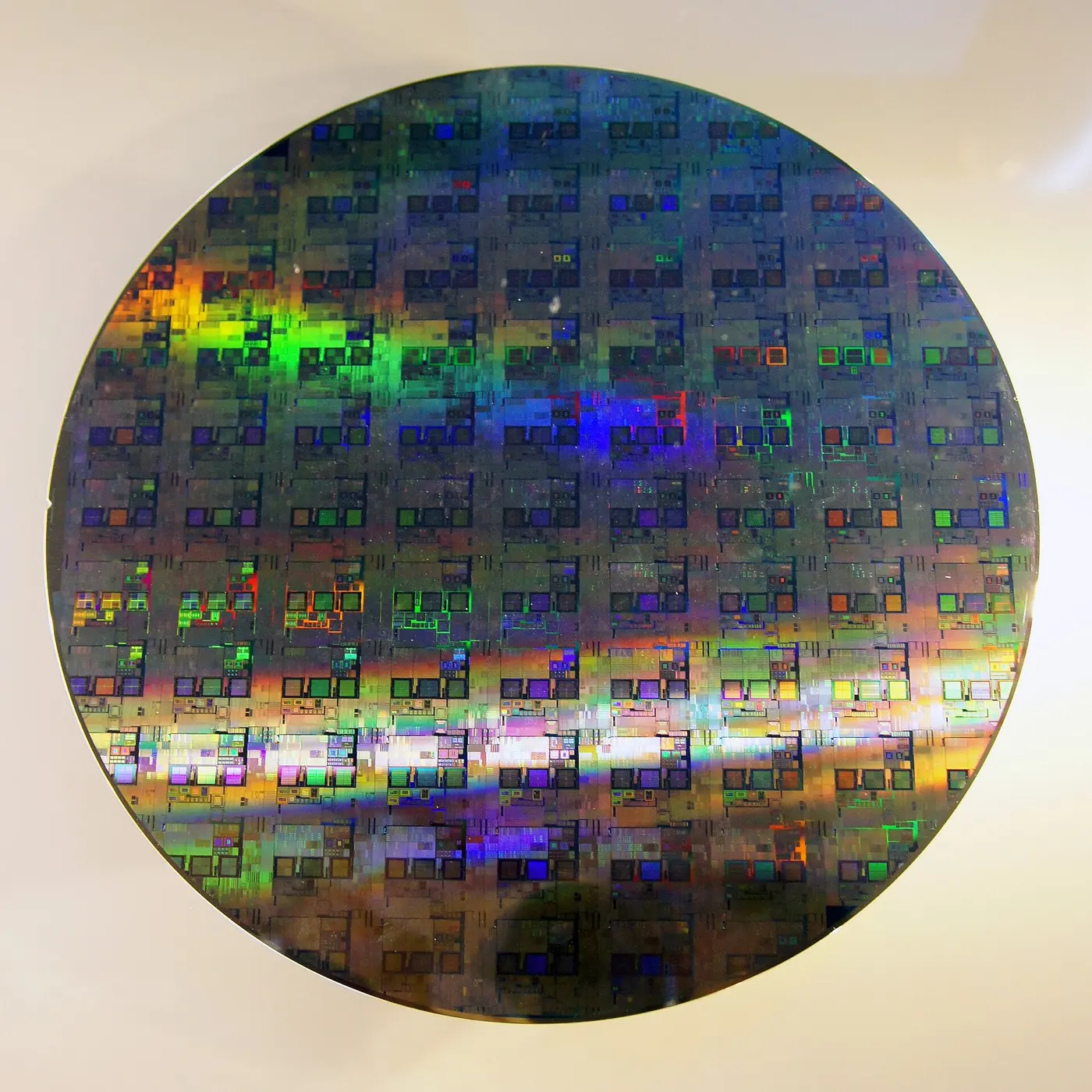
The foundry model is the division of the semiconductor industry into companies that design chips and companies that manufacture them. Morris Chang proposed the idea in 1985 and founded Taiwan Semiconductor Manufacturing Company (TSMC) to carry it out. Before that, every major chip company designed and built its own chips in its own factories.
Today most of the industry runs on Chang's model. Nvidia designs the processors that train AI systems but does not own a single factory. Apple designs the chips in every iPhone and Mac but pays TSMC to build them. Qualcomm, AMD, and Broadcom do the same. In 2025, TSMC earned about 70 percent of all revenue from chips made to order worldwide.
How Morris Chang split the chip industry
For the semiconductor industry's first three decades, a chip company handled everything from design to manufacturing under one roof. Intel, Motorola, and Texas Instruments each designed their chips and manufactured them in their own plants, called fabs. The industry calls this the integrated device manufacturer, or IDM, model. It worked when a new fab could be built for tens of millions of dollars. By the 1980s, each new generation of manufacturing technology cost far more, and a small company could no longer afford a factory running the newest process.
Morris Chang saw the problem from the inside. Born in Ningbo, China, in 1931, he moved to the United States at 18 and studied mechanical engineering at MIT. He spent 25 years at Texas Instruments, where he rose to run the company's worldwide semiconductor business. In 1985 the government of Taiwan recruited him to lead its push into the chip industry. He was 54 years old.
In 1987 Chang founded TSMC with a simple proposition: a factory that makes chips to order for any company and designs none of its own. The idea solved two problems at once. Because a pure-play foundry does not sell its own chips, a designer can share a proprietary blueprint without worrying that the factory will copy it for a rival product. And because the foundry takes orders from many designers, it can run its most expensive manufacturing lines at full capacity, spreading the fixed costs across more chips than any single company could sell.
The other half of the model is the fabless company, a firm that owns no factory and puts all its capital into engineering. Companies like Synopsys and Cadence make the design software, called electronic design automation (EDA) tools, that lets a small team produce a working chip. Arm licenses reusable circuit blocks that designers can build on. Together, these layers turned chip design into something a startup could attempt without first raising billions for a factory.
Why so few companies make leading-edge chips
Manufacturing chips at the smallest transistor sizes has enormous fixed costs and very low cost per additional chip. A foundry that serves more customers can invest in more advanced tools. Better tools produce better chips, which attracts more customers. Yield, the percentage of working chips per wafer, goes up with volume and with expertise built over years of running a process. A competitor cannot acquire that expertise quickly by hiring or spending.
The outcome is a market that narrows at each new technology generation. In 2002, about twenty companies could build chips at the leading edge. By 2026, only three can: TSMC, Samsung, and Intel. Of those three, only TSMC manufactures leading-edge chips at scale for outside customers. Samsung's foundry business holds roughly 6 percent of global foundry revenue. Intel relaunched its foundry services in 2021 after decades of building mostly its own chips, but it does not yet make leading-edge chips in large volumes for outside customers.
A single leading-edge fab now costs $25 billion or more to build. The equipment inside it comes from a handful of specialized suppliers. ASML, a Dutch company, is the only maker of extreme ultraviolet lithography machines, which print the smallest features on a chip. Firms in Japan and the United States produce the chemicals and remaining equipment. The high cost and extreme specialization mean that new entrants at the leading edge are nearly impossible.
Why chip manufacturing became a geopolitical issue
The concentration of advanced chip manufacturing in Taiwan turned a commercial arrangement into a strategic concern. One company, TSMC, makes the chips used in smartphones, cloud computing, and military hardware around the world. Most of its fabs sit on an island that China claims as its territory. For the full story of how this happened, see "Why does Taiwan make the world's most advanced chips?"
Export controls on chip manufacturing equipment are possible because so few companies make it. The United States, the Netherlands, and Japan between them control nearly every critical tool in the manufacturing chain. Restricting ASML's sales to China limits China's ability to build advanced chips, because no other company makes the same machines.
Governments are now trying to spread chip manufacturing more widely. The United States passed the CHIPS and Science Act in 2022 to subsidize domestic production. TSMC was awarded $6.6 billion under the law and began producing chips at its first Arizona fab in 2024. By mid-2026, TSMC had announced plans for ten fabs on the Arizona site. But building a factory is easier than reproducing the dense network of suppliers, engineers, and institutional knowledge that Taiwan built over thirty years.
Morris Chang's decision to separate chip design from manufacturing was a bet on capital efficiency. It made semiconductors cheaper and more widely available. It also funneled the world's most advanced chipmaking into a single company on a single island, and governments now treat that concentration as a strategic vulnerability.