
Julius Caesar
Julius Caesar was a Roman general and dictator whose conquest of Gaul and seizure of power ended the Roman Republic.
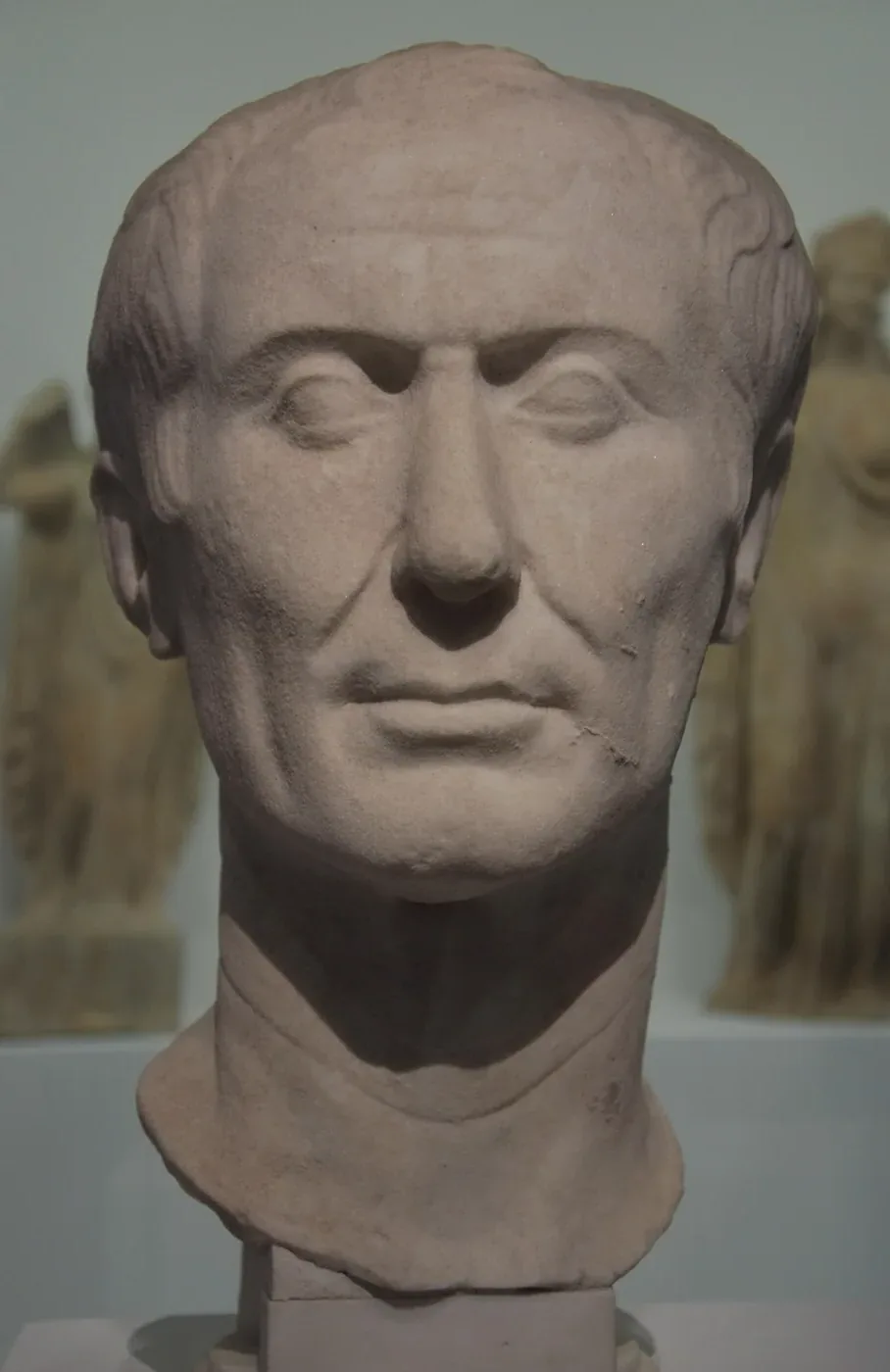
Gaius Julius Caesar (100–44 BC) was a Roman general and politician whose career ended the Roman Republic, a system of government that had lasted nearly 500 years. He conquered all of Gaul, crossed the Rubicon with his army, won a civil war, and made himself dictator for life. Senators assassinated him on March 15, 44 BC, stabbing him 23 times. They believed they were saving the Republic. Within a generation, Caesar's adopted heir ruled Rome as its first emperor. Caesar never held that title himself, but his family name later became the word for supreme ruler in German (Kaiser) and Russian (Tsar).
How Caesar rose to power
Born in 100 BC, Caesar came from a patrician family, the gens Julia, that traced its line back to the goddess Venus but had long since lost its money and influence. He was charming, ambitious, and self-conscious about his thinning hair, which he combed forward to hide. He spent most of his early career deep in debt.
At 25, while traveling across the Aegean Sea to study oratory in Rhodes, Caesar was captured by Cilician pirates. They set his ransom at twenty talents. Caesar laughed, told them they had no idea who they had captured, and insisted they raise the price to fifty. He spent 38 days as their prisoner, joking with his captors and warning that he would come back and crucify them all. After his ransom was paid, he raised a small fleet, hunted the pirates down, and did exactly that.
Caesar built his political career as a leader of the populares, a faction that appealed to ordinary Romans against the senatorial elite. In 60 BC he formed a private alliance with Pompey, Rome's leading general, and Crassus, Rome's richest man. Historians call this the First Triumvirate. The arrangement got Caesar elected consul for 59 BC. After his year in office, he received command of Rome's armies in Gaul.
Between 58 and 50 BC, Caesar fought his way across Gaul, a territory covering what is now France and Belgium, and brought it all under Roman control. The wars killed an estimated one million people and enslaved another million. It also made Caesar enormously wealthy and gave him a battle-hardened army loyal to him personally. He wrote his own account of the wars in spare, direct Latin that students still read in classrooms today.
Caesar's civil war and assassination
The combination of Caesar's wealth, fame, and personal army made his rivals in the Roman Senate see him as a threat to the Republic. The Senate, now aligned with Pompey, ordered Caesar to give up his command and return to Rome as a private citizen. If he obeyed, his enemies could have prosecuted him. His choice was between ruin and war.
In January 49 BC, Caesar led a single legion south across the Rubicon, a small river that marked the northern boundary of Italy. Roman law forbade any general from crossing it under arms. Caesar reportedly said "the die is cast" as he crossed. The phrase "crossing the Rubicon" still means taking a step that cannot be undone.
Caesar chased Pompey across the Mediterranean. At the Battle of Pharsalus in 48 BC, he destroyed Pompey's army. Pompey fled to Egypt, where agents of the Egyptian king killed him before Caesar arrived. Caesar stayed and began a relationship with Cleopatra, Egypt's queen, who bore him a son.
Back in Rome, Caesar had himself appointed dictator. The Republic had always allowed a dictator in emergencies, but traditionally only for six months at a time. In early 44 BC, Caesar took the title dictator perpetuo, meaning dictator for life. He pushed through reforms. The most lasting was a new calendar of 365 days with a leap year every four years, which took the place of Rome's old lunar system. Most of Europe kept the Julian calendar for over sixteen centuries.
On March 15, 44 BC, the date Romans called the Ides of March, a group of about 60 senators surrounded Caesar and stabbed him 23 times. The conspiracy was led by Marcus Brutus and Gaius Cassius. The assassination set off another round of civil wars. Octavian, Caesar's grand-nephew and adopted heir, was just 18 when Caesar died. He fought through the civil wars that followed and won, becoming Rome's sole ruler. He took the name Augustus and ruled as Rome's first emperor in all but title. The Republic that Brutus and Cassius killed to save was finished.
Was Julius Caesar an emperor?
No. Caesar held the title of dictator, an emergency office the Roman Republic had used for centuries, though traditionally with a time limit. He removed that limit by declaring himself dictator for life, and the act provoked his assassination. The formal position of emperor did not exist in his lifetime. The first person to hold that kind of power was his adopted heir, Augustus, who carefully avoided the words dictator and king. Augustus built a new system of rule around the title princeps, meaning "first citizen."
Caesar's influence on one-man rule outlasted Rome itself. For centuries afterward, Roman emperors used "Caesar" as part of their title. The word passed into German as Kaiser and into Russian as Tsar. No other Roman's name crossed into other languages as a word for supreme ruler.