
Spartacus
Spartacus was a Thracian gladiator who led Rome's largest slave revolt from 73 to 71 BC, defeating several Roman armies before being killed in battle.
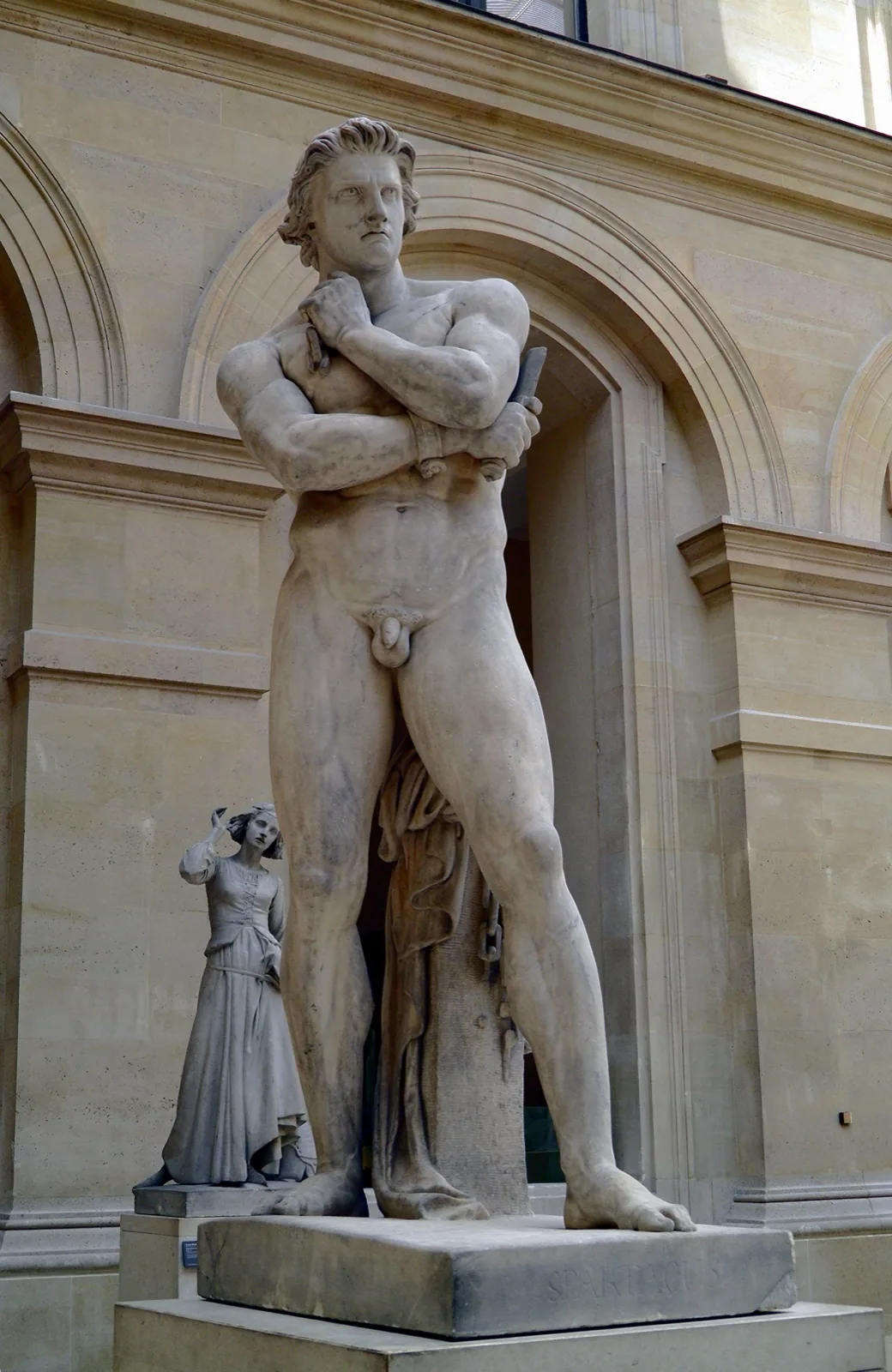
Spartacus was a Thracian gladiator who led the largest slave revolt in the history of the Roman Republic, from 73 to 71 BC. He and about seventy other fighters escaped from a training school in Capua, carrying kitchen knives and roasting spits. Over the next two years, their numbers grew to as many as 120,000 people, and they defeated one Roman army after another across the length of Italy. No enemy force had moved through Italy with such freedom since Hannibal's invasion more than a century earlier. Nearly everything known about Spartacus was written by the Romans who fought him. No word of his own survives.
How Spartacus's revolt began
Spartacus was born in Thrace, along the Strymon river in present-day Bulgaria. He may once have fought for Rome as an auxiliary soldier. At some point he was enslaved and sold to the gladiatorial training school of Lentulus Batiatus in Capua, south of Rome.
In 73 BC, the fighters at the school plotted an escape. The plot was betrayed, but about seventy of them fought their way out with whatever they could grab from the kitchen. Once outside, they seized wagons of gladiatorial weapons and climbed the slopes of Mount Vesuvius.
Rome sent a praetor named Gaius Claudius Glaber with about 3,000 militia to deal with what it considered a minor disturbance. Glaber blocked the one path down the mountain and waited. Spartacus's men wove ropes from wild grapevines growing on the slopes, lowered themselves down a cliff on the far side, and attacked the Roman camp from behind. They destroyed the force completely.
The victory drew followers from across the countryside. Escaped slaves and poor laborers joined Spartacus in growing numbers. Ancient writers put the total at the revolt's peak as high as 120,000. His army marched the length of Italy and back. Between 73 and 71 BC, his fighters defeated consular armies, forces led by Rome's two highest elected officials, in open battle. Rome had conquered most of the Mediterranean world. Losing pitched battles to escaped slaves was a humiliation its historians struggled to explain.
How Rome defeated Spartacus
What Spartacus actually intended remains unclear. Most historians think he planned to lead his followers north, over the Alps, and out of Roman territory to freedom. For reasons no ancient source explains, the army turned back south instead of crossing.
Rome gave command of the war to Marcus Licinius Crassus, the richest man in the Republic. Crassus found his legions demoralized by a string of defeats. To restore order, he revived decimation, an old punishment the Roman army had abandoned generations earlier. Soldiers were divided into groups of ten, and one man in each group, chosen by lot, was beaten to death by the other nine.
Crassus pushed Spartacus into the toe of southern Italy and built a line of ditches and walls to trap him there. Spartacus broke through once, but Crassus caught him at the Silarus River in 71 BC. Before the final battle, according to Plutarch, Spartacus killed his own horse. If he won, he said, he would have plenty of Roman horses. If he lost, he would not need one.
Spartacus fought his way toward Crassus in the battle, cutting down two centurions, but was killed before he reached him. His body was never identified on the field. After the fighting, Crassus crucified roughly 6,000 survivors along the Appian Way, the main road between Capua and Rome, and left the crosses standing. The Roman general Pompey, returning from a campaign in Spain, intercepted survivors fleeing north and claimed credit for ending the revolt. The dispute over who deserved the glory soured their relationship for years.
Why Spartacus became a symbol of resistance
Every surviving ancient account of Spartacus is Roman. The main sources, Plutarch, Appian, Sallust, and Florus, all wrote from Rome's side. Not a single word from Spartacus himself survives. The silence left a space that later generations filled with their own meaning.
In an 1861 letter to Friedrich Engels, Karl Marx called Spartacus 'the most splendid fellow in the whole of ancient history.' Toussaint Louverture was hailed as the 'Black Spartacus' during the Haitian Revolution. In 1916, Rosa Luxemburg and Karl Liebknecht called their antiwar group in Germany the Spartacus Group. Its failed Berlin uprising in January 1919 is remembered as the Spartacist revolt. Stanley Kubrick's 1960 film, and its famous 'I am Spartacus' scene, brought the story to audiences worldwide.
Spartacus may have wanted nothing more than to lead his followers to safety beyond Roman borders. But the revolt he led, and the crucifixions that followed, turned his name into one of the most enduring symbols of resistance against slavery.