
Henry Kissinger
Henry Kissinger was the US secretary of state who opened relations with China and shaped American foreign policy from 1969 to 1977.
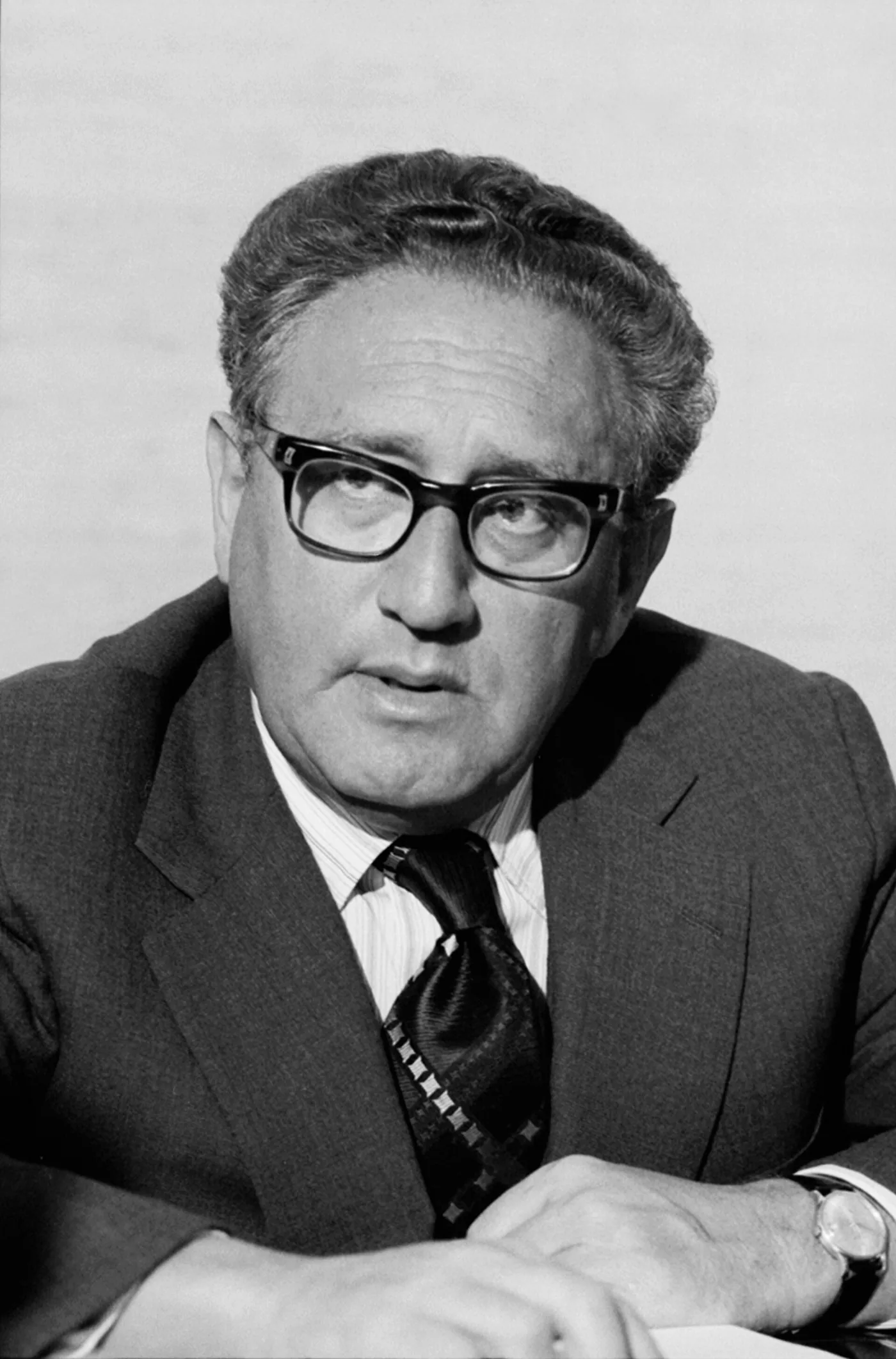
Henry Kissinger was the national security adviser and secretary of state who ran American foreign policy from 1969 to 1977, under Presidents Richard Nixon and Gerald Ford. Born in Germany, he fled the Nazis as a teenager, returned in a US Army uniform, and became one of the most powerful diplomats of the twentieth century. Kissinger opened relations with China, negotiated nuclear weapons agreements with Moscow, and won the Nobel Peace Prize for ending American involvement in Vietnam. He also played a direct role in American policies toward Cambodia, Bangladesh, Chile, and East Timor that cost many thousands of lives and made him one of the most debated figures in American history. He died on November 29, 2023, at one hundred years old.
How Kissinger rose from refugee to secretary of state
Kissinger was born Heinz Alfred Kissinger on May 27, 1923, in Fürth, a city in Bavaria, Germany. His family was Jewish. In 1938, when he was fifteen, they fled Nazi Germany. Thirteen of his relatives who stayed behind were murdered in the Holocaust.
Kissinger was drafted into the US Army, became an American citizen, and returned to Germany in uniform. He worked in counterintelligence, interrogating captured soldiers and helping to administer occupied towns. After the war he studied at Harvard. His doctoral dissertation examined the diplomacy of Metternich and Castlereagh at the Congress of Vienna of 1815. His conclusion from that history shaped everything that followed: peace depends on an arrangement of power that every major state can live with. A legitimate international order, in Kissinger's thinking, is simply one that no major power has reason to overturn. The real danger, Kissinger held, comes from revolutionary states that reject the arrangement itself.
In 1969, Richard Nixon made Kissinger his national security adviser. In 1973, Nixon also appointed him secretary of state, making Kissinger one of the few people to hold both jobs at once. He kept the secretary of state role under Gerald Ford until January 1977.
How Kissinger opened relations with China
In July 1971, Kissinger flew in secret from Pakistan to Beijing and held two days of meetings with Chinese Premier Zhou Enlai. He arranged for Nixon to visit China the following February, the first time a sitting American president met with leaders of the People's Republic. The move exploited the split between China and the Soviet Union. By talking to both, Washington gained better relations with Moscow and Beijing than either had with the other.
The same years produced a broader set of agreements with the Soviet Union, a policy known as detente. Kissinger and Nixon negotiated the SALT I treaty and the Anti-Ballistic Missile Treaty, the first agreements to place limits on American and Soviet nuclear arsenals. These were followed by the Helsinki process, which established shared rules between the two blocs on security and human rights.
When Egypt and Syria launched a war against Israel in October 1973, Kissinger spent months flying between Middle Eastern capitals in a practice that reporters called shuttle diplomacy. He extracted disengagement agreements between the combatants and drew Egypt away from Moscow and toward Washington, a shift that reshaped the region's alliances for decades.
Why is Henry Kissinger controversial?
In 1969, Kissinger and Nixon began a secret bombing campaign against Cambodia, a neutral country. In the initial phase, called Operation Menu, American planes flew 3,875 sorties and dropped over 100,000 tons of bombs. The bombing was concealed from Congress. It killed tens of thousands of Cambodian civilians and helped create the conditions in which the Khmer Rouge rose to power.
In 1971, Kissinger and Nixon supported Pakistan's military during its killings in East Pakistan, which later became Bangladesh. They did so because Pakistan served as the secret channel to Beijing. In Chile, the Nixon administration tried first to block and then to weaken the elected government of Salvador Allende. When General Augusto Pinochet overthrew Allende in a military coup on September 11, 1973, Washington welcomed the new government. In 1975, Kissinger gave Indonesia's President Suharto what amounted to approval ahead of Indonesia's 1975 invasion of East Timor.
Kissinger won the 1973 Nobel Peace Prize alongside Le Duc Tho of North Vietnam for the Paris Peace Accords, signed on January 27, 1973, which ended direct American involvement in Vietnam. Le Duc Tho declined the prize. Two years later, in April 1975, Saigon fell to North Vietnamese forces.
Kissinger's defense was that leaders must make decisions among poor choices with limited time and imperfect knowledge, and that refusing to make a hard calculation usually produces a worse result. His critics answered that his judgments were frequently mistaken even by the standards he set, and that the civilians who suffered had no say.
Kissinger's influence on American foreign policy
Kissinger introduced several ideas that became standard vocabulary in American diplomacy. Linkage means connecting separate negotiations so that progress in one depends on the other. Triangulation means using a third power to gain leverage over two rivals. Constructive ambiguity means leaving the wording of an agreement vague enough that both sides can accept it. Kissinger argued that dealing with unpleasant governments is sometimes necessary to protect America's interests.
After leaving office, Kissinger remained active for decades. He ran a consulting firm, wrote books on diplomacy and world order, and advised presidents of both parties. At the time of his death, he was still writing and still visiting Beijing. The terms he introduced, and the arguments about what they cost, are still part of how American foreign policy is discussed.