
Gulag
The Gulag was the Soviet Union's forced-labor camp system, through which roughly eighteen million people passed between 1930 and 1953.
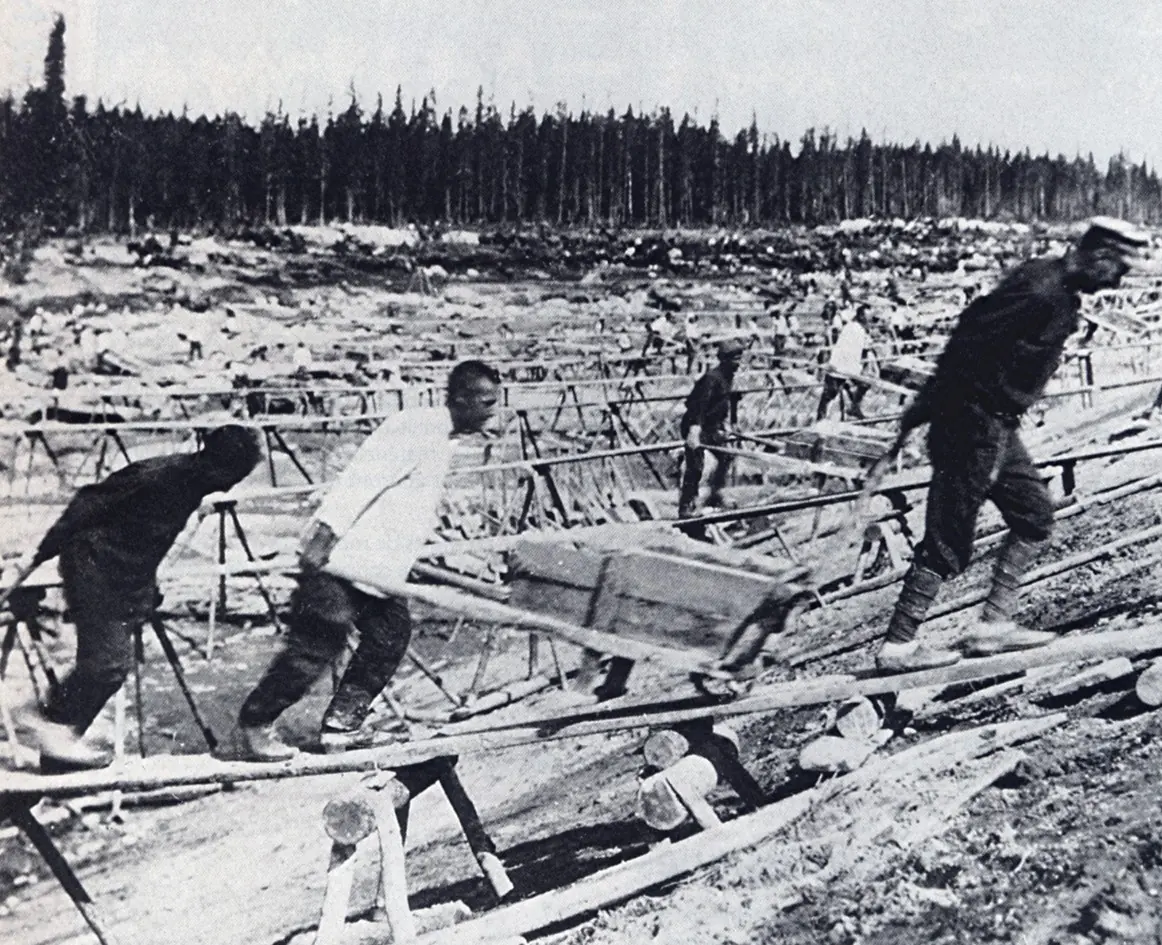
The Gulag was the Soviet Union's system of forced-labor camps. The name is a Russian acronym for the Chief Administration of Corrective Labor Camps, run by the Soviet secret police. Between 1930 and 1953, roughly eighteen million people moved through its network of camps and labor colonies, and more than 1.5 million of them died in custody. The system served two purposes: political repression and forced labor. Stalin's industrialization plans needed workers in places where no free person would go, and prisoners cost little or nothing in wages. That demand for free labor drove the system's expansion.
How Stalin built the camps
The camps existed before Stalin, but he expanded them into an economic system that stretched across the Soviet Union. Beginning in the late 1920s, the government forced millions of peasants onto collective farms. The secret police arrested or deported those who resisted, and the camps filled with them first.
Then came the Great Purge of 1937 and 1938. Stalin turned on his own Communist Party, the military, and the intelligentsia. The state convicted people of "counter-revolutionary activity" under Article 58 of the criminal code, often on fabricated evidence. During World War II, Stalin deported entire nationalities to Central Asia and Siberia on suspicion of disloyalty. The deported groups included Chechens, Crimean Tatars, and Volga Germans. The state treated Soviet soldiers who returned from German captivity as suspects for having survived.
In Norilsk, north of the Arctic Circle, prisoners mined nickel. At Kolyma, in the far northeast, they dug for gold in temperatures that dropped below minus fifty degrees Celsius. Kolyma was so remote that prisoners reached it by a sea voyage up the Pacific coast. They cut timber, laid railways through frozen ground, and dug canals. The most famous project was the White Sea Canal, built between 1931 and 1933 largely with hand tools. Thousands of prisoners died during its construction. A book commissioned from leading Soviet writers praised the canal as proof that hard labor could transform prisoners into useful citizens.
How the camps killed
Food rations in the Gulag depended on how much a prisoner produced. Those who hit their daily work quota received barely enough to survive. Those who fell short received less, which left them weaker, which meant they produced less, which meant they ate even less. The system killed people without anyone giving an order to do so.
The regime classified ordinary criminals as "socially close" and gave them authority over political prisoners. The politicals, many of them educated professionals convicted on fabricated charges, were the lowest group in the camp hierarchy and did the hardest labor.
The most lethal camps were in the far north and east. They sat in places so cold and remote that escape was nearly impossible. As an economic system, the Gulag was poor. Starving, coerced workers are unproductive. The camps required a large guard force, and the accounting was dishonest.
How many people died in the Gulag?
Soviet archives opened after 1991 give the clearest count. About eighteen million people in total moved through the Gulag's camps and labor colonies from 1930 to 1953. The camp population peaked at about 2.5 million in the early 1950s. Archival records show that between 1.5 and 1.7 million people died in custody. The real number is likely higher, because the records did not count everyone.
Many more died shortly after release, weakened by years of forced labor and malnutrition. Millions of others were sent into internal exile, a parallel system that moved entire populations to remote areas without formal imprisonment. Deaths in exile are harder to count. The figures are disputed at the margins, but the scale is not.
What happened to the Gulag after Stalin died?
Soviet leader Joseph Stalin died in March 1953, and the Gulag began shrinking almost immediately. Prisoners staged strikes in several camps, and the government granted amnesties. In 1956, Stalin's successor, Nikita Khrushchev, gave his "secret speech" denouncing Stalin's crimes, and review commissions freed about 100,000 prisoners. The government shut down the camp economy after finding it could not pay for itself. The Soviet state still locked up political dissidents on a smaller scale through the 1980s, until perestroika brought the practice to an end.
The outside world learned the full scale of the camps largely from one book. Aleksandr Solzhenitsyn was an army officer arrested in 1945 for criticizing Stalin in a private letter. He spent eight years as a prisoner. In December 1973, he published The Gulag Archipelago in Paris, drawing on his own experience and the accounts of 227 other survivors. The Soviet government expelled him in February 1974. The book turned the camps from a disputed allegation into a documented fact.
Russia never tried the people who ran the camps. There was no equivalent of the Nuremberg trials, and no senior official faced a courtroom for the camps. Memorial, a group that spent more than thirty years gathering the names and stories of victims, was ordered closed by a Russian court in December 2021. The cities the camps built, Norilsk and Vorkuta, still stand. The reckoning with what happened in them never finished.