
Perestroika and Glasnost
Perestroika and glasnost were Soviet leader Mikhail Gorbachev's reforms to restructure the economy and open public debate, introduced from 1985 to 1991.
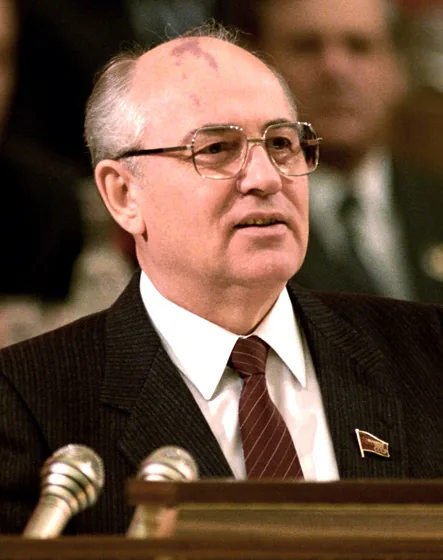
Perestroika (restructuring) and glasnost (openness) were two policies introduced by Soviet leader Mikhail Gorbachev starting in 1985. Perestroika aimed to reform the Soviet economy by allowing limited market activity within the state-controlled system. Glasnost loosened censorship and invited public criticism of the government. Gorbachev intended both reforms to preserve the Soviet system by making it more efficient and more honest. Instead, the economic changes disrupted production without replacing the old system, and the political openness gave a voice to movements that wanted to leave the Soviet Union entirely. Within six years, the Soviet Union dissolved into fifteen independent states, and the system Gorbachev tried to repair ceased to exist.
How Gorbachev tried to reform the Soviet Union
Gorbachev became General Secretary of the Communist Party in March 1985, at the age of 54. The three men who held the post before him had all died in office within about three years: Leonid Brezhnev in 1982, Yuri Andropov in 1984, and Konstantin Chernenko in 1985. Gorbachev came from a peasant family in southern Russia. His parents named him Viktor at birth, but his mother and grandmother, both devout Christians, had him secretly baptized and renamed Mikhail. He worked as an assistant combine harvester operator on a collective farm as a teenager before studying law at Moscow State University.
The Soviet economy Gorbachev inherited was stagnant. Consumer goods were scarce, and the gap with Western economies was growing. His economic response came in two stages. In 1987 the Law on State Enterprise let factories keep profits beyond their state orders and make their own decisions about production. In May 1988 the Law on Cooperatives allowed small private businesses for the first time in about sixty years, since Stalin's forced collectivization ended the last remnants of private enterprise. But the reforms did not replace central planning with a functioning market. They loosened the old system enough to disrupt supply chains while leaving nothing coherent in their place. Production fell, inflation rose, and shortages got worse.
Gorbachev also introduced limited democracy. In March 1989 the Soviet Union held its first contested elections, for the new Congress of People's Deputies. The physicist and dissident Andrei Sakharov won a seat. The sessions were televised live, and millions of people across the country watched their representatives openly criticize the government for the first time.
How glasnost turned against the system
The event that pushed glasnost from policy to crisis was the Chernobyl nuclear disaster. On April 26, 1986, a reactor at the Chernobyl plant in northern Ukraine exploded. The Soviet government said nothing for two days while a radioactive cloud spread west. Sweden detected the radiation before Moscow admitted what had happened. Gorbachev himself did not address the public for more than two weeks. The cover-up embarrassed him and strengthened the case for greater openness.
Once censorship loosened, it proved difficult to control. Newspapers reported on shortages, corruption, and the private privileges of Communist Party officials. Then glasnost reached the Soviet past. Publications began documenting the show trials, the forced famines, and the millions killed under Stalin. The gulag system entered public discussion. A government that had spent decades insisting only it could be trusted was now admitting it had lied.
Openness also allowed national independence movements to organize openly. On August 23, 1989, about two million Estonians, Latvians, and Lithuanians joined hands in a human chain stretching 675 kilometers across the three Baltic states. Across Eastern Europe that year, Gorbachev chose not to send troops to prop up communist governments, breaking with the Brezhnev Doctrine. One government after another fell, and in November the Berlin Wall opened.
What is the difference between perestroika and glasnost?
Perestroika, meaning "restructuring" in Russian, was the economic policy. It introduced market elements into the Soviet command economy, including letting state enterprises keep profits, allowing private cooperatives, and reducing the role of central planning ministries. Glasnost, meaning "openness," was the political and cultural policy. It relaxed censorship, allowed criticism of the government in the press, and opened discussion of crimes committed under previous Soviet leaders.
Gorbachev saw the two as working together. He believed the economy could not be reformed without honest public discussion of its problems, and that honest discussion required loosening the Communist Party's control over information. In practice, glasnost moved faster and went further than Gorbachev intended, while perestroika struggled to produce results. The openness revealed problems that the economic reforms could not fix quickly enough.
Why did perestroika fail?
Perestroika failed because the reforms were too partial to create a working system. The new laws weakened central planning without building a functioning market to replace it. Factories lost their guaranteed supplies but had no reliable way to find new ones. The result was falling production and worsening shortages, and thanks to glasnost, people could openly say so.
The political reforms created pressures Gorbachev had not anticipated. Contested elections brought critics into government. Open debate gave nationalist movements in the Baltic states, Georgia, Ukraine, and other republics a platform to demand independence. Gorbachev had intended to strengthen the Soviet system, but the combination of economic disruption and political opening weakened it faster than any reform could repair.
Gorbachev won the Nobel Peace Prize in 1990 for his role in ending the Cold War peacefully. At home, he was widely blamed for the economic crisis and the loss of the empire. He resigned as president on December 25, 1991, the day before the Soviet Union formally ceased to exist. He died on August 30, 2022, at the age of 91. Perestroika and glasnost remain one of the most significant attempts to reform a communist state from within, and their failure ended the Soviet Union and reshaped the political map of Europe and Central Asia.