
Hagia Sophia
The cathedral Justinian built in Constantinople in 537, now a mosque in Istanbul after nearly 1,500 years as a cathedral, mosque, and museum.
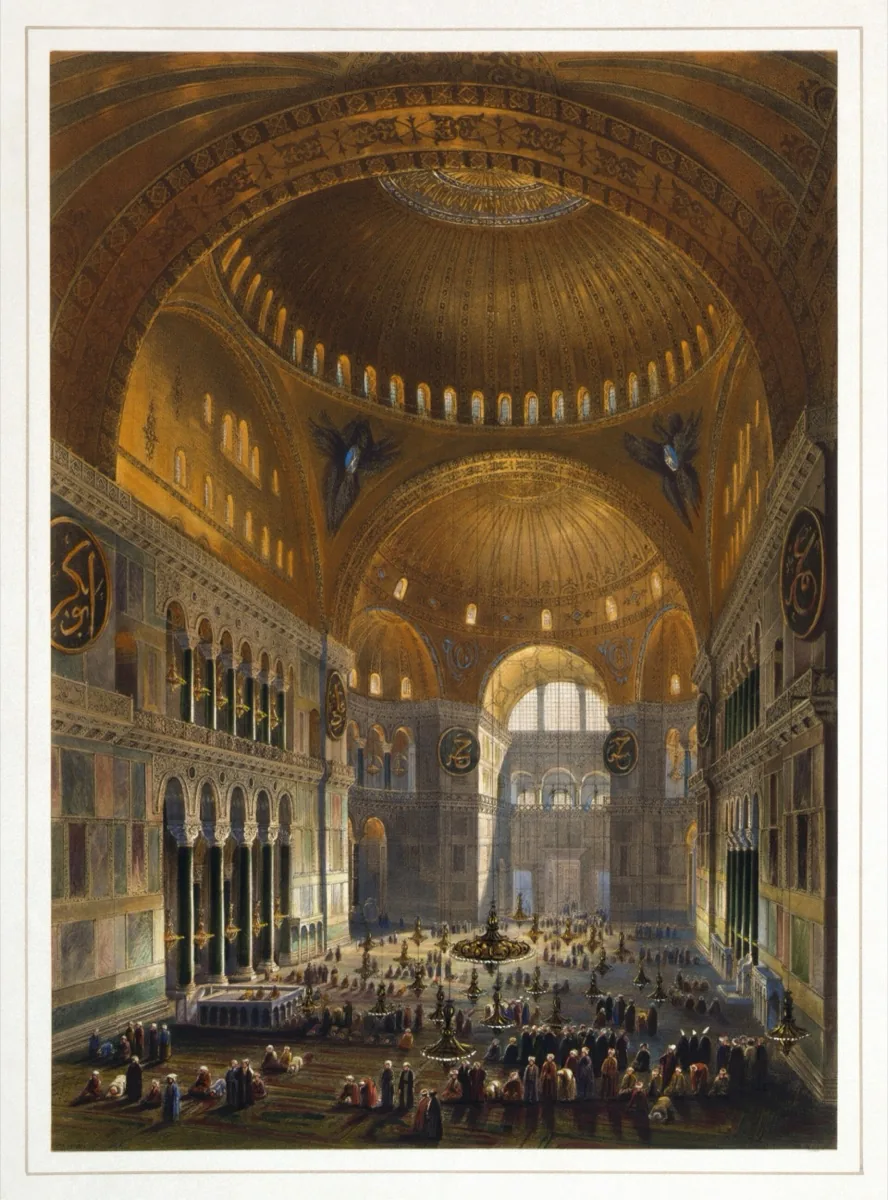
Hagia Sophia is a sixth-century building in Istanbul that has served as a cathedral, a mosque, a museum, and a mosque again over the course of nearly 1,500 years. The Byzantine emperor Justinian built it as the main cathedral of Constantinople, and it was dedicated in December 537. Its dome, about 31 meters across and 55 meters above the floor, made it the largest enclosed space in the world at the time. It held that record for nearly a thousand years. Forty windows ring the base of the dome, flooding the interior with light and making the dome appear to float. Writers who saw the finished cathedral said they could not explain how the building achieved this effect.
How Justinian built Hagia Sophia
In January 532, a week of riots called the Nika revolt burned much of Constantinople, including the cathedral that stood on the site. Justinian put down the revolt by force and then set out to rebuild the city on a larger scale. For the new cathedral he turned to Anthemius of Tralles and Isidore of Miletus, both trained as mathematicians. According to the historian Procopius, Justinian drew workers from across the empire. They built it in under six years, from February 532 to December 537.
The dome was the building's central achievement. Anthemius and Isidore set a round dome on a square base by using curved triangles called pendentives to carry the dome's weight down to four massive piers. The result was a vast open interior with no columns blocking the view.
The first dome was too flat for the mortar of the time. Earthquakes in 553 and 557 weakened the structure, and on May 7, 558, the dome collapsed, destroying the altar below it. Justinian, then in his seventies, ordered it rebuilt immediately. Isidore the Younger, nephew of one of the original designers, rebuilt the dome about six meters higher and steeper. That second dome, partly rebuilt after later earthquakes, has stood since 562.
Hagia Sophia as the center of an empire
Hagia Sophia stood as Eastern Christianity's most important church for close to a thousand years. Byzantine emperors were crowned inside it. In July 1054, Cardinal Humbert, a papal legate, walked into Hagia Sophia and placed a document on its altar excommunicating the Patriarch of Constantinople. That event is conventionally used to mark the formal split between Western and Eastern Christianity.
The building's fame reached far beyond Constantinople. The Russian Primary Chronicle records that envoys of Kievan Rus, sent to survey the world's religions, visited Hagia Sophia. They reported: "We knew not whether we were in heaven or on earth." Historians regard the account as a later addition to the chronicle, but it shows what the building meant to people who walked inside it. The story holds that the envoys' experience helped decide the choice of Orthodox Christianity for Kievan Rus.
In 1204, soldiers of the Fourth Crusade sacked Constantinople. The Crusade had been called to fight in the Holy Land, but the army turned on the largest Christian city in the world instead. The soldiers stripped Hagia Sophia of its silver, altar vessels, and relics. They replaced the Orthodox patriarch with a Latin one. The city never fully recovered.
How Hagia Sophia became a mosque
On May 29, 1453, the Ottoman sultan Mehmed II took Constantinople. He rode directly to Hagia Sophia and ordered it converted into a mosque within the same week. Mehmed claimed to be the successor of the Roman emperors, and the conversion was part of that assertion. Over the following century, workers added minarets to the exterior and installed a mihrab inside, angled toward Mecca. The Byzantine mosaics were covered in plaster over the following centuries, a process that ended up preserving them.
Hagia Sophia served as a mosque for 481 years. Ottoman architects spent much of that time building imperial mosques in response to Hagia Sophia's dome. The greatest of them, Mimar Sinan, built the Selimiye Mosque in Edirne, finished in 1575, with a dome that matched Hagia Sophia's at about 31 meters across.
Is Hagia Sophia a mosque or a museum?
Hagia Sophia is a mosque. In July 2020, Turkey's Council of State struck down the 1934 decree that had designated it a museum, and within weeks President Erdogan reopened it for Muslim prayer. The Greek government, several Orthodox churches, and UNESCO all protested. The decision was popular with Erdogan's religious-conservative base in Turkey.
The museum period lasted 86 years. In 1934, Mustafa Kemal Atatürk's government secularized the building as part of the new Turkish republic's break with its Ottoman past. When it opened as a museum in 1935, the Byzantine mosaics beneath the Ottoman plaster were being revealed. Hagia Sophia became part of a UNESCO World Heritage Site in 1985.
Today Hagia Sophia is officially the Hagia Sophia Grand Mosque. Foreign tourists pay a 25-euro entrance fee and follow a separate route through the upper galleries, where the most important surviving mosaics, including Byzantine imperial portraits, remain uncovered. On the ground floor, some mosaics are covered with curtains during prayer times.
Each of Hagia Sophia's changes of use was a statement by whoever held the city about how they saw themselves. The building has carried those statements for nearly 1,500 years.