
Mehmed II the Conqueror
Mehmed II was the Ottoman sultan who conquered Constantinople in 1453, ending the Byzantine Empire and making the city his new capital.
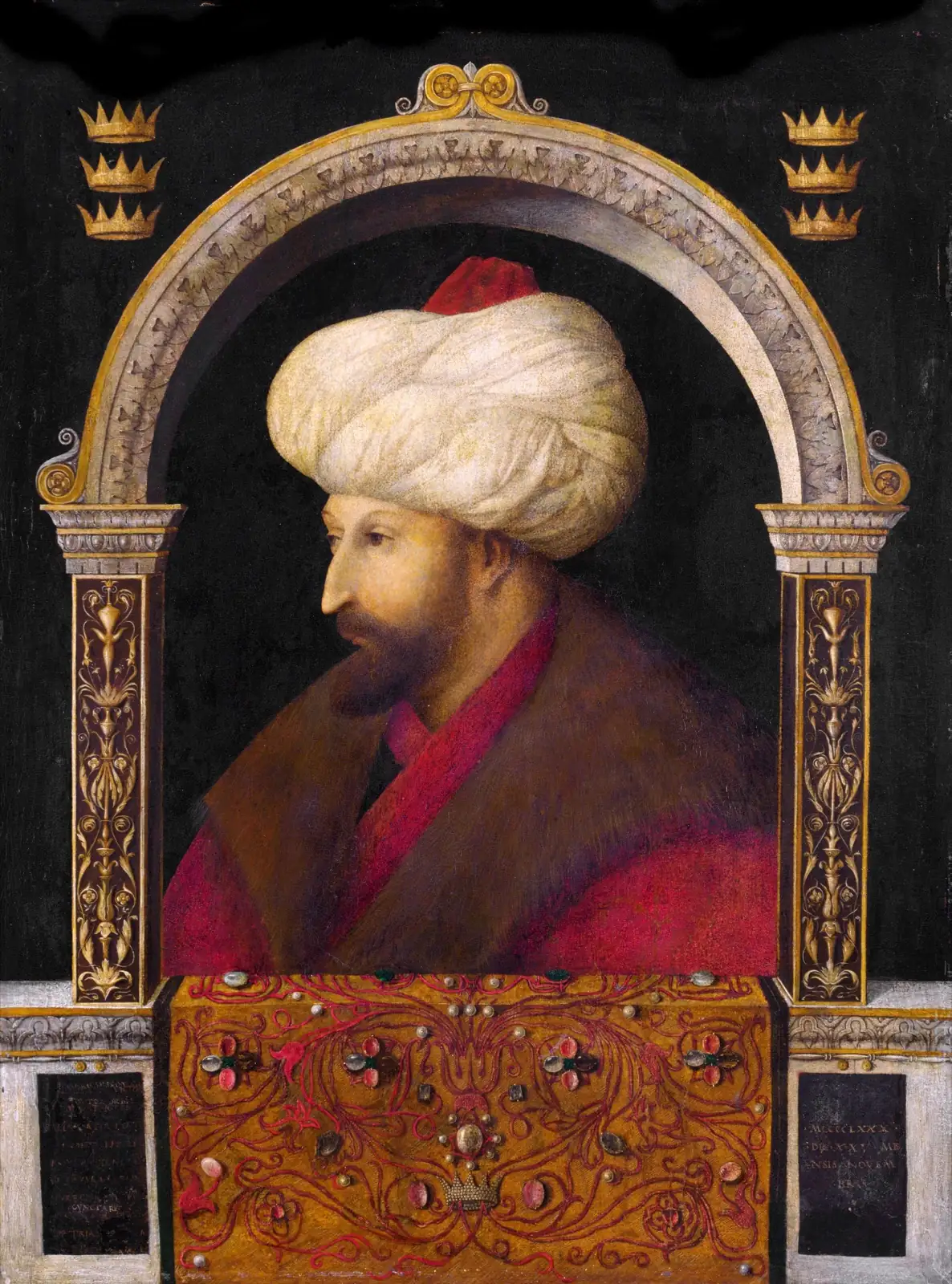
Mehmed II was the Ottoman sultan who conquered Constantinople on May 29, 1453. He was twenty-one years old. The city had been the capital of the Byzantine Empire for over a thousand years, and no Muslim army had ever taken it. Mehmed took it in fifty-three days. He did not destroy the city. He made it his own capital, later known as Istanbul, and took the title Kayser-i Rum, meaning Caesar of the Romans. Over the next thirty years he turned the Ottoman state into one of the largest empires in the world. He spoke several languages, collected Greek and Italian books, and invited a Venetian painter to his court to paint his portrait. Historians often treat 1453 as the end of the Middle Ages.
How Mehmed II took Constantinople
Mehmed was born in 1432, the son of Sultan Murad II. He was described by those who knew him as brilliant, brooding, and ruthless. From a young age he was fixated on Constantinople, the prize his ancestors had tried and failed to take. Mehmed became sultan for good in February 1451, at age eighteen, after his father died. He had briefly held the throne once before, from 1444 to 1446, when Murad abdicated, but his father returned to power after a military crisis on the western border.
In 1452 Mehmed built the fortress of Rumeli Hisari where the Bosphorus is at its narrowest, cutting off Constantinople's supply route from the Black Sea. He employed a Hungarian cannon-maker named Urban, who built bronze guns larger than any in Europe. The biggest fired stone projectiles that weighed more than 1,000 pounds.
The siege began on April 6, 1453. Mehmed had about 60,000 soldiers. The defenders, led by the Byzantine emperor Constantine XI Palaiologos, had roughly 7,000. Constantinople's Theodosian Walls were a triple line of fortifications that had stood for a thousand years. Mehmed's cannons cracked them open, and the defenders repaired the gaps each night. When a chain across the Golden Horn blocked his fleet, Mehmed ordered roughly seventy vessels dragged across land on wooden rollers and lowered into the water behind the barrier.
On May 29 the Ottomans broke through. Constantine XI removed his imperial regalia and charged into the final fighting. His body was never found with certainty. By nightfall the city had fallen and the last Roman emperor was dead. The fall of Constantinople shocked Christian Europe. Moscow's rulers later claimed their city was a Third Rome, heir to the empire Mehmed had ended.
How Mehmed II rebuilt Constantinople
Mehmed rode into the conquered city on a white horse and went straight to Hagia Sophia, which had been Christendom's greatest church for nearly a thousand years. He converted it into his imperial mosque. He built his palace, Topkapi, on the headland overlooking the harbor. Then he set about filling the city again. Constantinople had been shrinking for centuries, and Mehmed brought in Greeks, Armenians, Jews, and Muslims from other parts of his empire to repopulate it. He ordered the construction of mosques, markets, baths, and schools across the city.
He kept the Greek Orthodox patriarchate in existence and appointed the patriarch himself. Under the millet system, each religious community governed its own internal affairs. Mehmed saw himself as heir to both the Islamic and Roman traditions. He collected Greek and Latin manuscripts and brought the Venetian artist Gentile Bellini to Constantinople to sit for a portrait. Bellini's 1480 oil painting shows Mehmed in profile beneath a stone arch, wearing a large white turban.
Beyond Constantinople, Mehmed spent thirty years expanding the empire. He took the last Byzantine holdout at Trebizond in 1461 and overran the Morea in southern Greece. He waged a sixteen-year war against Venice, and in 1480 sent an Ottoman force of about 18,000 soldiers to Otranto in southern Italy. The force, commanded by Gedik Ahmed Pasha, held the city for over a year before withdrawing after Mehmed's death.
What languages did Mehmed II speak?
Mehmed spoke Ottoman Turkish, Arabic, Persian, and some Greek. Some sources also list Latin and Italian. He read widely in several of these languages and collected manuscripts from both the Islamic and classical Greek and Roman traditions. His interest in Greek and Latin set him apart from most rulers of his time and reflected his claim to be heir to Rome as well as the leader of an Islamic empire.
How did Mehmed II die?
Mehmed died on May 3, 1481, at age forty-nine. He was marching with his army through Anatolia to start another campaign when he fell ill near Gebze, east of Constantinople. The exact cause is uncertain. He had suffered from gout for years, and some historians attribute his death to his declining health. Some have suggested he was poisoned, possibly at the instigation of his eldest son Bayezid, but there is no firm evidence.
Mehmed's death set off a succession struggle between his two surviving sons, Bayezid and Cem. Bayezid won and ruled as Bayezid II from 1481 to 1512. In thirty years on the throne, Mehmed had turned a regional state into an empire that stretched from the Balkans to Anatolia. The empire lasted until 1922. Ottoman armies later besieged Vienna twice, and Mehmed's great-grandson Suleiman the Magnificent extended it to its greatest size.