
Congress of Vienna
The Congress of Vienna was the 1814–1815 conference that redrew Europe after Napoleon and kept the continent from general war for a century.
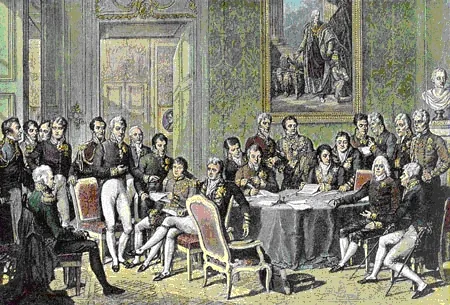
The Congress of Vienna was a conference of European leaders held in Vienna from September 1814 to June 1815, after the defeat of Napoleon. Four powers led the negotiations: Austria, Britain, Russia, and Prussia. France, though it had just lost the war against all of them, sent Charles-Maurice de Talleyrand, who won France a seat among the leading powers. Over nine months the diplomats redrew the map of Europe, built a ring of strengthened states around France, and created the Concert of Europe, a system of regular great-power meetings to manage crises without war. The settlement they produced kept Europe from a general war for nearly a century, until 1914.
How the Congress of Vienna redrew Europe
Austria's foreign minister, Klemens von Metternich, presided over the negotiations. Metternich was 41 years old, well-known across European courts for his charm and his many love affairs as much as for his diplomacy, and deeply conservative. He had watched the French Revolution sweep away monarchies across the continent, and he saw revolution and nationalism as forces that would destroy the old European order if left unchecked. His goal in Vienna was to restore Europe's royal families and keep the ideas of the revolution from spreading further.
Britain's representative was Viscount Castlereagh, the foreign secretary. Castlereagh cared more about geography than ideology. His main concern was that no single power should control the coast facing Britain across the English Channel, the same concern that had driven British foreign policy for centuries.
Tsar Alexander I of Russia arrived with the largest army in Europe and wanted Poland, most of which Russian troops already occupied. Prussia, allied with Russia, wanted the Kingdom of Saxony.
Talleyrand had the hardest job. He represented a defeated country sitting across from the nations that had defeated it. He was a former Catholic bishop who had served the French Revolution, then Napoleon, and now the restored Bourbon king, Louis XVIII. A clubfoot from infancy had left him with a permanent limp, ending any chance of a military career and directing him into the church instead. At Vienna, he argued for the principle of "legitimacy," the idea that Europe's rightful royal families should be restored to their thrones. The principle gave France common ground with the conservative powers and helped divide the coalition that had defeated it.
The hardest fight at the Congress was over Poland and Saxony. Russia and Prussia insisted on their claims. Britain and Austria resisted, worried that giving Russia all of Poland would make it too powerful. In January 1815, Britain, Austria, and France signed a secret treaty against Russia and Prussia. The threat of a new war forced a compromise. Russia got most of Poland but not all of it. Prussia received about two-fifths of Saxony, along with large territories in the Rhineland.
The Congress built a ring of strengthened buffer states around France. The Kingdom of the Netherlands was enlarged to include what is now Belgium. Prussia's new Rhineland territory put a major military power on France's northeastern border. Piedmont-Sardinia, in northern Italy, was given the port of Genoa. The old Holy Roman Empire, which Napoleon had dissolved in 1806, was not brought back. In its place the Congress created a German Confederation that grouped 39 states under a framework too decentralized to alarm any major power but large enough to provide stability in central Europe. The Congress also guaranteed Swiss neutrality and declared against the slave trade, though it set no deadline for ending it.
The Final Act was signed on June 9, 1815, nine days before the Battle of Waterloo ended Napoleon's last attempt at power.
What was the Concert of Europe?
The Concert of Europe was the diplomatic system that grew out of the Congress of Vienna. The great powers agreed to meet in congresses whenever a crisis threatened European stability, rather than settling disputes by war alone. They met at Aix-la-Chapelle in 1818, Troppau in 1820, Laibach in 1821, and Verona in 1822.
In practice, Austria's foreign minister Metternich and Tsar Alexander I used the Concert mainly to crush liberal and nationalist uprisings. When revolts broke out in Spain, Naples, and Piedmont in the early 1820s, the Concert authorized military interventions to restore the old monarchies. When revolutions swept across Europe in 1830 and again in 1848, the Concert's members put down most of them.
The Concert was conservative and often repressive. But it created something new in European politics: the expectation that major powers would negotiate before going to war. That idea outlasted the Concert itself and shaped the League of Nations after World War I and the United Nations after World War II.
Did the Congress of Vienna succeed?
By one measure, clearly. There was no general war across Europe between 1815 and 1914, a span of 99 years. There were wars during that period, including the Crimean War in the 1850s and the wars that unified Italy and Germany between 1859 and 1871. But none of them drew in every major power the way the Napoleonic Wars had or the way World War I would.
The settlement's weakness was that it tried to hold Europe in its existing order. Metternich and the other conservative leaders could slow the spread of constitutions and the growth of nationalism, but they could not stop those forces permanently. By 1871, both Italy and Germany had unified into nation-states, redrawing the borders the Congress had set. The multinational empires that the Congress had reinforced, the Austrian Empire among them, spent the rest of the century weakening from within.
Henry Kissinger wrote his 1954 doctoral thesis on Metternich and Castlereagh. It was later published as the book "A World Restored." Scholars of international relations still study the Vienna settlement as an example of how calculated diplomacy can produce a stable order. The Congress of Vienna did not prevent all wars. But it gave Europe nearly a century without a continental one, and the practice of great-power negotiation it established, building on the earlier Peace of Westphalia, became a lasting part of how nations deal with each other.