
Ulama
The ulama are the scholars of Islamic law, whose authority comes from learning rather than ordination.
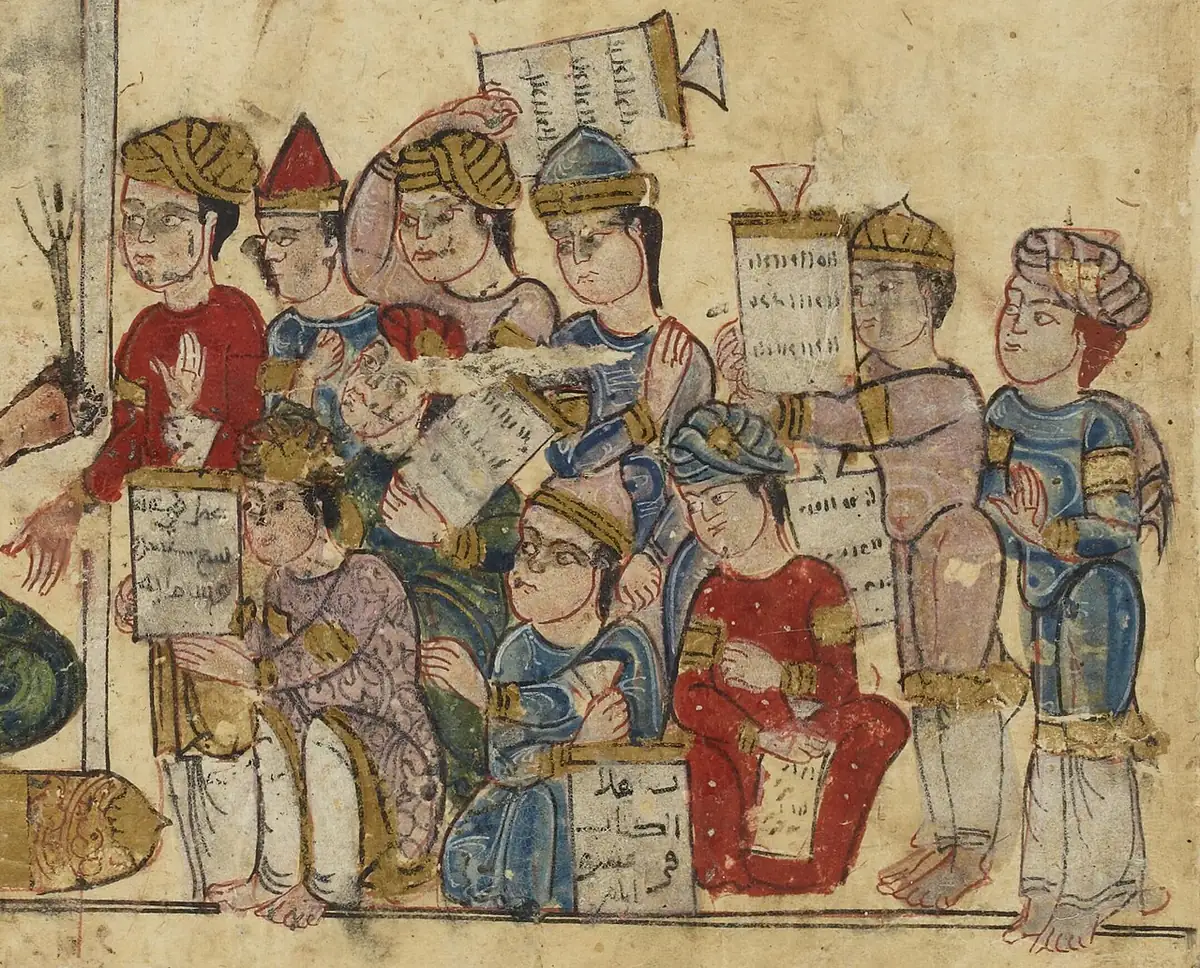
In Islam, the ulama are the people trained to interpret the Quran, the hadith, and the body of legal rulings built on them. The singular is alim, Arabic for "one who knows." Unlike Christian clergy, the ulama have no ordination ceremony, no rituals reserved for them alone, no institutional hierarchy like the Catholic Church, and no single figure at the top. In Sunni Islam there is no formal ranking among scholars at all. What makes someone an alim is learning, demonstrated and vouched for by other scholars. For fourteen centuries the ulama have served as the judges, teachers, and legal advisors of the Muslim world, and the tension between their religious authority and the political power of rulers has run through every era of Islamic history.
How someone became one of the ulama
The path to becoming an alim ran through years of study under an established scholar, ending with an ijaza, a certificate confirming the student's competence in a given text or field of law. There was no central examining board. A scholar trained at one end of the Muslim world could be taken seriously at the other, because the chain of teacher-to-student relationships stretched across borders and generations.
The ulama filled several distinct roles. A qadi served as a court judge, appointed by the ruler to settle disputes under Islamic law. A mufti answered legal questions by issuing fatwas, opinions that carried moral weight but were not enforceable on their own. A mudarris ran instruction at a madrasa. An imam led congregational prayer at a mosque, a function rather than a title of authority.
Centers of learning like Al-Azhar in Cairo, founded in 970, and the seminary cities of Najaf in Iraq and Qom in Iran became the places where reputations were built. These institutions were supported by waqf, a type of permanent trust. A donor would set aside land or property whose income was dedicated forever to a mosque, school, or hospital. Because waqf property could not be confiscated or resold, it gave scholars a source of funding that rulers could not take away.
How the ulama and rulers depended on each other
Political rulers depended on the ulama to declare their rule just, their wars permitted, and their taxes valid. Scholars depended on rulers to put their rulings into practice. Neither side could function well without the other.
The mainstream Sunni position held that even a bad ruler was better than civil disorder, and that scholars should advise and criticize rather than take up arms. But scholars also drew lines. Abu Hanifa was an eighth-century jurist whose legal school became the most widely followed in Islam. He refused the caliph al-Mansur's demand to serve as chief judge and was imprisoned for it. He died in a Baghdad prison in 767. Ahmad ibn Hanbal, founder of another major legal school, was chained, flogged, and locked up for two years in the 830s. His offense was refusing to accept the caliph al-Ma'mun's position on whether the Quran was created or had existed eternally. Both chose confinement over obedience, and both became more respected for it.
Different states organized the relationship differently. The Ottoman Empire built a hierarchy of paid religious posts with the shaykh al-Islam at the top, a government-salaried cleric whose formal approval was required before a sultan could be deposed. The shaykh al-Islam issued the fatwas that removed Sultan Ibrahim in 1648 and Sultan Abdulhamid II in 1909. The Safavid Empire in Iran brought Shia scholars from Lebanon and Iraq to provide religious backing for its new Shia state, and later discovered those scholars had agendas of their own. Over time, Shia scholarship developed an explicit hierarchy of seniority absent from Sunni Islam. At its peak sits the marja al-taqlid, a senior cleric recognized by his followers as the highest living authority, whose legal opinions they are expected to follow.
How modern states took away the ulama's independence
Starting in the nineteenth century, modernizing governments across the Muslim world nationalized waqf trusts, cutting off the scholars' independent funding. They opened state-run schools and courts, ending the scholars' hold on education and justice. Governments adopted European-style legal codes that pushed Islamic law to the margins, mostly marriage, divorce, and inheritance. In the space of a few decades, people who had once run the courts, the schools, and the charities found themselves drawing government salaries as employees of state religious ministries.
The fallout reshaped politics across the Muslim world. Organizations like Egypt's Muslim Brotherhood, founded in 1928, were led by laypeople, not trained scholars. Several of the most influential radical Islamist writers of the twentieth century had no formal training as religious scholars. Sayyid Qutb, whose ideas later shaped al-Qaeda, was a literary critic by training. Their common claim was that the established ulama had traded their independence for a paycheck.
The ulama today
Iran tested a different idea. Ayatollah Khomeini claimed that while the hidden Imam remained in occultation, qualified jurists had not just the right but the duty to govern. In 1979 he and his allies seized power on that basis, creating a modern state run by Islamic scholars. Most senior Shia clerics outside Iran, including the most senior marja in Najaf at the time, rejected the idea that clerics should hold political power directly.
Across the rest of the Muslim world, religious authority has splintered. A government that wants a religious endorsement turns to a scholar on its payroll. An armed group that needs religious backing recruits a sympathetic cleric willing to supply it. Ordinary believers increasingly look to online preachers and social media personalities with little or no formal training. The question that has run through the ulama's entire history, who has the standing to say what Islam requires, remains open. No single person or institution can settle it.