
Roman Legion
A Roman legion was a unit of about 5,000 professional soldiers that formed the core of Rome's army from the Republic through the Empire.
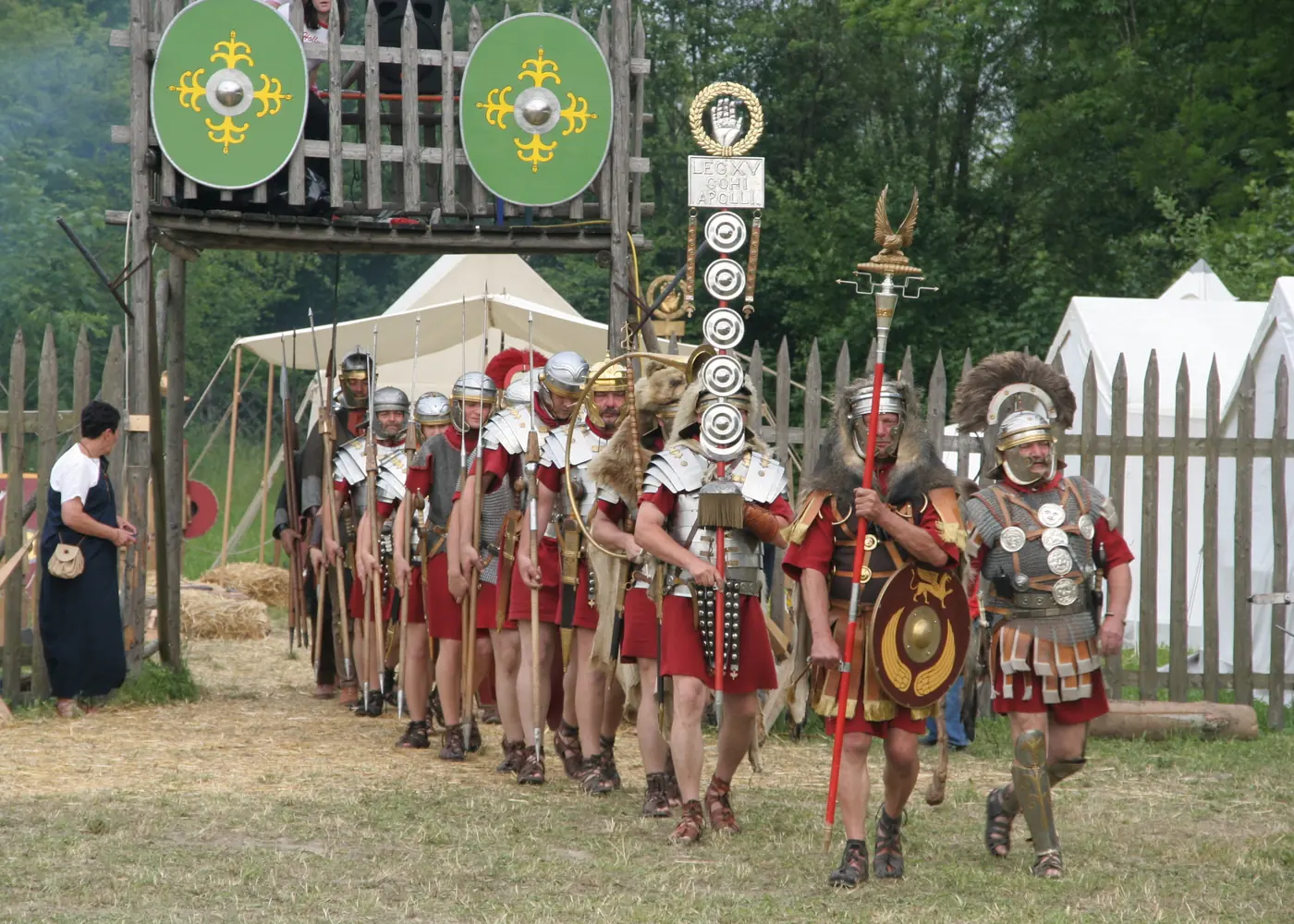
A Roman legion was a unit of about 5,000 heavy infantry that served as the core of Rome's army from around the fourth century BC through the fall of the western Empire. It was owned by the Roman state, not by any individual ruler, and it could be destroyed in battle and rebuilt without losing its name or identity. Rome's enemies relied on individual warriors fighting for personal glory. Rome fielded something different: a standardized organization where every soldier carried the same weapons, followed the same orders, and held a fixed place in the line. That system helped a single city on the Tiber River conquer and hold the entire Mediterranean world.
How the Roman legion was organized
A legion was divided into ten cohorts, and each cohort into six centuries. Despite the name, a century held about 80 men, not 100, grouped into tent parties of eight called contubernia. The eight soldiers in a contubernium shared a tent on campaign and a barrack room in a permanent fort. The first cohort was double-sized, with about 800 soldiers, and carried the legion's eagle standard, the aquila. A full-strength legion had roughly 5,000 to 5,500 men. At the height of the empire, Rome maintained about 28 legions posted from Britain to Syria.
The standard legionary kit included the gladius, a short sword designed for close-range stabbing, and two pila, heavy javelins with soft iron shanks that bent on impact so an enemy could not throw them back. Legionaries also wore body armor and carried the scutum, a tall curved shield that covered them from shoulder to knee. Soldiers drilled constantly until they could form, reform, and maneuver in battle without hesitation. A legion could lose its commander and keep fighting, because the chain of command ran all the way down to the century level.
The officer who held the legion together day to day was the centurion. Centurions were career soldiers promoted from the ranks. They trained the men, enforced discipline, and led from the front. The senior centurion, called the primus pilus, commanded the first century of the first cohort and sat in the legion's war council. The centurion fills the same role that a senior sergeant fills in modern armies.
A unit that broke and ran in battle could face decimation: one out of every ten soldiers, selected at random, was beaten to death by the other nine. The punishment was rare, but the threat reinforced the expectation that no legionary would abandon his position.
How the Marian reforms changed the Roman army
Before the reforms, only Roman citizens who owned land could serve. They paid for their own weapons and armor, and when the war ended they went home to work their fields. The army assembled when Rome needed it and disbanded when the fighting ended. That system worked for a city-state defending nearby territory. It did not work for an empire fighting wars in Spain, North Africa, and Greece at the same time.
Around 107 BC, the general Gaius Marius changed the rules. Marius was not a Roman aristocrat. He was born around 157 BC near the town of Arpinum, about 60 miles southeast of Rome, the same small town where Cicero grew up half a century later. His father was a farmer, and ancient sources describe Marius as rough in speech and unpolished in manner. He first served as a soldier in Spain in 134 BC and spent the next decade as a junior officer before entering politics. He eventually served as consul seven times, more than any Roman before him.
Marius opened the legions to the capite censi, the landless poor who owned no property. The state armed, equipped, and paid them. For the first time, Rome had a professional standing army of career soldiers who remained in the ranks for years.
The reform solved one problem and created another. Professional soldiers depended on their general for their wages, their equipment, and the grant of land they expected when they were discharged. Their loyalty shifted from the Roman Senate to the commander who provided for them. Within a generation, generals could march their own legions against Rome itself. Julius Caesar crossed the Rubicon with one of his legions in 49 BC and seized power. The civil wars that followed ended the Republic and produced the Empire under Augustus.
The roads and forts that Roman legions built
Legionaries spent as much time building as fighting. Every evening on the march, a legion dug a fortified camp with earthen walls, a ditch, and a wooden palisade. The camp layout was standardized, so any soldier from any legion could walk into one he had never seen and know where to find headquarters, the hospital, and his unit's position.
On a larger scale, legions built Rome's road network. By the height of the empire, paved Roman roads stretched roughly 50,000 miles across Europe, North Africa, and the Middle East. The roads were built for durability, with layered stone, drainage ditches, and a cambered surface to shed water. Many lasted centuries. They let armies march about 20 miles a day, but they also carried trade, mail, and government officials, connecting distant provinces to Rome.
Legions also built the frontier walls and permanent forts that marked Rome's borders. Hadrian's Wall in northern Britain, begun around 122 AD, stretched 73 miles across the island and took legionaries years to complete. Where legions settled permanently, Latin, Roman law, coinage, and Roman customs followed. Towns grew up around permanent camps. Border provinces gradually became Roman not just in law but in language and culture. The long period of relative peace that resulted, later called the Pax Romana, depended on this network of roads, forts, and settled veterans as much as it depended on the soldiers who patrolled the frontiers.
The legion's most lasting contribution was the idea itself: a permanent military organization with a defined hierarchy, career officers, standardized equipment, and built-in logistics and engineering. Every modern army that drills its soldiers in set formations, maintains a rank structure, and builds its own fortifications works within a system the Romans developed about two thousand years ago.