
Augustus
Augustus was Rome's first emperor, who ended a century of civil war and built a monarchy while keeping the appearance of a republic.
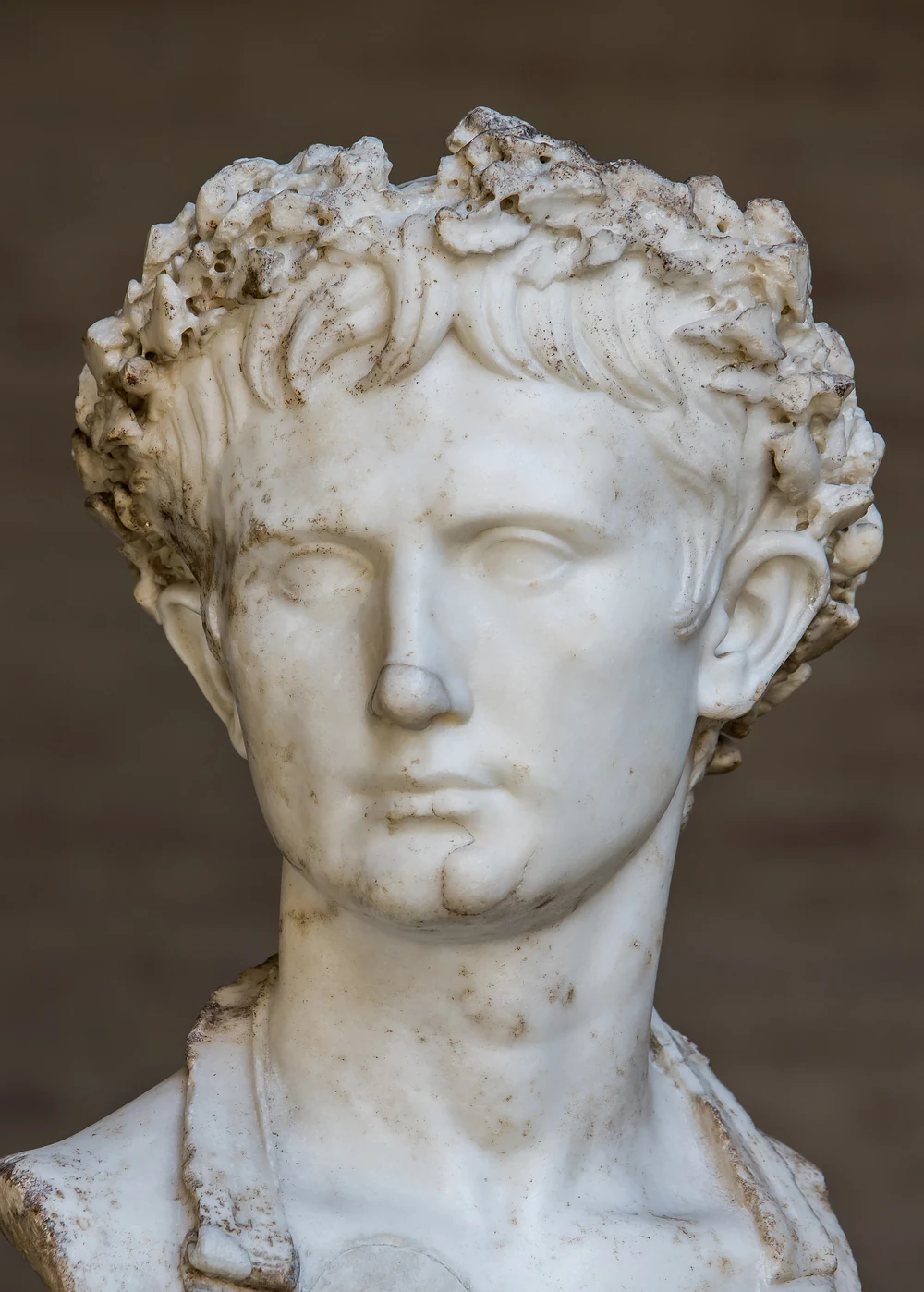
Augustus was the first emperor of Rome. His birth name was Gaius Octavius, and he was born in 63 BCE. His great-uncle Julius Caesar named him as adopted son and heir in his will, and when Caesar was murdered in 44 BCE, the eighteen-year-old Octavius inherited both a famous name and a civil war. Over the next thirteen years he defeated every rival, ending with Mark Antony and Cleopatra at the Battle of Actium in 31 BCE. He then ruled for more than forty years, rebuilt the city of Rome, and reformed its army and government. His reign started a long period of internal peace across the empire known as the Pax Romana, which lasted about two hundred years. He managed all of this while claiming he had simply restored the Roman Republic. He was about five feet seven inches tall, prone to illness, and wore thick-soled shoes to look taller.
How Augustus rose to power
Julius Caesar was stabbed to death by senators on March 15, 44 BCE. His will named his great-nephew Octavius as his adopted son and heir. Octavius was eighteen years old. He took Caesar's name and, with it, the loyalty of Caesar's soldiers and veterans.
The Roman Republic had been tearing itself apart in civil wars for decades, and Caesar's murder started another round. Octavian, as he was now called, first allied with the Roman Senate against Mark Antony, then switched sides and joined Antony in a three-man alliance. Together they crushed Caesar's assassins at the Battle of Philippi in 42 BCE. The two men divided most of the Roman world between them: Octavian took the west, Antony took the east.
The partnership lasted about a decade. Antony settled in Egypt with Cleopatra, and Octavian used Antony's relationship with the Egyptian queen to turn Roman opinion against him. In September 31 BCE, their fleets met off the western coast of Greece at Actium. Octavian's admiral, Marcus Agrippa, won a decisive victory. Antony and Cleopatra retreated to Egypt, where both took their own lives the following year. Octavian was thirty-two. Every rival for power in Rome was dead or defeated.
How Augustus built a monarchy without calling it one
In January 27 BCE, Octavian stood before the Senate and formally gave back his emergency powers. The Senate, as arranged, asked him to keep most of them. They voted him a new title, Augustus, meaning "the revered one." He called himself princeps, meaning "first citizen," and never used the word king.
The care was deliberate. His adoptive father had been killed for looking too much like a monarch. Augustus left the consuls, the Senate, and republican elections in place. In practice, he commanded nearly every legion in the empire, governed the provinces where those soldiers were stationed, and controlled the state's money. Romans understood what he was. After a century of civil war, they were willing to accept peace on those terms.
He was careful in person, too. He lived modestly by the standards of Rome's wealthy, ate plain food, and dressed without display. The biographer Suetonius described him as handsome, with curly hair, a calm expression, and bright eyes. His motto was festina lente: make haste slowly.
Augustus died on August 19, 14 CE, at the age of 75, in the town of Nola in southern Italy. Power passed to his stepson Tiberius. That smooth transfer proved what everyone already knew: the Republic was gone, and Rome was ruled by one man.
What did Augustus accomplish?
Augustus overhauled nearly every part of how Rome worked. He turned the Roman army from a collection of personal militias into a standing professional force of about 250,000 soldiers serving fixed terms of twenty to twenty-five years. He replaced the Republic's uneven tax collection with a census-based system of land taxes and poll taxes that funded the state directly. He built roads, aqueducts, temples, and a new forum, and he restored dozens of crumbling public buildings. The biographer Suetonius wrote that Augustus could fairly claim to have inherited a capital built of brick and handed on one built of marble.
The broader result was the Pax Romana, a period of roughly two hundred years, from 27 BCE to 180 CE, during which the empire stretched from Britain to the Euphrates with relatively little internal conflict. Augustus did not live to see most of it, but the system of government he built made it possible.
Why is the month of August named after Augustus?
The Roman Senate renamed the month of Sextilis to Augustus in 8 BCE in his honor. Sextilis was the month of several of his greatest achievements. He had entered his first consulship during that month, celebrated three military triumphs, and received Egypt's surrender after defeating Antony and Cleopatra. The name survived the fall of Rome and passed into most European languages. His adopted name, Caesar, spread even further. It became the German word Kaiser and the Russian word Tsar, both meaning emperor. The system of one-man rule Augustus built in Rome lasted, in various forms, for nearly 1,500 years.