
Kargil War
The Kargil War was a 1999 conflict between India and Pakistan fought on mountain peaks above 16,000 feet in Kashmir.
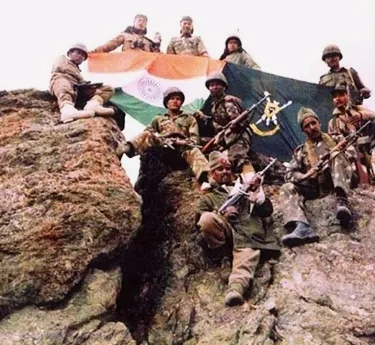
The Kargil War was a conflict between India and Pakistan fought from May to July 1999 on mountain peaks above 16,000 feet in the Kashmir region. Pakistani soldiers crossed the Line of Control and occupied mountain heights overlooking Kargil, trying to cut India's main highway to the region of Ladakh. India launched a military campaign to take the peaks back, and 527 Indian soldiers died in the fighting. It was one of the few armed conflicts between two countries that had both openly tested nuclear weapons, and it came just months after the two prime ministers had signed a peace declaration.
How Pakistan's army planned the Kargil intrusion
In February 1999, Indian Prime Minister Atal Bihari Vajpayee rode the inaugural Delhi-to-Lahore bus to Pakistan, where Pakistan's Prime Minister Nawaz Sharif met him at the border. The two leaders signed the Lahore Declaration, committing to settle their disputes, including Kashmir, through dialogue.
Pakistan's army chief, General Pervez Musharraf, was already planning an operation that would undo it. Musharraf had been appointed army chief in October 1998, months after both India and Pakistan tested nuclear weapons that May. He was born in Delhi in 1943 and had migrated to Pakistan as a child during the partition. He had spent his career in the army and had commanded operations near the Siachen Glacier, the disputed ice field at the far northern end of the Line of Control. He and a small group of senior officers revived an old plan to send troops across the Line of Control and seize the ridges above Kargil. The goal was to cut National Highway 1, India's only road between Srinagar and Leh, and force India to negotiate over Kashmir from a position of weakness.
Musharraf kept the civilian government largely in the dark. Starting in early 1999, soldiers from Pakistan's Northern Light Infantry, along with Kashmiri militants, crossed into Indian-held territory and occupied dozens of positions on peaks as high as 18,000 feet.
How India fought to retake the Kargil peaks
India discovered the Pakistani positions in early May 1999 and launched Operation Vijay. Over the following weeks, India mobilized about 200,000 troops across the broader region and deployed roughly 30,000 to the Kargil sector. The task was simple to describe and hard to carry out: climb steep, exposed mountainsides in thin air to attack defenders who held the high ground with machine guns.
Indian infantry fought for peaks including Tololing, Tiger Hill, and Point 5140, losing soldiers on each climb. Supplies, including artillery shells and wounded soldiers, had to be carried on foot or with mules. At those altitudes, soldiers suffered from altitude sickness, and helicopters could barely fly high enough to help. Nighttime temperatures dropped well below freezing. The Indian Air Force joined the operation under the name Operation Safed Sagar, with Mirage 2000 jets dropping laser-guided bombs on fortified positions at altitudes above 16,000 feet.
India lost 527 soldiers and suffered more than 1,300 wounded. Pakistan's death toll is disputed, and estimates range between several hundred and more than a thousand dead.
How the Kargil War ended
India confined its operations to its own side of the Line of Control, which made Pakistan's position difficult to defend internationally. Western governments pushed for a halt, and Pakistan found itself diplomatically isolated.
On July 4, 1999, Pakistan's Prime Minister Nawaz Sharif flew to Washington and met President Bill Clinton at Blair House. Clinton told Sharif that a full withdrawal behind the Line of Control was the price of American support. American intelligence had reportedly detected signs that Pakistan was preparing its nuclear weapons, adding urgency to the talks. Sharif agreed to order a withdrawal.
By July 26, 1999, the last Pakistani positions had been cleared. India marks July 26 as Kargil Vijay Diwas, a national day honoring the soldiers who fought.
Who won the Kargil War?
India won. Indian forces recaptured most of the occupied positions, and Pakistan withdrew behind the Line of Control with no territorial gains. India also won diplomatically: by confining its operations to its own side of the border, India made Pakistan's position difficult to defend, while Pakistan ended the war isolated.
Inside Pakistan, the war led directly to a military coup. Pakistan's army chief, General Pervez Musharraf, had planned the Kargil operation, but Pakistan's prime minister, Nawaz Sharif, had ordered the withdrawal under American pressure. The rift between them deepened over the following months. On October 12, 1999, Sharif tried to dismiss Musharraf while Musharraf was on a flight returning from Sri Lanka. Sharif ordered Karachi's airport to refuse the plane permission to land. The army seized the airport, let the plane land, and within hours took control of the government. Musharraf ruled Pakistan for nine years, first as chief executive and then as president. He left power in 2008 and died in exile in Dubai in 2023.
The Kargil War remains the deadliest war between India and Pakistan since their 1971 war. It showed that two countries with nuclear weapons could still fight a conventional war. But the nuclear dimension made every day of fighting more dangerous, and it gave the United States a strong reason to step in and end it.