
Partition of India
The 1947 division of British India into India and Pakistan, which triggered mass migration and communal violence that killed up to two million people.
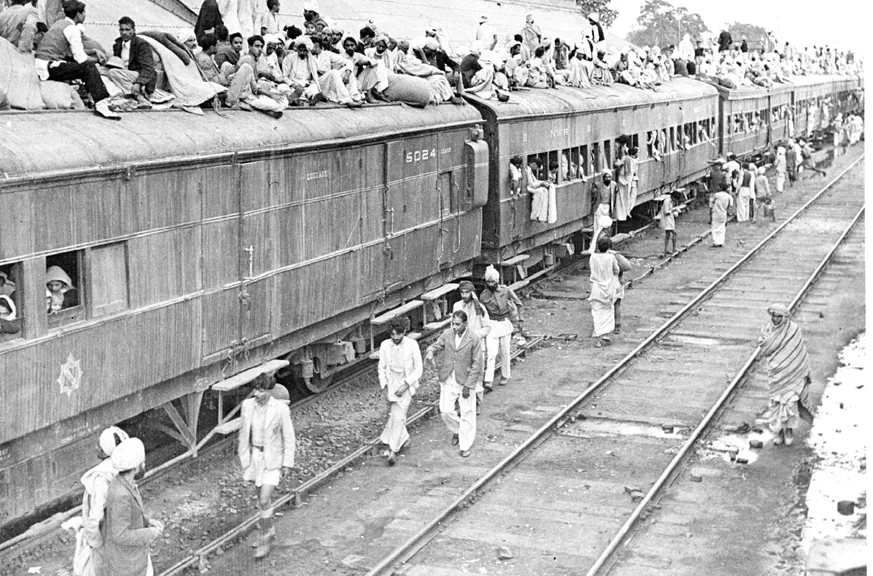
The partition of India was the division of British India into two independent countries, India and Pakistan, on August 15, 1947. A British lawyer named Cyril Radcliffe, who had never visited India, drew the border in about five weeks. The partition triggered the largest population transfer of the twentieth century. Between 10 and 20 million people crossed the new borders. Hindus and Sikhs moved toward India. Muslims moved toward Pakistan. Communal violence during the migration killed between 200,000 and two million people. Pakistan was split into two noncontiguous halves, West Pakistan and East Pakistan, with roughly a thousand miles of Indian land between them. The eastern wing broke away in 1971 to become Bangladesh.
Why was India partitioned?
India was partitioned because the leaders of its two largest political movements could not agree on whether Hindus and Muslims could share a single independent state. Muhammad Ali Jinnah, the head of the All-India Muslim League, argued that they were two separate nations. The Indian National Congress, led by Jawaharlal Nehru, insisted on a united India. Years of failed negotiations and growing communal violence convinced the British government that dividing the country was the only way to hand over power.
For most of British rule, India's independence movement had brought Hindus and Muslims together. Mahatma Gandhi led civil disobedience campaigns that drew support across religious lines. But the question of what a free India would look like split the movement. At the Muslim League's session in Lahore in March 1940, Jinnah's party formally demanded that Muslim-majority regions become independent states. This position became known as the two-nation theory.
On August 16, 1946, the Muslim League called for "Direct Action" to press its demand for Pakistan. Riots erupted in Calcutta that killed between 4,000 and 10,000 people in four days and then spread across northern India. Lord Mountbatten, Britain's last viceroy, arrived in March 1947 with a deadline to hand over power by June 1948. He decided the worsening violence could not wait and moved independence forward to August 15, 1947.
How Cyril Radcliffe drew the partition border
Mountbatten appointed Cyril Radcliffe, a British lawyer with no knowledge of India, to draw the new border. Radcliffe chaired two boundary commissions, one for Punjab in the west and one for Bengal in the east. These were the two provinces with the most mixed populations of Muslims and non-Muslims. He arrived in Delhi on July 8, 1947, and had about five weeks to finish.
Radcliffe worked from outdated census maps. He finished the boundary lines before independence day, but Mountbatten held them back so they would not overshadow the celebrations. The borders were published on August 17, two days after independence had already taken effect. Millions of people discovered which country they now lived in only after the fact. Many later blamed this secrecy for the chaos that followed.
Radcliffe took no fee for the work and later burned all his papers. The Orbis blog has the full story of how Radcliffe drew the border in five weeks.
How many people died in the partition of India?
Estimates of the death toll range from 200,000 to two million. The exact number will never be known because record-keeping collapsed during the crisis.
The violence was worst in Punjab and Bengal, the two provinces the border cut through. In Punjab, where Sikh, Hindu, and Muslim communities had lived side by side for generations, armed groups from every community attacked refugees heading the other way. Attackers destroyed whole villages. Some trains carrying refugees arrived at their destinations with everyone on board killed. Tens of thousands of women were abducted.
The violence was not one-sided. It struck every community. Most of the migrants walked, moving in processions so long they could take hours to pass a single point. The British administration had largely left by then, and neither India's nor Pakistan's new government had enough police or troops to stop the killing.
How the partition of India created the Kashmir dispute
The partition left a major question unresolved: who would get Jammu and Kashmir. Kashmir had a Hindu ruler, Maharaja Hari Singh, but a Muslim-majority population. Hari Singh chose not to join either country.
In October 1947, armed tribesmen crossed into Kashmir from Pakistan. Hari Singh signed an instrument of accession to India in exchange for military help, and Indian troops flew into the capital, Srinagar. The fighting ended with a ceasefire line that still divides Kashmir today. India and Pakistan went on to fight three more wars, in 1965, 1971, and 1999. Both countries tested nuclear weapons in 1998. The Orbis blog covers the full history of the Kashmir conflict.
Nearly eight decades after 1947, India and Pakistan are nuclear-armed rivals that cannot agree on where the border in Kashmir belongs. The partition ended British rule in India. The conflicts it created are still unresolved.