
Karl Marx
Karl Marx was a German philosopher whose theory that economics drives history became the official doctrine of governments ruling a third of humanity.
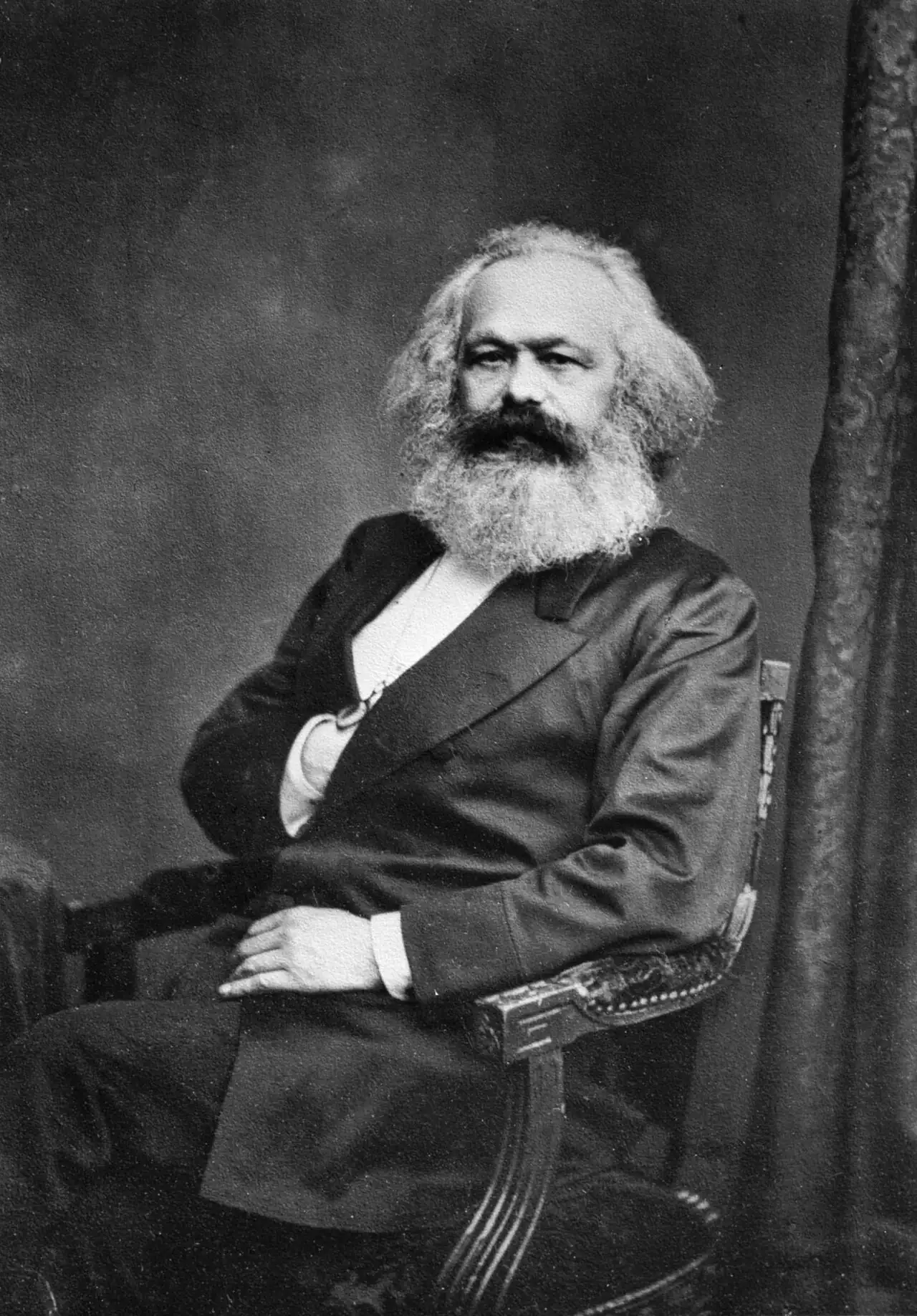
Karl Marx (1818-1883) was a German philosopher and journalist who argued that how a society produces and distributes goods determines its politics, laws, and culture. He lived most of his adult life in London, poor and in exile, spending his days in the British Museum reading room and sending dispatches to American newspapers to earn rent money. About a dozen people attended his funeral. Within seventy years of his death, governments claiming to follow his ideas controlled the Soviet Union, China, the Eastern Bloc, and large parts of Asia, roughly a third of the world's population.
How Karl Marx became an exile
Marx was born in Trier, Prussia, on May 5, 1818. His family was Jewish but had become Lutheran so that his father, a lawyer, could keep his practice under Prussian law. Marx studied philosophy at university, then moved into radical journalism. Prussian censors shut down his newspaper in 1843, and Marx left for Paris.
In Paris in 1844, Marx met Friedrich Engels, the son of a cotton mill owner who would soon write a book about factory life in Manchester. The two became close collaborators. Engels sent Marx money from that point on, for nearly forty years.
Marx did not stay in one place for long. The French government expelled him in 1845 at Prussia's request. Belgium expelled him in 1848. After a brief return to Germany during the revolutions of that year, Marx settled in London in 1849 and never left.
Life in London was hard. Marx had married Jenny von Westphalen in 1843. She came from an aristocratic Prussian family and was four years older than Marx. Together they had seven children, but four died young, three of them in their cramped rooms in Soho. Marx suffered from boils and was often ill. There were stretches when Marx had to pawn his coat and could not go out. Marx earned some money as a foreign correspondent for the New York Tribune, writing hundreds of columns over about a decade on subjects from British politics to the opium trade. For the rest, he depended on Engels, who worked in his family's cotton business in Manchester.
Marx spent his days in the reading room of the British Museum, filling notebooks with research for the book that became Capital. He died on March 14, 1883, at 64. His funeral at Highgate Cemetery drew about a dozen mourners.
What Karl Marx argued
Marx's central argument was that how a society produces goods, what tools it uses and who owns them, determines its politics, its laws, and its way of thinking. History advances through struggle between classes. Every economic system gives rise to the class that will eventually destroy it. Feudalism produced the merchants who built capitalism. Capitalism, Marx argued, would produce the factory workers who would overthrow it.
Marx explained how this works through a concept he called surplus value. People who work for wages produce more than they are paid. The difference is the owner's profit. Competition pushes owners to extract ever more from their workers. Marx expected this to concentrate wealth in fewer and fewer hands, trigger crisis after crisis, and in the end destroy a system in which work was done collectively but profits went to private owners.
Marx presented this theory in Capital, whose first volume came out in 1867. Only the first volume appeared in his lifetime. Engels edited and published the second and third volumes after Marx died. The Communist Manifesto, which Marx and Engels published in early 1848, just weeks before revolutions swept across Europe, is a pamphlet calling for action, not the theory itself. The Manifesto includes passages that admire capitalism. Marx credited the capitalist class with building more productive capacity in barely a century than all earlier centuries put together, and with creating one global market where none had existed.
Was Karl Marx right?
Marx correctly predicted that wealth would concentrate, that trade would become global, and that financial crises would keep coming. The idea that economic interests shape politics more than politicians admit is now a standard tool in political science and history.
Other predictions failed. Workers in industrial countries did not grow steadily poorer. Living standards in capitalist economies rose, partly because governments introduced labor protections and welfare programs. And revolution came not in industrialized Britain or Germany but in Russia, still largely agricultural, and in China, still a peasant society. It took Lenin's inventions, including a tightly organized revolutionary party and a theory of imperialism, to turn Marx's ideas into a program for seizing power in those countries. The distance between where Marx expected revolution and where it actually came is one of the central questions of twentieth-century history.
Marx had almost nothing to say about how a post-capitalist state should be run. His successors filled that gap however they chose, and what they built stretched from Nordic welfare states to the Gulag. The Soviet Union that claimed his name collapsed in 1991. Where a government still officially cites Marx, as China's Communist Party does, the label serves to justify the party's rule, not to describe what it does. Today few political movements follow Marx's program, but his way of analyzing society, asking who benefits from an economic arrangement and whose interests are built into institutions that look neutral, is used across the social sciences.