
Kharijites
The Kharijites were an early Islamic faction that split from Caliph Ali in 657 and introduced takfir, the practice of declaring other Muslims unbelievers.
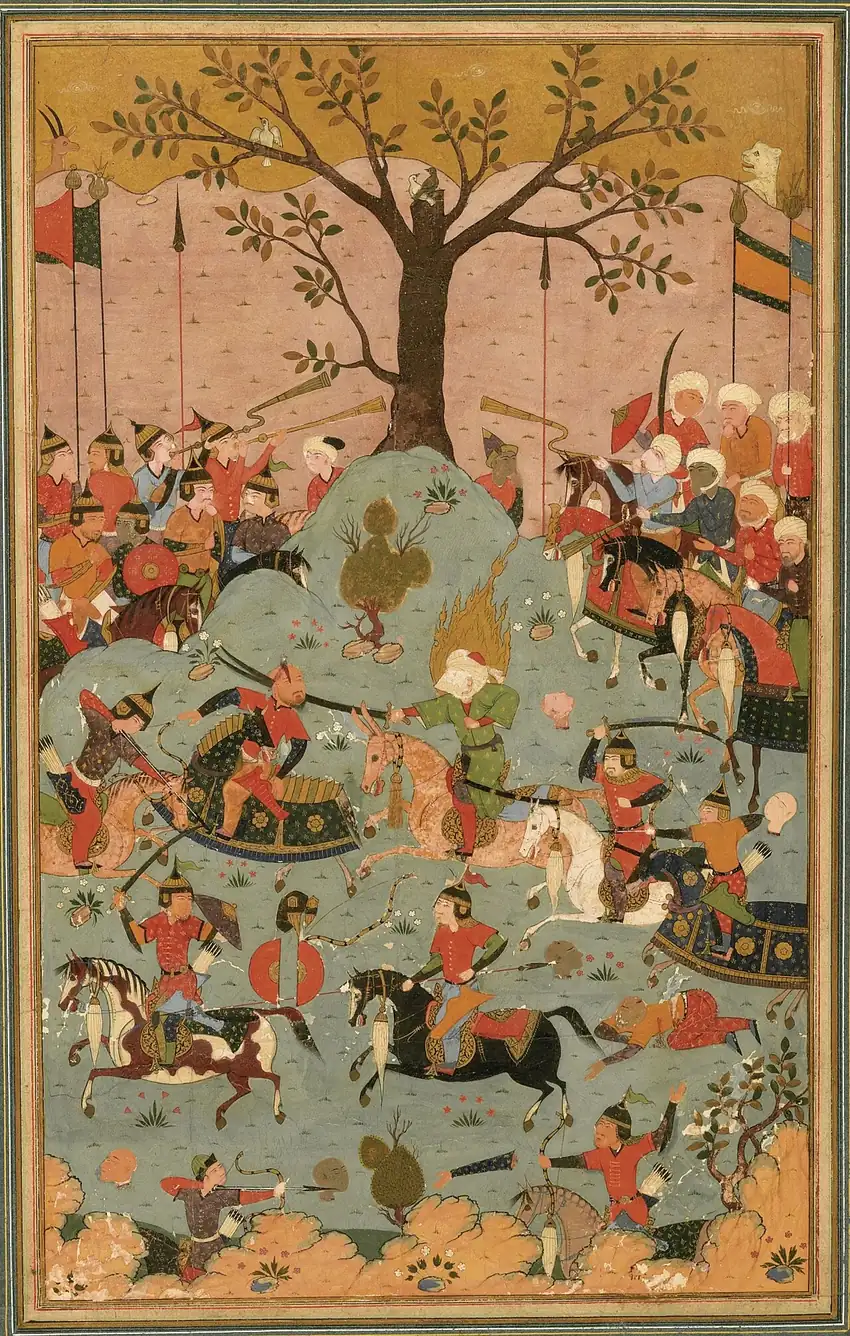
Islam's first civil war produced three factions: the Sunnis, the Shia, and the Kharijites, the smallest and most radical of the three. The word Kharijite comes from an Arabic root meaning "to go out," pointing to a specific moment in 657 when a group of soldiers walked out of the caliph Ali's army over a dispute about God's authority. Their central claim was that any leader who falls into serious sin loses his standing as a Muslim and can be lawfully killed. Four years later, they turned that logic on Ali and killed him. The movement itself largely died out within a few centuries, but the idea at its center did not. Al-Qaeda and the Islamic State both draw on Kharijite reasoning when they declare fellow Muslims to be legitimate targets. When mainstream Muslim scholars push back, they reach for the same label: Khawarij. Few terms in Islamic political debate are older or carry more weight.
How the Kharijites split from Ali
The break happened at the Battle of Siffin in 657, where Ali, the fourth caliph, met the forces of Muawiya, governor of Syria, along the Euphrates. Ali was a cousin of the Prophet Muhammad and married to his daughter Fatimah. For Shia Muslims, he was the Prophet's rightful heir. His forces were gaining the upper hand when Muawiya's troops hoisted Quran pages onto their lance points, demanding that the dispute be settled by negotiation rather than the sword. Ali's soldiers would not attack men carrying scripture. Ali agreed to negotiate, though he believed it was a mistake.
A substantial faction among Ali's own supporters refused to accept the deal. They believed God had already decided who should rule. Submitting that question to a panel of men was, in their view, an act of unbelief. They summed up their position in a single phrase: la hukma illa lillah, "only God may judge." They walked out of Ali's camp, formed their own force, and pronounced both Ali and Muawiya disqualified from leadership.
Ali tried negotiation first. When that failed, he marched on their position at Nahrawan in July 658. Around 1,200 took the amnesty he offered before the fighting began. His army killed most of the remaining 2,800 or so. Survivors dispersed across the empire and kept fighting. In January 661, one of them, Abd al-Rahman ibn Muljam, entered the Great Mosque of Kufa during the dawn prayer and cut Ali down with a sword coated in poison. Ali died of the wound two days later. His assassin had once been one of his own soldiers.
What the Kharijites believed
Three principles defined Kharijite thinking.
The first was moral absolutism. A person's faith, the Kharijites held, shows in what they do. A Muslim who commits a serious sin does not merely fall short. That person has left Islam.
The second was takfir: pronouncing a fellow Muslim to be a non-believer. The practical stakes were life and death. Under Islamic law, a Muslim's blood is protected. Once someone is declared a non-believer in wartime, that protection disappears.
The third was an open view of leadership. Mainstream opinion required the caliph to belong to the Quraysh, the Prophet's tribe. The Kharijites rejected that entirely. Any devout Muslim, in their view, could hold the office, no matter his tribe, ethnicity, or background. Some Kharijite factions went further and said a formerly enslaved man could serve as caliph. And any caliph who sinned could be removed on the spot.
This open approach to power attracted followers on the empire's edges. The Umayyad caliphs treated non-Arab converts as second-class citizens, taxing them at higher rates and keeping them out of government. For people who had been told they could never lead because of their ancestry, a movement that cared only about piety was a genuine alternative. Kharijite uprisings wore down the Umayyad caliphate and played a part in its collapse.
The problem was that moral absolutism turned inward. Once the Kharijites decided that sinning made a person a non-believer, and that non-believers could be killed, every internal disagreement about right and wrong became a death sentence. The Azariqa, the most violent of the sub-groups, went so far as to declare that any Muslim who did not fight alongside them had left the faith, and that their families, including women and children, were fair targets. The factions fractured and fought among themselves. By the 900s, the Kharijites had ceased to matter as a political movement.
Do Kharijites still exist?
One branch did survive: the Ibadis, who separated from the violent mainstream of the movement at an early stage and refused to shed Muslim blood. Ibadis are one of the two largest Muslim communities in Oman today and also live in parts of Algeria, Libya, and Zanzibar. Oman's role in the Middle East has been shaped by this tradition. The sultanate has long positioned itself as a go-between, staying neutral in the rivalry between Iran and Saudi Arabia and opening its doors to talks that no other country in the region can host. Observers trace that diplomatic style back to centuries of Ibadi experience living as a minority and finding ways to get along with neighbors who followed different schools of Islam.
The Ibadis are one legacy. The other is the idea. When the Islamic State built its case for killing Shia civilians, Sunni government employees, and competing jihadist factions, every justification passed through takfir: strip someone of their Muslim identity, and the rules protecting Muslim life no longer apply. When scholars at al-Azhar and other religious authorities responded, they did not simply call the violence wrong. They called it Kharijism, invoking a heresy that Muslims recognized and rejected in their very first generation. Both sides know the history behind the word. The argument about who qualifies as a Muslim, and what can be done to someone judged to have left the faith, began in Ali's camp fourteen centuries ago and continues today.