
Kwame Nkrumah
Kwame Nkrumah was the first president of Ghana, the first sub-Saharan African country to win independence from colonial rule.
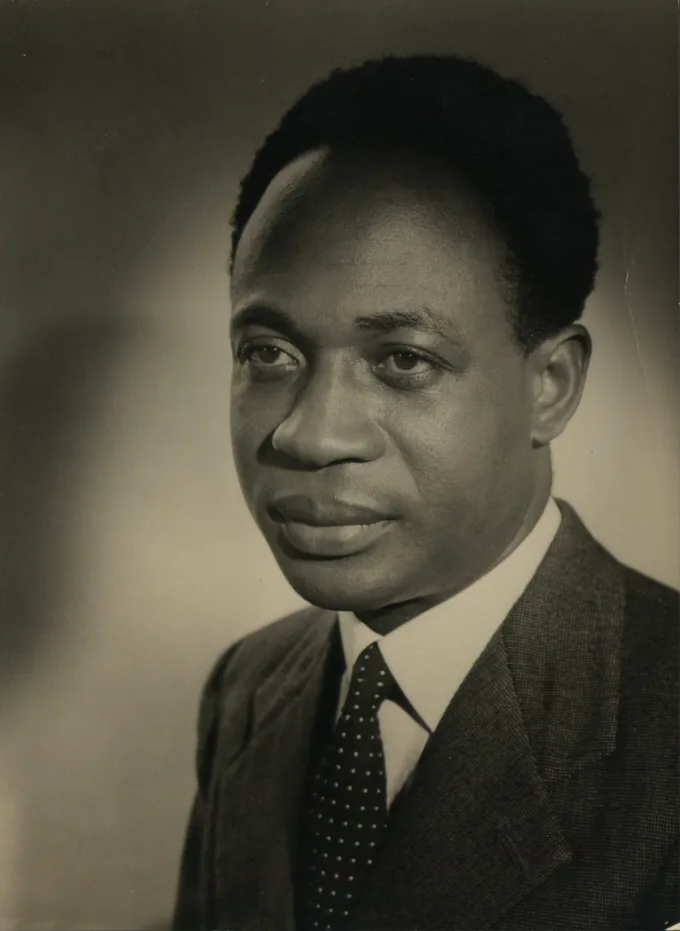
Kwame Nkrumah led Ghana to independence in 1957, making it the first country in sub-Saharan Africa to gain independence from a European colonial power. At the ceremony on March 6, he told the crowd that Ghana's freedom meant nothing unless it was connected to the liberation of every other African colony. Over the next nine years Nkrumah funded anti-colonial movements across the continent, helped create the Organization of African Unity, and published the book that defined neo-colonialism. He also locked up political opponents, declared himself president for life, and exhausted the country's foreign reserves. In 1966, his own military overthrew him while he was on a plane to China, trying to broker an end to the Vietnam War.
How Nkrumah won Ghana's independence
Born in Nkroful, a small village in the Gold Coast, Nkrumah lived in the United States for ten years before entering politics. He enrolled at Lincoln University in Pennsylvania in 1935, earning degrees in sociology and theology. He went on to complete two master's degrees at the University of Pennsylvania, washing dishes and selling fish to pay his way. In 1945 he moved to London and took part in organizing the Fifth Pan-African Congress in Manchester with W. E. B. Du Bois and George Padmore. The congress called for the immediate end of colonial rule in Africa.
Nkrumah went back to the Gold Coast in 1947, taking a job as secretary of the United Gold Coast Convention, an independence party run by lawyers and traditional leaders. He soon decided its leaders moved too slowly. In 1949 he left to start the Convention People's Party under the slogan "self-government now." He built a movement through rallies and newspapers and launched a wave of strikes and boycotts he named Positive Action. Colonial authorities arrested him in 1950.
In February 1951, while Nkrumah sat in a cell, his party swept the Gold Coast's first general election, winning 34 of 38 contested seats. Nkrumah himself took his constituency with 22,780 votes out of 23,122. The British governor let him out to lead the new government. Six years later the colony became Ghana. Over the following ten years, more than thirty countries in Africa gained their independence.
How Nkrumah dismantled Ghana's democracy
Nkrumah turned Ghana into the base for Africa's anti-colonial movement. He gave money and safe haven to liberation groups from across the continent and argued for uniting Africa under one government with a shared military and a common currency. Alongside Jawaharlal Nehru, Gamal Abdel Nasser, Josip Broz Tito, and Sukarno, he became one of the leading voices calling for countries to stay out of the Cold War. In 1963 he helped create the Organization of African Unity, though other member states rejected his call for full political union.
Inside Ghana, Nkrumah's government grew increasingly repressive. In 1958 he pushed through the Preventive Detention Act, which allowed the state to hold people without trial for up to five years. The limit was later removed entirely. Nkrumah used the law to lock up opposition leaders, union organizers, and in time his own former allies. In 1963 he fired Chief Justice Kobina Arku Korsah after the court cleared defendants Nkrumah wanted found guilty. A 1964 referendum turned Ghana into a single-party state and gave Nkrumah the presidency for life. He cultivated a personality cult, taking the title Osagyefo, meaning "the redeemer."
Nkrumah poured Ghana's cocoa earnings into government-run industrial projects. The Akosombo Dam, built on the Volta River, still generates electricity for Ghana today. But many other projects never operated at full capacity, and the aluminum smelter the dam was built to supply remained under foreign ownership. When the global price of cocoa fell sharply in the mid-1960s, the economy built on those earnings fell apart with it. By 1966, Ghana's foreign currency reserves, once around $560 million, had been almost entirely spent, and the government could no longer pay its debts.
On the morning of February 24, 1966, with Nkrumah abroad on a flight to China, soldiers and police took control of Accra. Crowds celebrated in the streets. Nkrumah took refuge in Guinea, where President Sékou Touré named him honorary co-president. He never went back to Ghana. He died of prostate cancer in Bucharest, Romania, on April 27, 1972.
Was the CIA involved in Nkrumah's overthrow?
Documents released decades later show that the CIA was in contact with the officers who carried out the coup, and a former CIA officer wrote that the agency's Accra station was given internal credit for the outcome. Declassified British records reveal that the UK Foreign Office ran a covert propaganda campaign against Nkrumah's government. But the domestic causes of the coup were real. Ghana was nearly bankrupt, political opponents were jailed without trial, and the military had its own reasons to act. The balance of evidence suggests Western intelligence agencies encouraged a coup that Ghanaians organized for reasons of their own.
Nkrumah's legacy in Ghana today
In 1965, Nkrumah published Neo-Colonialism, the Last Stage of Imperialism. The book argued that official independence counted for little when foreign corporations still directed a country's economy through trade, lending, and control of raw materials. The United States government sent a formal protest and turned down Ghana's request for more than $100 million in food aid. The idea Nkrumah laid out remains at the center of arguments about how African economies relate to the rest of the world.
Ghana later restored Nkrumah's reputation. His body was brought home, and he is buried in a memorial park in Accra. His portrait appears on Ghana's banknotes. September 21, his birthday, is a public holiday. Across the continent, Nkrumah is widely seen as a founding figure of African independence.