
Jawaharlal Nehru
Jawaharlal Nehru was India's first prime minister, serving from 1947 to 1964 and shaping its democracy, economy and foreign policy.
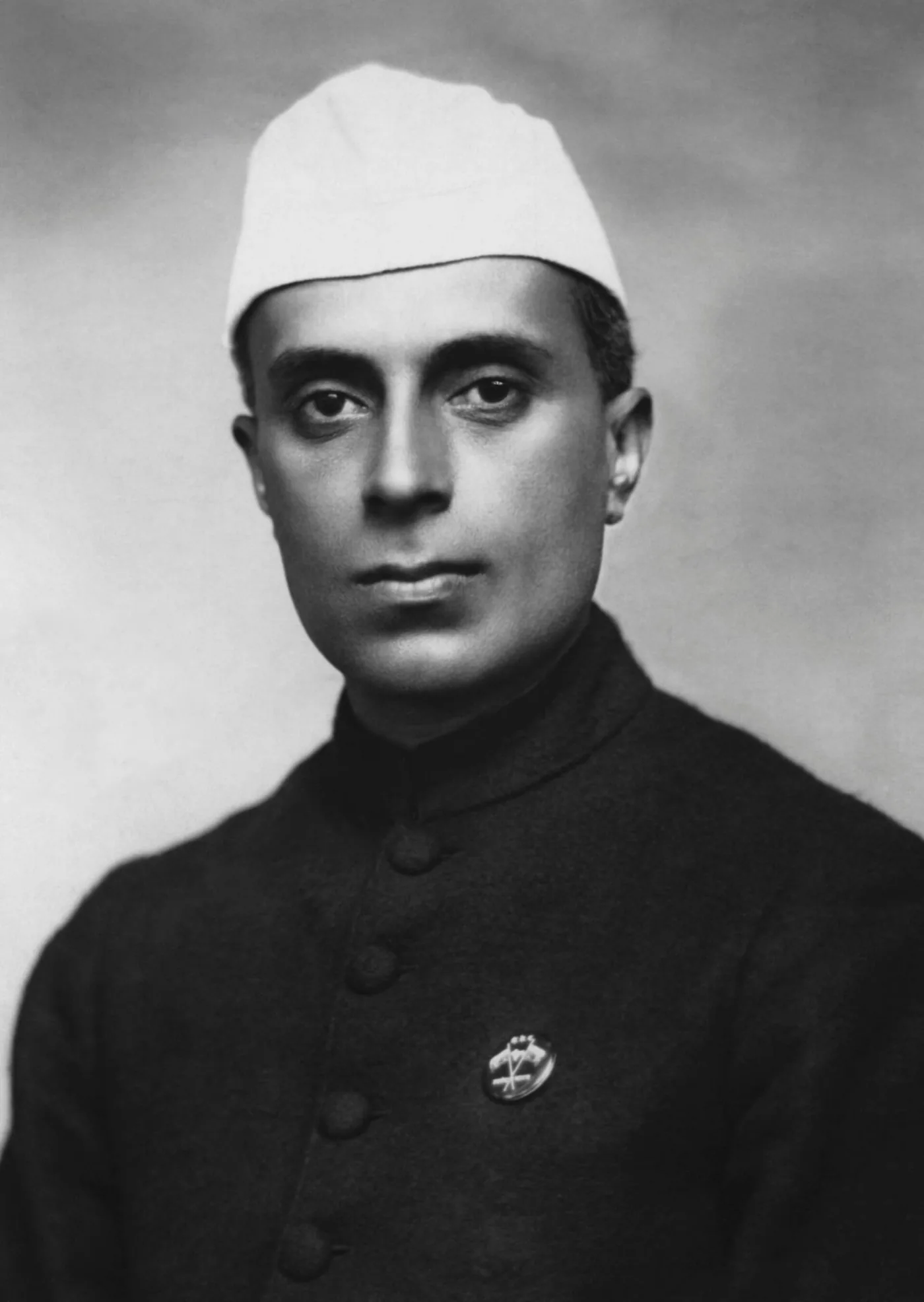
Jawaharlal Nehru was the first prime minister of India, serving from independence in August 1947 until his death in May 1964. In those nearly seventeen years he shaped most of the institutions that still define the country: a parliamentary democracy, a state-led economy, and a foreign policy of non-alignment between the Cold War blocs. He was born on November 14, 1889, in Allahabad, the son of Motilal Nehru, one of India's most prominent lawyers. He attended Harrow as a teenager, studied at Trinity College, Cambridge, and trained as a barrister at the Inner Temple in London. He once said he felt more at home in English than in Hindi or Urdu. Over the course of the independence struggle, British authorities imprisoned him nine times, for a total of about nine years, and he used his time in prison to write several books, including The Discovery of India. He was rarely seen without a red rose in his buttonhole.
Nehru, Gandhi, and Indian independence
Nehru and Mohandas Gandhi made an unlikely pair. Gandhi was deeply religious, idealized village life, and distrusted industry. Nehru, a committed modernist and socialist, saw village India as held back by poverty and caste, problems to be solved through steel mills and dams. But Gandhi could mobilize millions of people in a way Nehru could not, and Nehru could address an international audience in terms Gandhi would not. Gandhi named Nehru his political heir.
Independence came at midnight on August 15, 1947, when Nehru addressed the Constituent Assembly with what became known as the "tryst with destiny" speech. But it came with partition. The violence that followed the division of British India into India and Pakistan killed, by most estimates, between 200,000 and two million people. About fifteen million were forced from their homes. Pakistan was carved out as a Muslim-majority state. Many voices demanded that India declare itself a Hindu nation. Nehru would not do it. India became a secular, democratic republic. About thirty-five million Muslims chose to stay.
What Nehru built as prime minister
Nehru built three things that lasted: a working democracy, a planned economy, and a foreign policy of non-alignment.
Political scientists at the time considered democracy in a poor country close to impossible. India held elections by universal suffrage starting in 1951, when most of the voters could not read or write. Nehru submitted to parliamentary questioning and tolerated a hostile press. He had no serious political rival but showed no interest in becoming a strongman.
His economic program was built around centralized five-year planning, government ownership of steel and heavy industry, tight import restrictions, and a licensing regime for private investment. He described India's new dams and factories as "the temples of modern India." The program created a scientific and industrial base. But it also produced slow growth, averaging about 3.5 percent a year from the 1950s through the 1980s. Economists later called this the "Hindu rate of growth." The licensing system created a permit bureaucracy that was not dismantled until India's economic reforms in 1991.
Nehru helped found the non-aligned movement together with Yugoslavia's Josip Broz Tito, Egypt's Gamal Abdel Nasser, and Indonesia's Sukarno. Non-alignment was a bloc of newly independent countries that stayed outside both Cold War alliances. It took shape at the Bandung Conference in 1955 and was formally established at a summit in Belgrade in 1961. The movement gave newly independent countries diplomatic leverage that Washington and Moscow would not have offered on their own. Critics saw it as high-minded talk that ended with many member states taking Soviet arms anyway.
The 1962 war with China
Nehru had promoted friendship with Beijing and sponsored China's return to international diplomacy. He used the catchphrase "Hindi-Chini bhai-bhai," a call for brotherhood between the two countries. But a border dispute over the Aksai Chin plateau and the eastern Himalayan frontier went unresolved. Nehru authorized a "forward policy" of placing small military posts in the disputed territory, without the forces to defend them.
In October 1962, the Chinese army attacked. Over the next month it routed Indian forces in both sectors and advanced deep into the northeastern state of Assam, then withdrew on its own terms. India lost over 1,300 soldiers killed and nearly 4,000 captured. The defeat destroyed Nehru's credibility on foreign policy. He had staked India's international standing on peaceful coexistence with China, and China had answered with an invasion. He never recovered. Nehru died on May 27, 1964, at the age of 74.
Nehru's legacy in India
Nehru's legacies include the secular constitution, the state-led economy, the non-aligned foreign policy instinct, and a political dynasty. His daughter Indira Gandhi and his grandson Rajiv Gandhi both served as prime minister. The Nehru-Gandhi family led Congress for decades after independence.
The sharpest debate is over secularism. India's governing party since 2014, the Bharatiya Janata Party, defines itself against the secular state Nehru built, favoring a more explicitly Hindu national identity. More than sixty years after his death, the institutions Nehru created still define India's government and its politics.