
Josip Broz Tito
Josip Broz Tito was the communist leader of Yugoslavia who broke with Stalin in 1948 and held six republics together until his death in 1980.
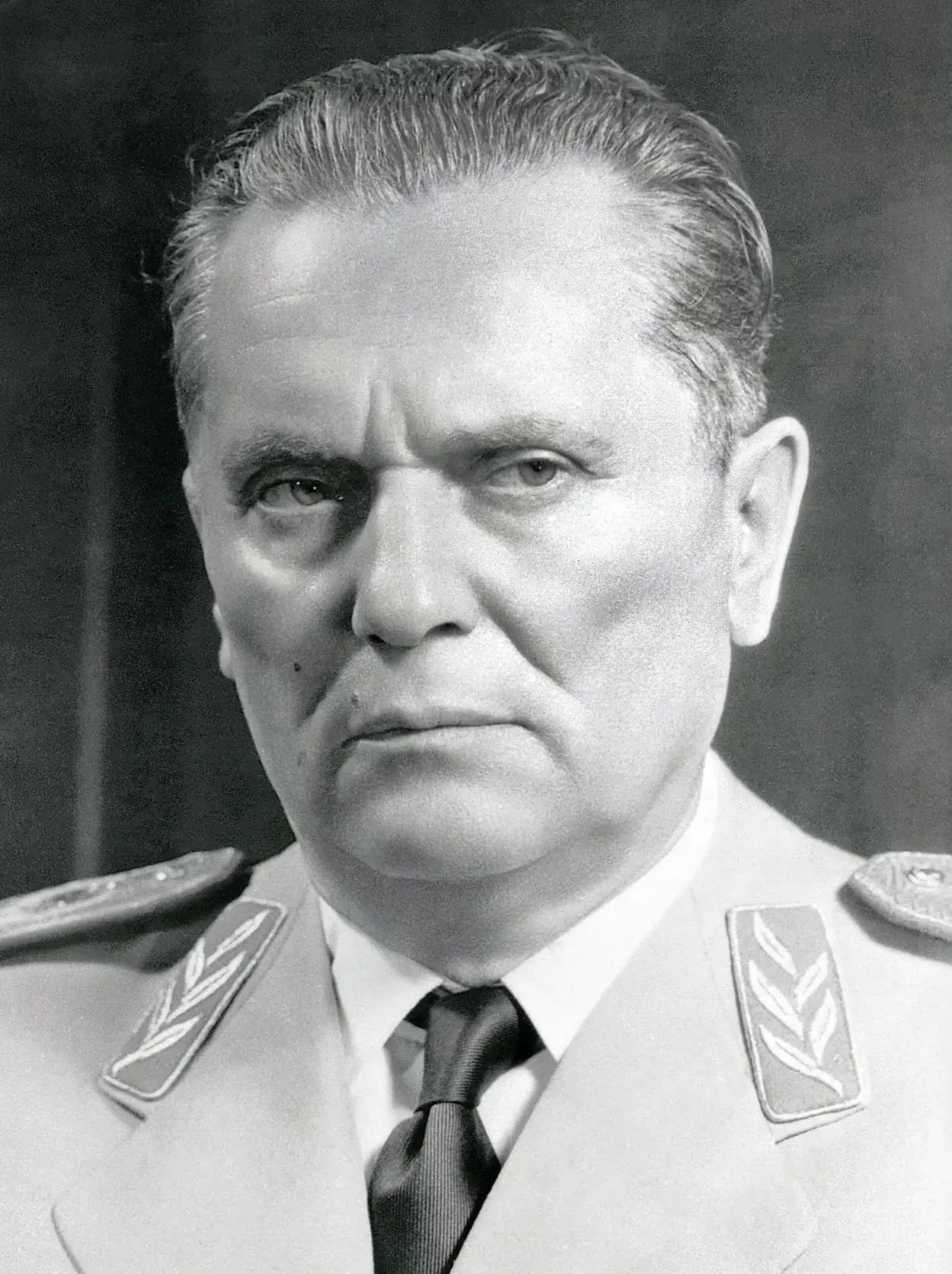
Josip Broz Tito (1892–1980) was the communist leader who ruled Yugoslavia for thirty-five years, from the end of World War II until his death. He was born in the village of Kumrovec in Croatia, then part of the Habsburg empire, the seventh of fifteen children of a Croatian father and a Slovenian mother. He led the Yugoslav Partisans against the German occupation, took power in 1945, and split with Stalin in 1948, making Yugoslavia the first communist country to break from Moscow and stay independent. He co-founded the Non-Aligned Movement and kept his country of six republics and about twenty million people outside both the Soviet and Western blocs for thirty years. His funeral in 1980 drew four kings, thirty-one presidents, and twenty-two prime ministers. Eleven years later, Yugoslavia fell apart in war.
How Tito fought his way to power
Josip Broz trained as a metalworker, served in the Austro-Hungarian army in World War I, and was wounded in battle and taken prisoner on the Eastern Front. He spent the rest of the war in Russia, where he saw the 1917 revolution. He came home a communist.
During the 1920s and 1930s he worked in the underground Yugoslav Communist Party and spent years in Yugoslav prisons. He adopted the pseudonym Tito around 1934, a common name in his home region of Zagorje. In 1937 he became general secretary of the Yugoslav Communist Party, which then had only a few thousand members. He lived through Stalin's purges of exiled Yugoslav communists in Moscow.
When Germany invaded Yugoslavia in April 1941, Tito organized the Partisans, a resistance movement that grew to hundreds of thousands of fighters. The Partisans recruited across national lines: Serbs, Croats, Slovenes, Bosnians, and Montenegrins, united by the slogan "brotherhood and unity." This happened while Yugoslavia was also going through a civil war among its own ethnic groups. The royalist Chetniks, the other main resistance group, increasingly avoided fighting the Germans and collaborated locally with the occupiers. By 1943 the British recognized that the Partisans were tying down more German divisions and redirected their backing to Tito. When the war ended in 1945, the Partisans had freed most of the country without outside help. Soviet forces assisted only in the northeast.
Tito had won his country with his own fighters, not with Soviet soldiers, and that fact defined his rule. The war's end brought mass killing. In the weeks after Germany's surrender, Yugoslav forces executed tens of thousands of prisoners in what became known as the Bleiburg repatriations. The dead were mostly Croatian soldiers and civilians who had fought alongside the German occupiers.
How Tito broke with Stalin
In June 1948 the Soviet-led Cominform, the coordinating body of European communist parties, expelled Yugoslavia. Stalin expected Yugoslav communists to overthrow Tito within weeks. They did not. Tito controlled his own security apparatus, commanded an army loyal to him personally, and carried the prestige of having liberated the country. He rounded up those who stayed loyal to Moscow and sent them to Goli Otok, a prison camp on a barren island in the Adriatic where about 13,000 people were held between 1949 and 1956. Stalin also sent assassins after Tito. None of them succeeded, and Stalin died first, in March 1953.
The break had two large consequences. First, the United States began sending arms and money to a communist government, reasoning that a fracture in the Soviet bloc was worth supporting. Second, Yugoslavia needed its own model to justify standing alone. It developed workers' self-management, a system that gave factory workers' councils formal authority over enterprise decisions. Yugoslavia also opened its borders. Its citizens could travel abroad, and the country attracted Western tourists and sold consumer goods that people in Warsaw Pact states could not buy. Tito himself lived more like a European head of state than a communist leader, with over thirty official residences and a presidential yacht called the Galeb.
In July 1956, Tito met Egypt's president, Gamal Abdel Nasser, and India's prime minister, Jawaharlal Nehru, on the Brijuni islands and signed the declaration that laid the ground for the Non-Aligned Movement. The first formal summit of the movement took place in Belgrade in 1961. Yugoslavia, a country of about twenty million people, conducted its own foreign policy, independent of both blocs, for thirty years.
Why did Yugoslavia fall apart after Tito?
Tito controlled the party, the army, and the government. He was the founder of the country, and he was the only person who could make its six republics cooperate. His 1974 constitution gave large new powers to those six republics and two autonomous provinces. The goal was to weaken nationalism by spreading authority. The result was the reverse: eight regional party organizations, each with its own power base, a set of overlapping economies, and a center with too little authority to resolve conflicts between them.
Tito died on May 4, 1980. He left behind a rotating collective presidency, which kept things running for about a decade. During that decade, debt climbed and inflation spiraled. Once the old communist ideology lost its hold, republican politicians discovered that appeals to national identity won elections faster than anything else. The wars began in 1991.
Under Tito, there were three and a half decades of peace among groups who had killed each other in the 1940s and did so again in the 1990s. He held Yugoslavia together, but he never built institutions that could do it without him.