
Sinking of the Lusitania
A German U-boat torpedoed the Cunard liner Lusitania off Ireland on May 7, 1915, killing 1,197 people and turning American opinion against Germany.
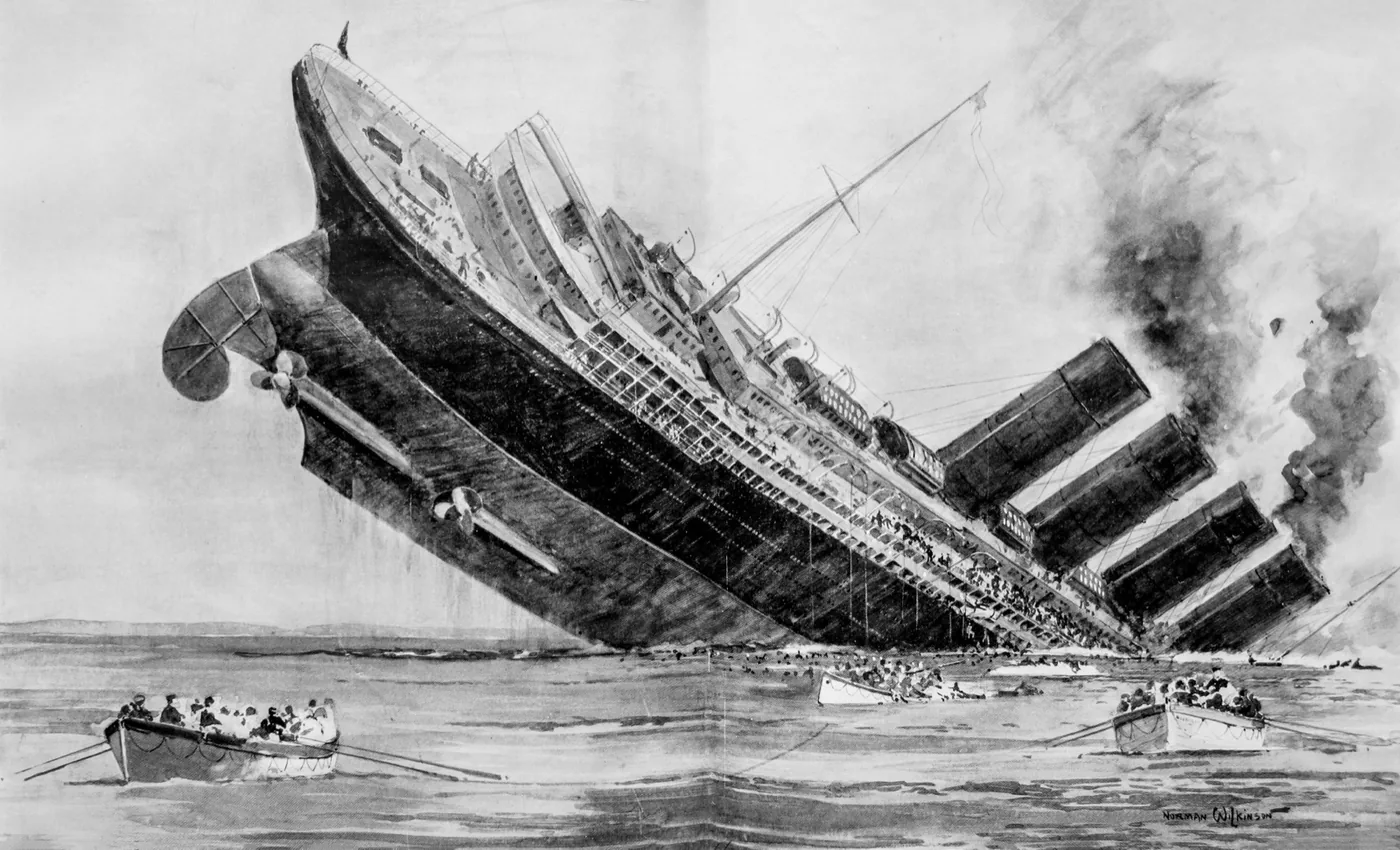
The RMS Lusitania was a British ocean liner that a German U-boat torpedoed and sank off the southern coast of Ireland on May 7, 1915. She carried 1,960 passengers and crew. 1,197 of them died, including 128 Americans and 94 children. The ship went down in eighteen minutes, before rescue boats could arrive. Germany had designated the seas near Britain as a combat zone and warned passengers not to sail, but the speed of the sinking and the number of civilian dead shocked the world. The disaster did not pull the United States into World War I right away. It shifted American opinion against Germany and stayed in public memory for two years, until the United States entered the war in April 1917.
How the Lusitania was sunk
The Lusitania was one of the largest and fastest passenger ships in the world when she entered service in 1907. Built for the Cunard Line, she could cross the Atlantic at 26 knots. On May 1, 1915, she left New York for Liverpool with 1,960 passengers and crew. That same morning, the German embassy placed a warning in New York newspapers, printed beside Cunard's own advertisement for the voyage, telling travelers that those sailing into British waters on British ships did so at their own risk.
Six days later, on the afternoon of May 7, the submarine U-20 was patrolling off the Old Head of Kinsale on Ireland's southern coast. Its commander, Kapitanleutnant Walther Schwieger, was 30 years old and had a reputation for firing first and identifying his targets later. At 2:10 p.m. he fired a single torpedo at the Lusitania. It struck the starboard side, near the bridge. Seconds later, a second, larger explosion came from deep within the ship.
The Lusitania tilted so sharply to starboard that most of the lifeboats on the port side could not be lowered. Her captain, William Thomas Turner, was a veteran Cunard commander who had gone to sea as a cabin boy at the age of eight. Turner stayed on the bridge as the Lusitania sank from under him and survived by clinging to wreckage. Many passengers were not as fortunate. The ship went down bow first, about 11 miles off the coast of Kinsale, in water only 93 meters deep. The wreck is still there today.
Why did Germany sink the Lusitania?
Germany argued that the Lusitania was a legitimate military target. In February 1915, Berlin had designated the seas surrounding the British Isles as a combat zone, and German submarines had orders to sink merchant ships carrying supplies to Britain. The Lusitania's cargo on its final voyage included about 4.2 million rifle cartridges, roughly 5,000 shrapnel casings, and several thousand percussion fuses.
Germany defended the sinking openly, saying a ship carrying war material for an enemy could not claim the protection of a passenger vessel. Most of the world rejected the argument. Public opinion in neutral countries saw drowned women and children, not a munitions shipment. Theodore Roosevelt called the sinking piracy and murder. British recruiting posters used the ship's name as a rallying cry.
What caused the Lusitania to sink so fast?
The Lusitania sank in eighteen minutes. The Titanic, hit by an iceberg three years earlier, took over two and a half hours. The speed caught everyone aboard off guard and is the main reason so many people died.
Schwieger's torpedo caused the first explosion, and then a second, larger blast followed from inside the ship. The cause of that second explosion has been debated for over a century. Some investigators have pointed to the ammunition in the cargo hold. Others blame a steam boiler rupture or coal dust igniting in a nearly empty fuel bunker. No theory has been confirmed. What is clear is that the severe list to starboard made most of the lifeboats impossible to launch.
How the sinking of the Lusitania changed the war
The disaster did not pull the United States into World War I. President Woodrow Wilson had kept America out of the European war. Days after the sinking, Wilson told an audience that a man could be "too proud to fight." His critics used the phrase against him for the rest of his career.
Wilson sent a series of diplomatic notes insisting that Germany end its attacks on civilian vessels. Germany pulled back rather than risk drawing America into the conflict, and by 1916 it had mostly stopped torpedoing ships without warning.
But the sinking changed how Americans saw the war. Before May 1915, most Americans considered the conflict a European problem. Afterward, a growing number saw Germany as the aggressor. The memory of a civilian ship torpedoed with no advance warning stayed with the American public.
In February 1917, Germany resumed sinking every ship near Britain, calculating that it could starve Britain into surrender before the United States could mobilize. The Zimmermann Telegram then revealed a German proposal to help Mexico reclaim territory from the United States. Wilson asked Congress for a declaration of war in April 1917. The sinking had not caused America's entry into the war, but it had helped prepare the country to accept it.