
Woodrow Wilson
Woodrow Wilson was the 28th president of the United States, known for creating the Federal Reserve and championing the League of Nations.
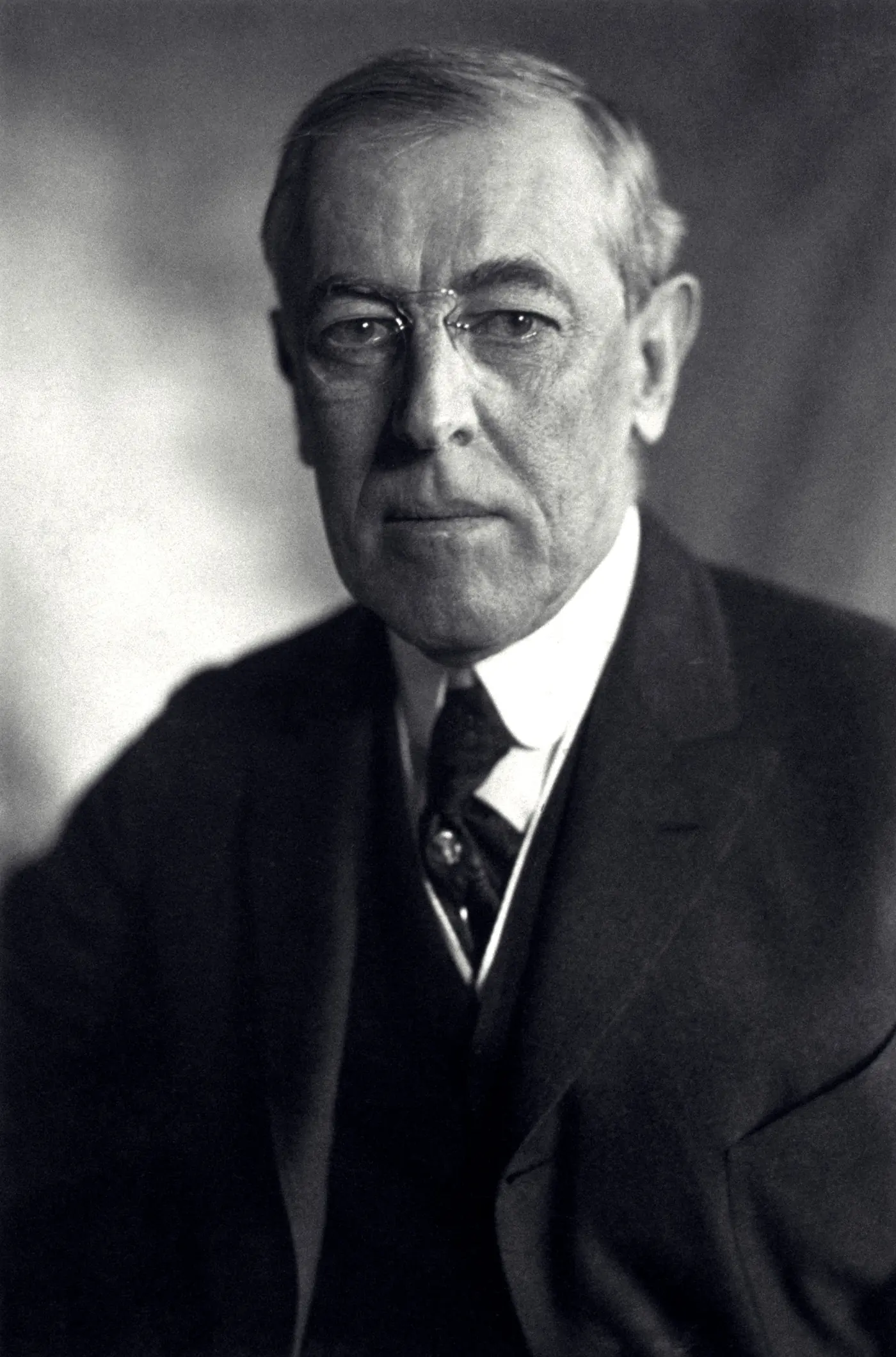
Woodrow Wilson was the 28th president of the United States, serving from 1913 to 1921. He is the only American president to hold a PhD. Before entering politics, Wilson was a political scientist and president of Princeton University. He won the governorship of New Jersey in 1910 and the presidency two years later. His first term produced landmark legislation, including the Federal Reserve Act and the first modern income tax. He won reelection in 1916 on the promise that he had kept America out of the First World War. Five months later, he asked Congress to declare war. After the war, he championed a League of Nations to prevent future conflicts, but the Senate rejected it. Wilson suffered a severe stroke in October 1919 and spent his last seventeen months in office partly paralyzed, with his wife controlling access to him.
Woodrow Wilson before the war
Wilson was born in Staunton, Virginia, in 1856, the son of a Presbyterian minister. He grew up in the South during the Civil War and Reconstruction. He studied at Princeton and earned a PhD in history and political science from Johns Hopkins University in 1886. His dissertation, published as Congressional Government, argued that the American system gave too much power to congressional committees and too little to the president.
Wilson spent nearly two decades as a professor before Princeton made him its president in 1902. In 1910, New Jersey Democrats recruited him to run for governor. He won, and in 1912 he won the presidency after Theodore Roosevelt split the Republican vote by running as a third-party candidate.
In his first two years, Wilson pushed through a series of major laws. He signed a reduction in tariffs combined with the first income tax under the new Sixteenth Amendment. The Federal Reserve Act of 1913 established a central bank for the first time in nearly eighty years. The Federal Reserve is still in place, and American monetary policy runs through it. Wilson also created the Federal Trade Commission and signed the Clayton Antitrust Act, giving the government new authority over monopolies and unfair business practices.
How Wilson took America into the First World War
Wilson won reelection in 1916 with the slogan "He kept us out of war." Within five months, Germany resumed unrestricted submarine warfare, sinking ships carrying American passengers and cargo. Then the Zimmermann Telegram was published, revealing that Germany had offered Mexico an alliance against the United States. In April 1917, Wilson asked Congress to declare war, calling it a fight to make the world safe for democracy.
The United States mobilized quickly. The government imposed a military draft, set up a propaganda operation, and passed the Espionage and Sedition Acts. People went to prison for antiwar speech. The socialist Eugene Debs was jailed and ran for president from his cell.
Wilson arrived in Europe in December 1918 as the most celebrated leader alive. He brought the Fourteen Points, his plan for a peace based on open diplomacy, free trade, and self-determination. At the Paris peace conference, France's Georges Clemenceau and Britain's David Lloyd George demanded reparations and territorial gains. Wilson conceded large parts of his program to preserve the one thing he cared about most: a League of Nations that would settle future disputes without war. He accepted a war-guilt clause that blamed Germany for the conflict. He accepted a deal giving Germany's concessions in China's Shandong province to Japan. He extended self-determination almost exclusively to European peoples and left the colonial empires untouched. Ho Chi Minh, at the time a young Vietnamese man living in Paris, petitioned Wilson for Vietnamese rights. Wilson did not respond.
Why did the United States not join the League of Nations?
Wilson brought the Treaty of Versailles home and put it before the Senate. Senator Henry Cabot Lodge led a group of Republicans who would ratify the treaty, but only if it included conditions preserving Congress's sole authority to send American troops to war. Wilson would not accept Lodge's conditions. He embarked on a cross-country speaking tour to pressure the Senate, traveling eight thousand miles in twenty-two days.
On October 2, 1919, Wilson suffered a massive stroke that left his entire left side paralyzed. For the final year and a half of his term, his wife Edith and his physician decided who could reach the president. The public did not know how sick he was.
The Senate voted on the treaty twice. Both times Wilson ordered his allies to reject it with Lodge's conditions, and the first time, Lodge's allies rejected it without them. America never joined the League of Nations. Wilson won the Nobel Peace Prize in 1920 for creating the League, but he left office in March 1921. He died in Washington on February 3, 1924.
Woodrow Wilson and segregation
Under Wilson, the federal government brought back racial segregation in its offices. Federal agencies that had been integrated since Reconstruction began separating Black and white workers with divided washrooms and screened-off work areas, and fired Black employees. Wilson defended the policy to Black delegations, telling them that segregation benefited the people it demoted.
This followed from his own views. Wilson's writings on American history had taken the side of the white South in describing Reconstruction. He screened The Birth of a Nation, a film that glorified the Ku Klux Klan, at the White House. In 2020, Princeton University removed Wilson's name from its School of Public and International Affairs because of his record on race.
Ideas Wilson championed, including collective security, self-determination, and the belief that America has a duty to lead the international order, became standard in American foreign policy after the Second World War. Those ideas still shape how presidents talk about America's role in the world.