
Matthew Perry and the Black Ships
Matthew Perry was a US Navy commodore who forced Japan to open to the West in 1853, ending over two centuries of isolation.
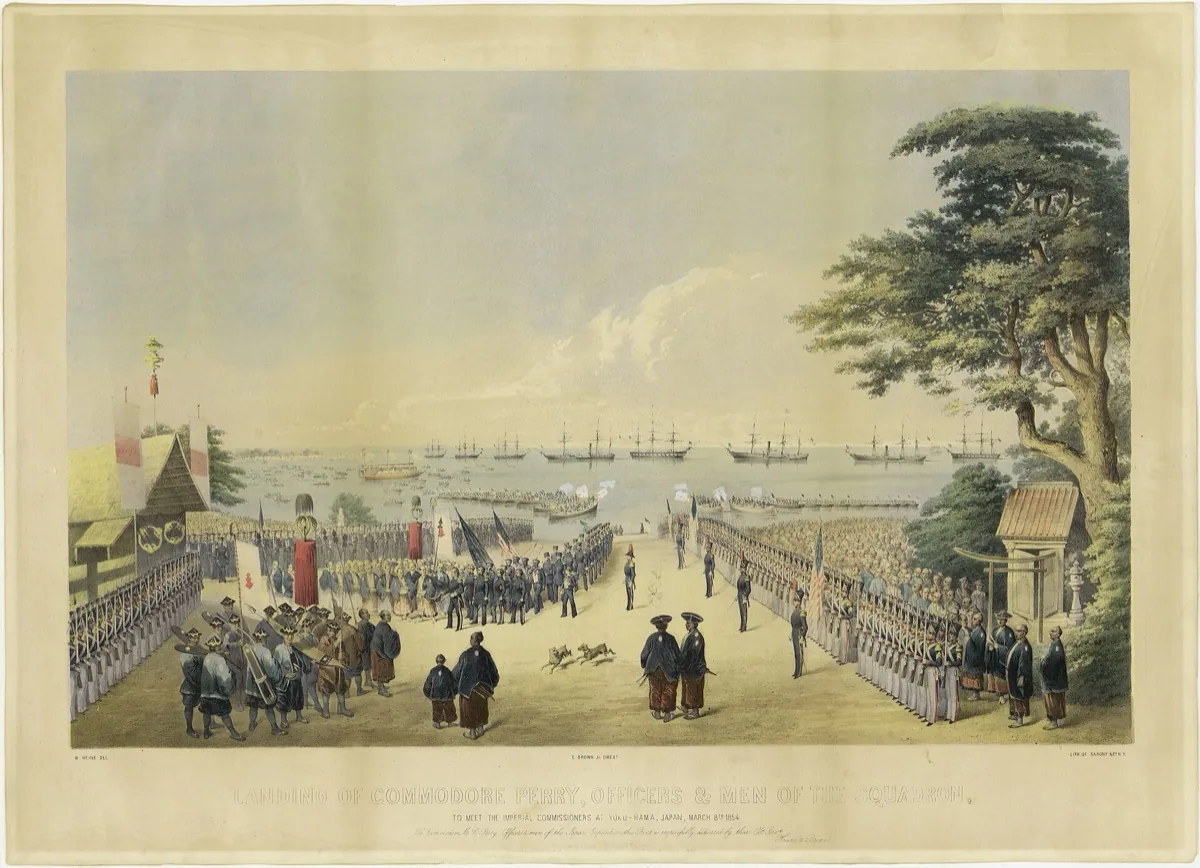
Matthew Calbraith Perry was a United States Navy commodore who sailed four warships into Edo Bay, Japan, on July 8, 1853, and demanded that the country open its ports to American ships. Japan had been closed to nearly all foreigners for over two centuries under the Tokugawa shogunate, and Perry's arrival ended that isolation. The treaty he forced the following year helped set off a chain of events that brought down the shogunate within fifteen years. Perry came from a naval family in Newport, Rhode Island. His older brother, Oliver Hazard Perry, was a national hero for defeating a British fleet on Lake Erie in 1813. Matthew went to sea at fifteen, spent nearly fifty years in the Navy, and pushed it to adopt steam power. The Japanese called his warships kurofune, "black ships." The term is still used in Japan for any sudden outside force that changes the country.
How Perry forced Japan open
The United States wanted Japan open for practical reasons. American whaling ships in the North Pacific needed safe harbors. Shipwrecked American sailors who reached Japan were arrested and held as criminals. Steamships running from California to China needed coal, and Japan sat directly on that route. Washington had already asked Japan to open its ports and been refused.
President Millard Fillmore gave Perry a letter demanding that Japan open, with orders to make the request impossible to turn down. Perry was fifty-nine, a career officer who had spent months studying how the shogunate judged foreign power. He planned every detail of his approach.
When his four warships entered Edo Bay, two of them coal-burning steamers trailing black smoke, he refused to speak with the junior officials dispatched to deal with him. He would accept only the most senior representatives the shogunate could send. He put his gun crews through firing drills where the Japanese onshore could see them. He sent boats to survey the bay without permission, a deliberate provocation that showed his ships could reach Edo, the capital, whenever he chose. On July 14, he went ashore, handed over Fillmore's letter, told the Japanese he would come back for their reply, and sailed for China.
The Convention of Kanagawa and the unequal treaties
Perry came back seven months later, in February 1854, with nine ships. In the time since his first visit, the shogunate had realized it could not keep him out. Its shore batteries were decades out of date and it had nothing resembling a fleet. The shogunate took the unusual step of asking the regional lords, the daimyo, for advice on how to respond, breaking with centuries of practice. That consultation was an admission of weakness, and the daimyo did not forget it.
The result was the Convention of Kanagawa, agreed on March 31, 1854. The terms were modest: Japan opened two ports, Shimoda and Hakodate, to American ships, agreed to protect shipwrecked sailors, and accepted an American consul. The agreement did not open regular trade.
Trade came later. The first American consul, Townsend Harris, spent two years negotiating a full commercial treaty, which Japan signed on July 29, 1858. The Harris Treaty opened five ports, fixed Japanese tariffs at low rates, and gave Americans extraterritoriality, meaning they were exempt from Japanese courts. Britain, France, Russia, and the Netherlands quickly demanded the same terms. Japan found itself, like China, bound by unequal treaties that would shape its dealings with Western powers for decades.
The treaties wrecked the shogunate's reason for existing: its promise that it kept Japan safe from foreign powers. Within a generation, samurai from the outer domains toppled the shogunate and began rebuilding Japan with Western technology and institutions. By 1905, Japan had industrialized, built a modern army and navy, and defeated Russia in war. Perry did not live to see any of it. He died in New York on March 4, 1858, at sixty-three.
Perry's Black Ships
The Japanese called Perry's warships kurofune, meaning "black ships." Two of the four vessels were steam-powered frigates, a technology Japan had never seen. They were painted black and their coal-fired engines trailed black smoke across the bay. To people who had lived under near-total isolation for over two hundred years, the sight was frightening.
The word outlived the ships. In Japanese, kurofune now means any sudden outside force that compels the country to change, whether a trade demand, a new technology, or a foreign competitor entering the market.
In 1945, ninety-two years after Perry's squadron entered Edo Bay, Japan signed its surrender aboard the USS Missouri in the same waters. General Douglas MacArthur had Perry's original flag brought from the Naval Academy in Annapolis and displayed it facing the surrender table.